
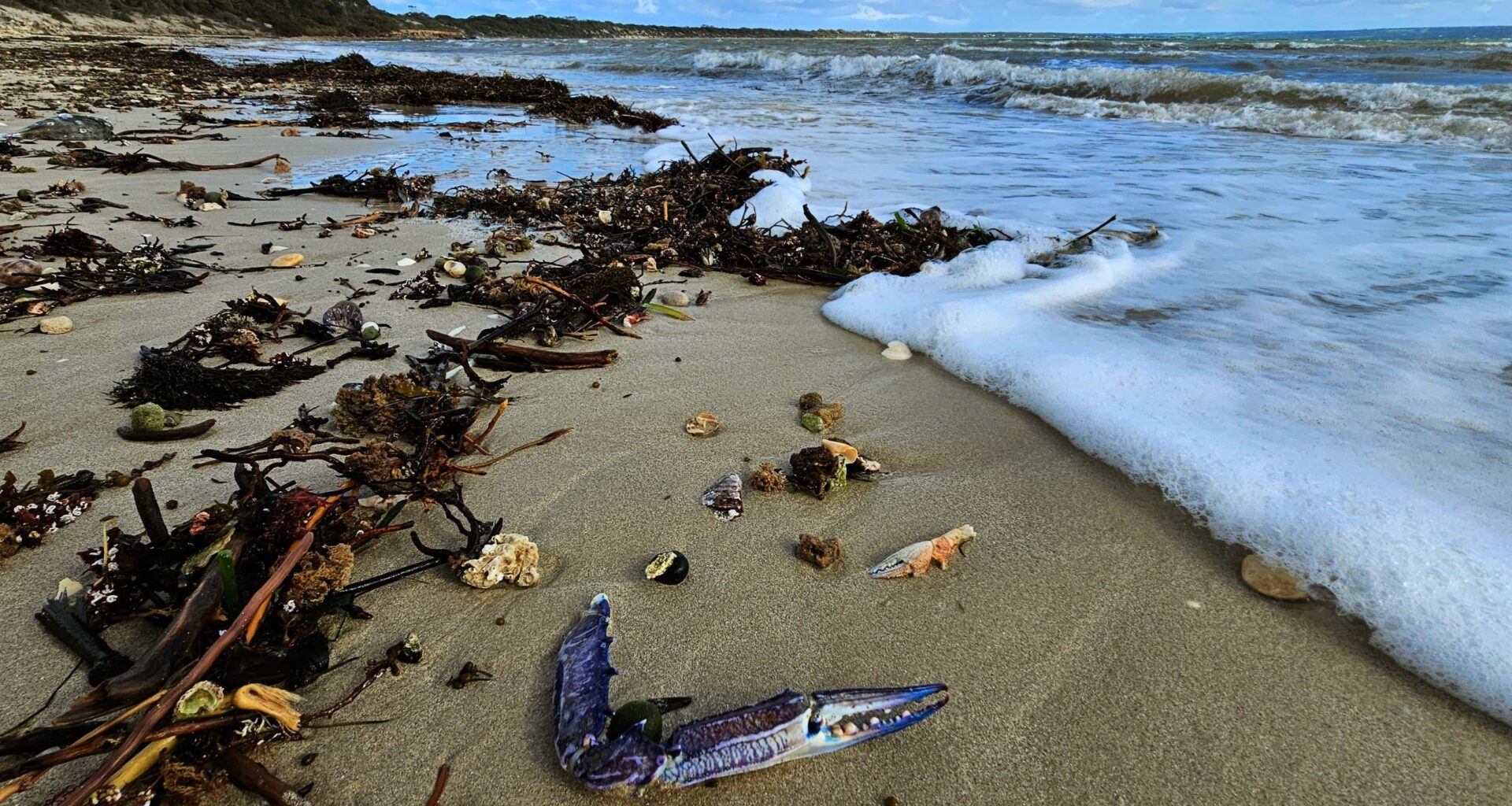
The algal bloom crisis across South Australia should be treated as a disaster for health and a clear warning about the urgent need for real climate action, Alison Barrett reports.
Alison Barrett writes:
Health experts have called for governments to implement Health in All Policies approaches in responding to the ecological disaster along South Australia’s coastline and marine and estuarine waters.
They warn that the toxic algal bloom, caused by a climate change-fuelled marine heatwave, has wide-ranging health consequences, from its impact on livelihoods to harming physical and mental health and wellbeing, and cultural health.
The bloom underscores the urgency of Australia stepping up responses to climate and environmental crises through an overhaul of environmental protection laws and the phase out of fossil fuels, they say.
Many health leaders have also criticised the slowness of governments’ responses to the disaster, and described their own personal distress at witnessing the traumatic impact on marine life.
Dr Kate Wylie, a GP in Adelaide and Executive Director of Doctors for the Environment Australia (DEA), told Croakey about a recent walk she’d taken along a northern Adelaide beach where “there were dead, large rays, and…a lot of dead animals washed up on the shore”.
“It was awful, heartbreaking,” she said.
Susanne Tegen, Chief Executive of the National Rural Health Alliance, recently photographed masses of dead marine life on South Australian beaches.
“It was terribly sad,” she told Croakey. “I have never seen so many washed up fish and crabs before.”
The Minister for Health, Disability and Ageing, Mark Butler, whose electorate of Hindmarsh incorporates some of the affected coastline, told ABC Radio National this week: “…only the weekend before last I was taking a walk and I saw a dead shark, a number of dead rays, dead fish, dead cuttlefish – scenes I’d never seen in all of my decades walking along Adelaide beaches.”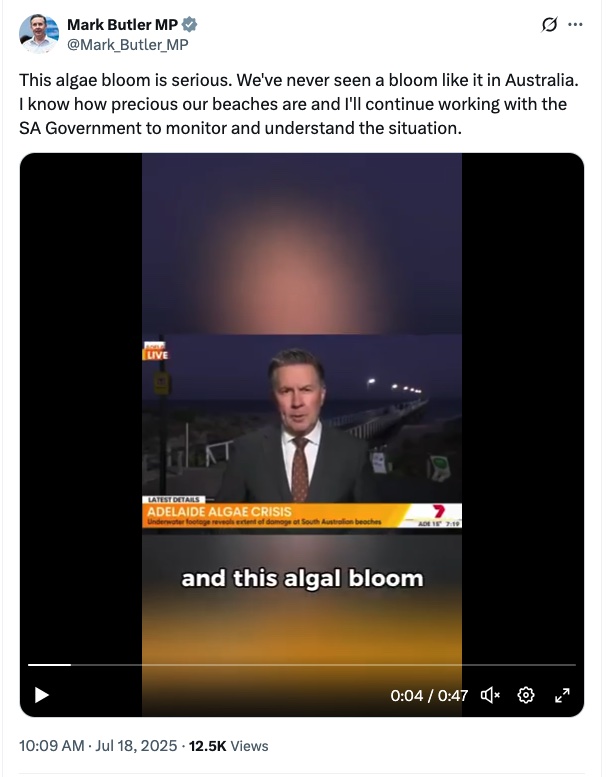
More than 450 marine species have been observed washed up across SA coastlines, with over 14,000 observations by citizen scientists, according to a Biodiversity Council report.
“What we see washing up on beaches is just a tiny fraction of the animals actually killed, with most animal bodies left rotting on the seafloor,” said Professor Gretta Pecl from the University of Tasmania’s Institute for Marine and Antarctic Studies and Centre for Marine Socioecology.
“Because of the connectivity of oceans and their food webs, the impact of this harmful bloom will massively exceed the boundaries of the physical bloom itself; there will also be cascading consequences for other regions of Australia.
“The scale of wildlife death nationally from this marine heatwave is likely to be equivalent to the Black Summer Bushfires, considering both the algal bloom and unprecedented damage to coral reefs on the east and west coasts.”
Health impacts
The algal bloom began in summer and now affects 4,500 square km. This area is almost double the size of Australia’s Capital Territory, and includes metropolitan beaches and estuarine sites, Port River, West Lakes, Fleurieu Peninsula, Kangaroo Island, Yorke Pensinsula, Eyre Peninsula coastlines and the Coorong National Park.
The Coorong is of major significance to Ngarrindjeri people’s culture and identity, and is internationally recognised for supporting rare and endangered plants and animals.
Associate Professor Toby Freeman, Director of Research at Stretton Health Equity at the University of Adelaide, said “it’s a priority to consider the impacts for First Nations peoples given their strong connection to Country being affected by these awful disasters”.
He stressed the wide-ranging mental health impacts and said mental health expertise is needed as part of the response to disasters like the marine algal bloom.
“Such disasters cause grief, distress, anger, solastalgia and ecological mourning. These impacts are increasingly recognised as a substantial mental health issue,” he said.
The National Health and Climate Strategy is clear that the mental health toll from climate breakdown is only going to get worse, Freeman told Croakey, and requires “collective, community-based responses for which our mental health system and ways of working aren’t necessarily well set up”.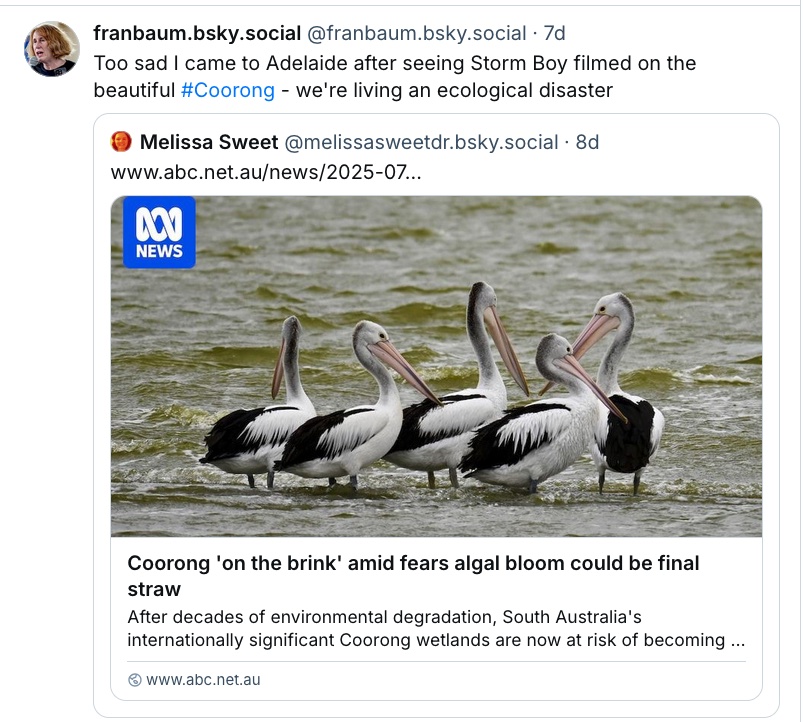
Livelihoods devastated
The wide-ranging impacts were highlighted in a joint statement to Croakey from Professor Craig Williams, Dean of Programs (Science, Construction and Project Management) UniSA STEM and Healthy Environments and Lives (HEAL) Network SA Lead, and Associate Professor Carmel Williams, Director of Centre for HiAP Research Translation.
As well as impacting mental health through ecoanxiety, solastalgia and potentially through reduced social interaction, the algal bloom disaster is likely to affect people’s ability to use coastal environments for exercise and recreation, impacting physical health, they said.
They also suggested the bloom could impact on socio-economic status through decreased productivity of fisheries and tourism industries.
“Impacts on fisheries may be acute through inability to take catch, and chronic through disturbances to trophic webs [food webs]. It is unclear just what impacts mass mortality to different components of the trophic webs supporting fisheries will have on global nutrition. This is a massive, massive concern.
“Developing decision support systems to inform responses is required. Specifically, how would communities respond to such things in a way that is organised, evidence-based, and coherent with existing policy? There is a lot of work to be done in this space.”
Dr Dominic McAfee, ARC Grant-Funded Researcher, Environment Institute, Division of Research and Innovation at The University of Adelaide said it was “heartbreaking” to see the challenges facing the oyster farmers with whom he works.
“They cannot sell their oysters, but must manage their stock daily in the sea, keeping their oysters alive, which is hard work during good times,” he told Croakey.
“They have reported sore eyes and throats while working at sea. But I think the emotional toll, and economic impact is what would hurt the most.”
McAfee said community-based projects to repair the coast will be an important part of the human-nature healing following this algal bloom.
“The public are crying out for information on what can be done and what they can do. Community-based projects can play their part by enabling communities to come together to work on nature report, which can help heal people and environment simultaneously.”
Ecoanxiety
Responding to the algal bloom, Dr Brianna Le Busque and Professor Carla Litchfield, researchers in Environmental Science and Psychology at University of South Australia, began exploring ecoanxiety in more than 500 people.
While specific results aren’t available, as data collection remains open until the end of July, Le Busque told Croakey that many participants are reporting ecoanxiety about the algal bloom, “on several days or more”.
She said many people are also thinking about the impacts of climate change more broadly now because of the algal bloom.
“Another interesting result emerging is that people have stopped swimming in the ocean, surfing, fishing etc,” Le Busque said.
“Participants are reporting feeling ‘grief of seeing dead marine animals’, and that they are ‘no longer visiting the beach because it’s sad’.”
She told Croakey that one participant reported that they “used to surf everyday but haven’t surfed since March”.
“We know how important nature (and specifically blue spaces) can be for people’s wellbeing, and this has been taken away from people,” she said.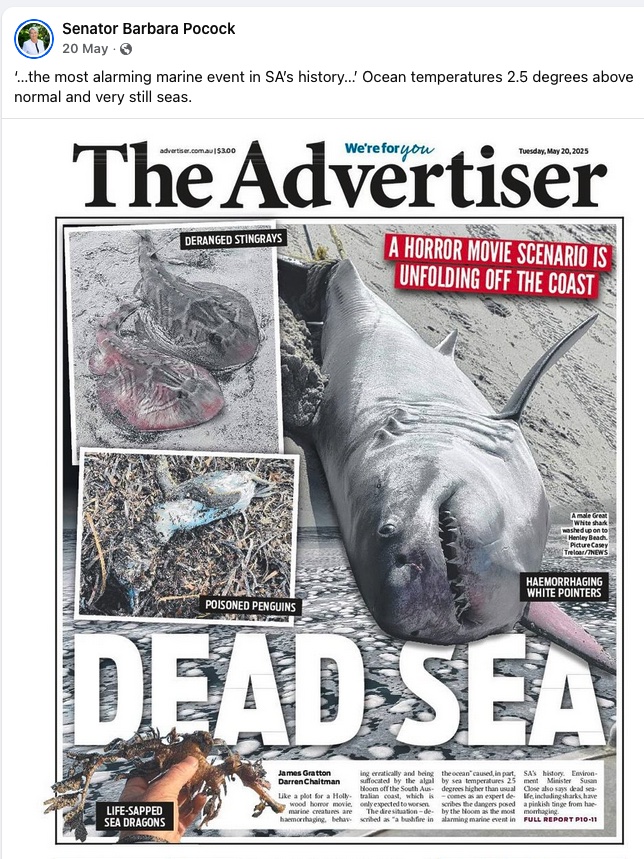
Community identity
Dr Ania Kotarba-Morley, Future Making Fellow at the University of Adelaide, said environmental disasters like this can be “deeply destabilising” for communities, particularly in coastal areas where livelihoods, cultural practices and identities are “so deeply connected to the marine environment”.
They can also cause economic stress, especially for oyster farmers, fishers and tourism operators, which can “ripple through entire communities”, she told Croakey.
Kotarba-Morley said there’s often a sense of helplessness and frustration – especially when the causes are seen as preventable or linked to broader systemic issues like climate change or poor water management.
“This can strain, often already low, trust in institutions and between community members themselves – especially where there are competing views on how to respond.”
However, “on the other hand, these kinds of slow-onset environmental crises can also galvanise collective action”, she said.
“We’ve seen communities come together to monitor water quality, advocate for policy changes and participate in restoration projects.”
Shared efforts such as these can strengthen social bonds and enhance resilience – but “only when there’s appropriate support, communication and investment in long-term recovery”.
Too little, too late
This week, the Federal and South Australian Governments announced joint funding of $28 million to support efforts “addressing the impacts of the harmful algal bloom”.
The funding will go towards science and research, community support and clean-up efforts, industry assistance, public forums and information campaigns. However, many say this is a case of “too little, too late”.
Federal Environment Minister Murray Watt stopped short of declaring a national disaster, and the Greens have launched a petition calling on the PM to declare one.
“If there were dead fish washing up on Bondi Beach every day, there would be a national outcry and response,” says the petition.
“A declaration of a national disaster is important to ensure communities and industries that are bearing the brunt of this crisis can access the resources they need, including climate mitigation and adaptation. The scientists tell us that we could be facing another 18 months with this toxic algal bloom.”
Sarah Hanson-Young, Greens Senator for SA and spokesperson for environment and water, will chair a Senate inquiry into the algal disaster, and says it will amplify the voices of scientists, affected industries and the local South Australian community.
“We need governments at all levels that will act to take climate change mitigation and adaptation seriously. This is not a far off future problem, the crisis is here and now.”
She said it beggars belief that in 2025, the Environment Minister can sign off on a massive fossil fuel expansion such as the Woodside North-West Shelf gas project without having to take into consideration the massive climate impacts of the pollution it produces.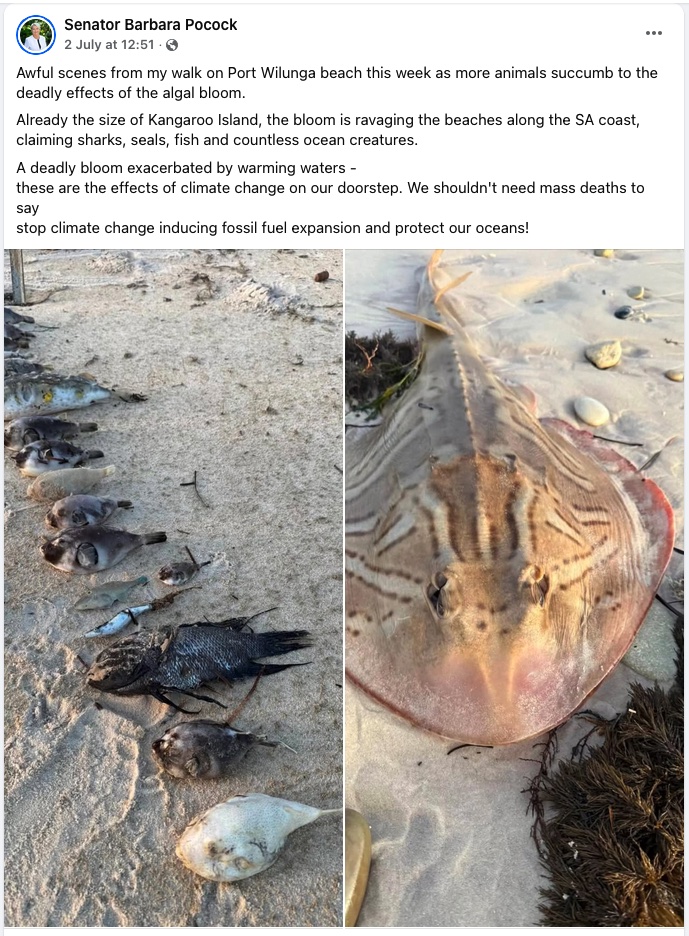
Dr Miriam van den Berg, research fellow at the Stretton Health Equity at The University of Adelaide, said “the biggest concern I have with this whole thing is how long it took the government to respond”.
“My Dad lives at Victor Harbor [on the Fleurieu Peninsula] and he mentioned to me months ago that this was happening,” she said. “Local people were raising alarm bells, but no one was listening.”
Susanne Tegen told Croakey that “lack of action over the last six months has resulted in thousands of dead crabs, fish, and molluscs” washed up on the beaches on Kangaroo Island, which she recently visited.
According to Tegen, locals complained in January and “only now some state action is being taken, federally it is still lacking. Indeed, the current action is not enough”.
Climate action
Experts interviewed by Croakey stressed the importance of climate action and ensuring Health in All Policies perspectives and expertise informs responses.
They cited the National Health and Climate Strategy, which urges a Health in All Policies approach “recognising that collaboration across different policy areas is crucial to the development of just and equitable responses to address the impact of climate change on health”.
Dr Kate Wylie said Minister Butler “should be really championing the importance of a Health in All Policies approach when it comes to recognising the impacts of the algal bloom and the health effects of climate change more generally”.
Wylie said: “While we continue to expand fossil fuels, while we continue to be dependent on coal, oil and gas, we will continue to make these problems worse. We can’t pretend this is not happening.
“Decisions by our government[s] are impacting the…health of our community…and this algal bloom is a local example of that for us here in South Australia.”
Wylie also highlighted the significance of the outbreak for Australia’s bid to host COP31 in South Australia. “I certainly hope that [SA Premier] Peter Malinauskus understands the implications of what’s happening here in South Australia regarding those negotiations.”
Indigenous knowledges are globally recognised as critical for addressing environmental crises. “Indigenous ways of knowing and seeing are essential for meeting the environmental challenges of today and the future,” the Australia State of the Environment report states.
This can be done by including Indigenous representation at all levels of policy and decision-making, empowering Indigenous people through Indigenous-led and governed caring for Country programs and prioritising Indigenous cultural principles and knowledge, according to the report.
Faith Coleman, ecologist of estuaries, saline lakes and coastal lagoons, told Croakey the $28 million in government funding is a good start toward supporting our regional communities, “but will do little toward preparing for, or even better, preventing another of these events”.
She said we need to undertake monitoring of water temperatures, currents and health of benthic communities – [the ecological region at the bottom of a body of water, such as an ocean, lake, or stream] – and diversity of our phytoplankton, so we can take measures to mitigate impacts.
“We need to stop exacerbating climate change, or tax the lives out of our fossil fuel industries so we can restore our underwater green carpets – our seagrasses, our oyster beds, kelp forests, macroalgae reefs, sponge gardens, mangroves and saltmarsh,” Coleman said.
Dr Joanne Flavel, Senior Research Fellow at Stretton Health Equity, said: “You can’t put a price on places like the Coorong, but it seems debates about climate action do just that. What has happened with the Coorong has revealed how wrong the argument against climate action is.”
Rather than the emphasis on the “cost of net zero, the cost to the economy, the cost to jobs” that tends to happen whenever climate is mentioned, “we must take a long-term view and consider more than the cost of action”, Flavel told Croakey.
“We must consider the cost of inaction, the cost of delayed action, because the damage to the Coorong shows that there is a heavy cost to not acting and a heavy cost to delayed action, which also impacts on the economy and on jobs,” she said.
“If those against climate action will not consider the impacts on lives of heat-related illness with rising average temperatures, they must heed the vivid examples of the economic and human cost of every once-in-a-century flood, bushfire and other environmental impacts such as this algal bloom”.
Longstanding warnings
Dr Kate Wylie and Dr Sue Murray-Jones, a retired marine ecologist, both highlighted that people have been sounding the alarm about climate-driven events like the algal bloom for years.
Wylie said, it shows what “we have always predicted would happen” and what science tells us is going to become worse and more frequent over time.
Murray-Jones said while some small-scale interventions may help, this algal bloom “is intractable, as far as I can tell”.
“Until such time as we get climate change under control, I don’t think there’s anything that can really be done at present…which I hate saying,” she said.
“We’re getting more of this stuff all around the world, and really, why aren’t we doing more about climate change?”
Murray-Jones said more needs to be done to support fisherman and address potential current and future mental health issues resulting from the algal bloom disaster.
“Government should be stepping in to help retrain or provide a living for some of these people who might be out of business permanently,” because even if this specific bloom dissipates, it’s looking increasingly likely that it will come back, Murray-Jones said.
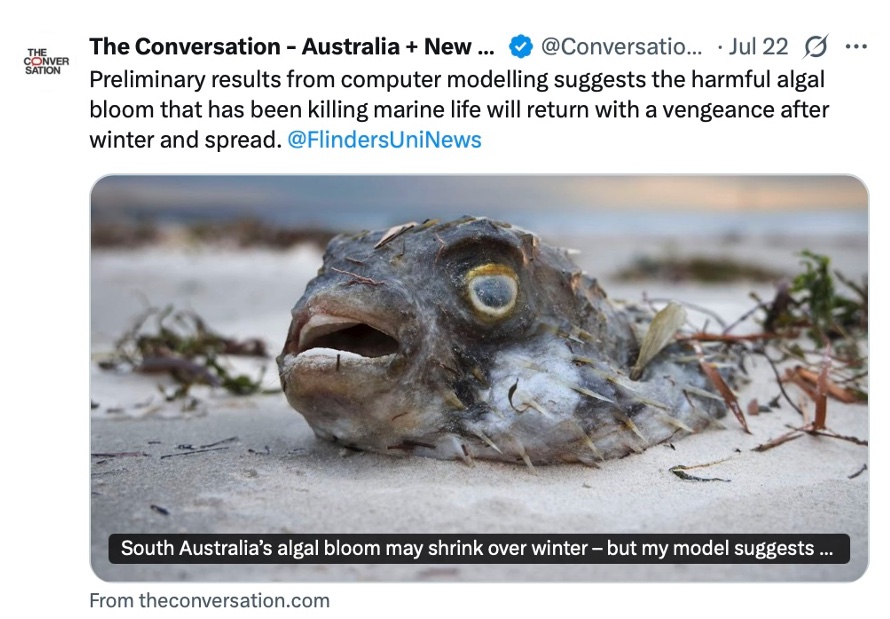
In their joint statement, Professor Craig Williams and Associate Professor Carmel Williams called for a strong focus on developing response and adaptation strategies. They urged local and global governments to “strengthen their action on climate change to ensure the climate remains below the two-degree critical threshold”.
If not, the health and wellbeing of South Australians and other coastal communities will continue to be negatively impacted by frequent natural disasters associated with climate change, they said.
McAfee also added his calls for Australia to accelerate its decarbonisation efforts, saying we need to address the root cause of marine heatwaves and algal bloom disasters – climate change and nutrient pollution.
He echoed comments by Murray-Jones that the scale of this bloom is too great for much to be done to reduce it.
“But we need urgent action now to learn from this bloom, be proactive in preserving vulnerable marine species and areas, support impacted coastal communities and industries,” he said.
“There is much to be done immediately so we are prepared for future blooms, not just in South Australia but nationwide.”
This includes supporting healthy, biodiverse marine ecosystems so they can recover and reducing nutrient pollution and runoff, according to McAfee.
As well, marine-protected areas and ecosystem restoration have an important role and could reduce the impacts of climate-driven events like heatwaves, storms and algal blooms by drawing down and sequestering carbon, protecting shorelines from storm surges and by filtering excess nutrients out of the water.
“Marine ecosystems can bounce back, but they require bold policymaking and investment now.”
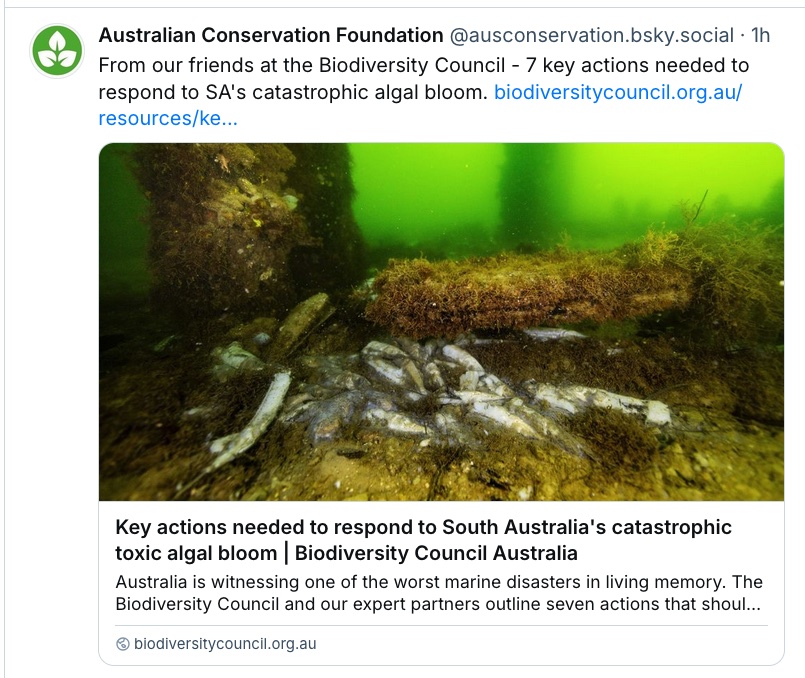 https://biodiversitycouncil.org.au/news/7-actions-needed-to-respond-to-sa-algal-bloom
Health department responses
David Cunliffe, SA Health Principal Water Quality Adviser, said SA Health is part of the Harmful Algal Bloom Taskforce, providing health advice to South Australian people and industries on how to respond to the algal bloom.
“As part of the taskforce, SA Health is in regular communication with the Harmful Algal Bloom Reference Group to provide updates and ongoing public health information,” he told Croakey. The Reference Group includes representatives from Seafood Industry South Australia, RecFish SA, Conservation Council, Tourism Industry Council and First Nations groups.
A spokesperson for the Federal Department of Health, Disability and Ageing told Croakey the South Australian Government is leading the response to the algal bloom and has updated the Australian Government and States and Territories on their response to the algal bloom, including through the Environmental Health Standing Committee.
They “understand that South Australia is undertaking a Health Impact Assessment” and “adopted a One Health approach, involving a holistic integrated human, animal, plant (including aquatic animals and plants) and environmental considerations to manage and control the algal bloom and affected communities”.
“Algal blooms are influenced by warmer ocean temperatures, such as marine heatwaves. Climate change is increasing the frequency, intensity and duration of marine heatwaves, which may increase the risk of future algal blooms,” the spokesperson said.
SA Health told Croakey advice remains the same for the algal bloom (Karenia mikimotoi): “In humans, exposure (including through breathing in algae particles broken up by the surf and wind) can cause skin irritation (if swimming in water), eye irritation (through swimming or exposure to sea spray), as well as respiratory symptoms like coughing and shortness of breath.
“These symptoms disappear when the exposure stops or following washing in clean water. There are no long-term effects. In general, people should avoid swimming in affected areas and avoid contact with discoloured water or foam. If they do enter this water they should take care to wash in clean water afterwards.”
• For more information, visit the SA Health website here. On the algal bloom taskforce, visit the Department of Environment and Water website here.
 https://www.pbs.org/newshour/show/marine-biologist-sylvia-earle-on-why-the-ocean-matters
** AI transcribing app, Otter was used to transcribe interviews for this story. Quotes were verified against audio.
See Croakey’s archive of articles on the environmental determinants of health