

Tens of thousands of public service jobs in Canada could be on the chopping block amid the federal government’s plans to cut costs, according to a new report.
The report, written by Canadian Centre for Policy Alternatives senior economist David Macdonald, predicts how many federal jobs could be lost due to Prime Minister Mark Carney’s cuts.
Finance Minister Francois-Philippe Champagne revealed the cost-cutting plan in letters sent to several ministers earlier this month. He asked a majority of government departments to decrease spending on federal programs by 7.5 per cent next spring, 10 per cent the year after, and 15 per cent by 2028.
Some departments have been spared from possible layoffs, including those that are getting a boost in spending.
“The newly elected federal government has promised major military spending increases and tax cuts,” reads the report. “To pay for it, the government is seeking 15 per cent in cuts across all federal departments except the Department of Defence, the RCMP, Canada Border Services Agency, the Supreme Court, and the Parliamentary Budget Office.”
Macdonald forecasts that all government departments could experience a cumulative total of over 57,000 job losses between 2024 and 2028 with this new directive.
Hardest hit public service jobs in Canada
JHVEPhoto/Shutterstock
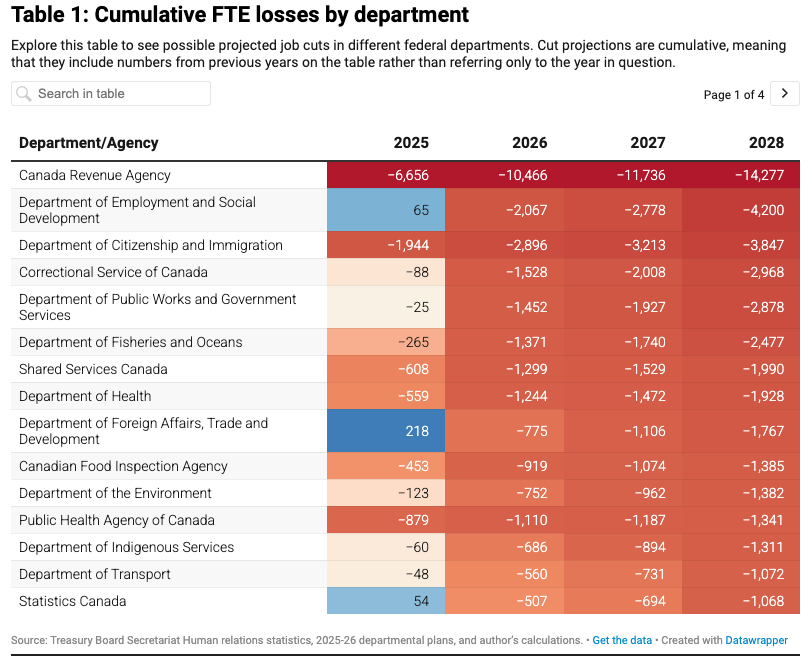
According to the report, the hardest hit public service departments will likely be the Canada Revenue Agency (CRA), Employment and Social Development (ESDC), and Citizenship and Immigration (CIC).
While all three of these were impacted by former Prime Minister Justin Trudeau’s 2023 “refocusing government spending” budget cuts, Macdonald says Carney’s directive will put even more jobs on the line.
The CRA laid off close to 7,000 full-time employees during Trudeau’s government in 2025.
“With the federal government’s new directive to cut, losses within the CRA could more than double to 14,277. That will impact public services: it will be harder to get help with tax issues, and already long wait times will get longer,” reads the report.
Macdonald explains that ministers have some flexibility in choosing what to cut, as long as the total cut is 15 per cent. This means a department could propose cutting less than 15 per cent of its staff and instead decrease funding to other budget items.
In the CRA’s case, this alternative might not be possible because staffing makes up 83 per cent of its budget, according to Macdonald.
“It will have little choice but to cut staff further as the transfers that it administers, like to seniors or the Canada child benefit, are off the chopping block. There is little the department can do to shift these cuts elsewhere,” reads the report.
Macdonald forecasts the ESDC will lay off 2,000 full-time jobs next year, doubling by 2028 to over 4,000 positions.
“That will impact public services: help with Employment Insurance and Canada Pension Plan payments to seniors could become harder to find,” he wrote.
The CIC is expected to axe 3,847 employees in three years’ time, which could impact passport, visa and citizenship wait times.
Canadian Centre for Policy Alternatives
Job losses by province
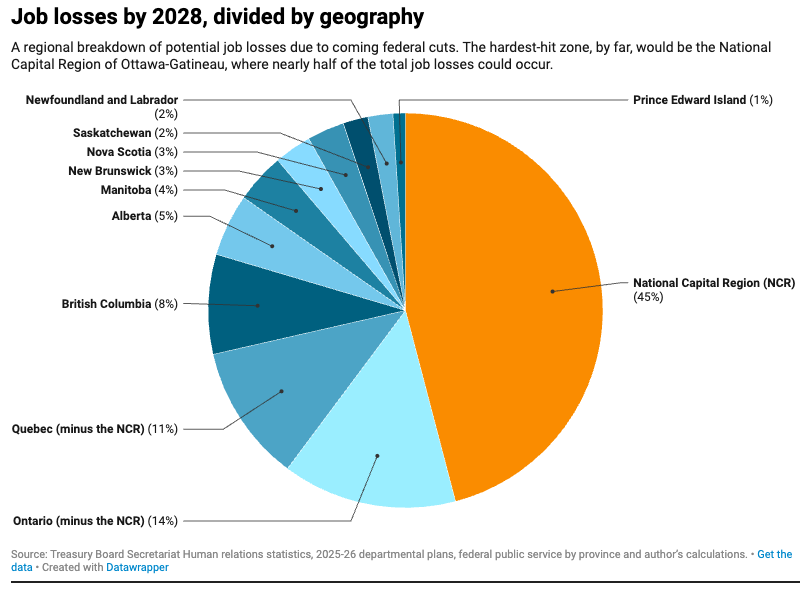
Macdonald states that Ottawa and Gatineau “will bear the brunt” of the lay-offs due to the public service cuts in Canada.
“Those two cities could lose 24,421 full-time jobs by 2028, representing 45 per cent of all lost positions,” he explained.
The rest of Ontario is forecasted to face an additional loss of 7,812 jobs, and Quebec is expected to see an additional 5,926 jobs eliminated.
Canadian Centre for Policy Alternatives
Overall, the senior economist says service from public service programs in Canada will “suffer” under Carney’s cuts.
“There will be fewer staff on the tax, EI, and CPP call lines. Passport offices will lengthen wait times, which had been improving,” he wrote. “Reducing staffing and service levels isn’t the right way to pay for a major military build-up and middle- and upper-income tax cuts. The trade-off just isn’t worth the pain.”
The Liberal government’s proposed middle-class income tax cut kicked in on July 1. While it promises billions of dollars in tax savings to Canadians over five years, critics argue that it’s not a long-term solution for the cost-of-living crisis.