
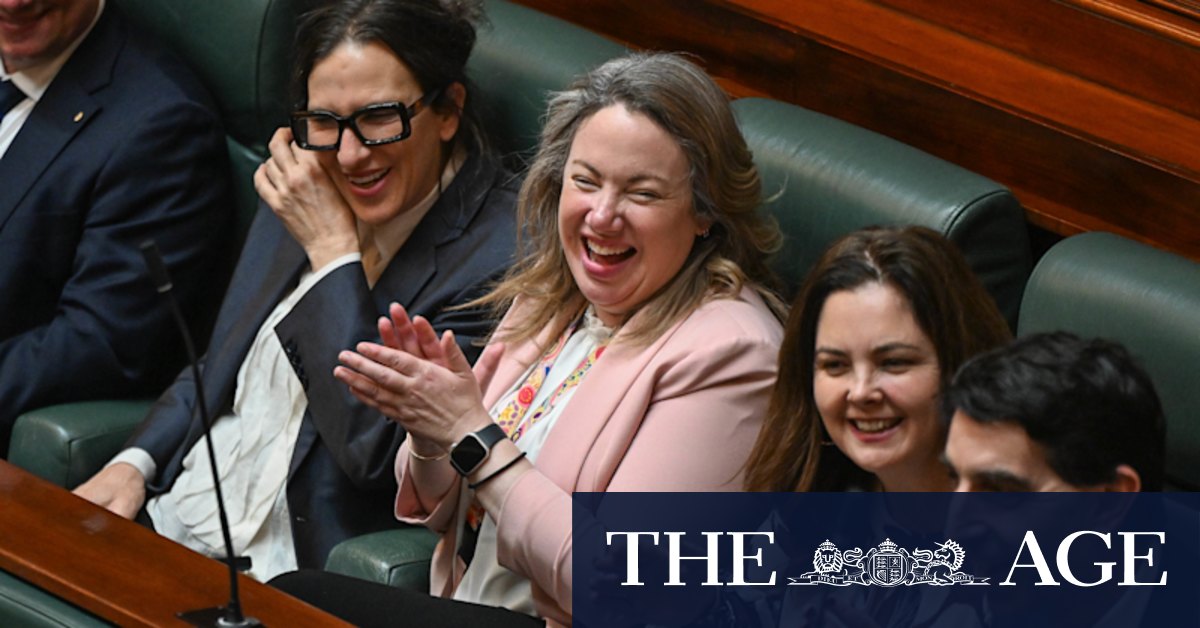
They thanked Jill Hennessy, the former health minister who championed the historic reform through parliament in 2017.
“While you might not agree with the bill itself, we would all like to think that we could make a real impact on public life,” Labor MP Mathew Hilakari told the chamber late on Tuesday. “That is a real credit to her – the impact that she has made on public life.”
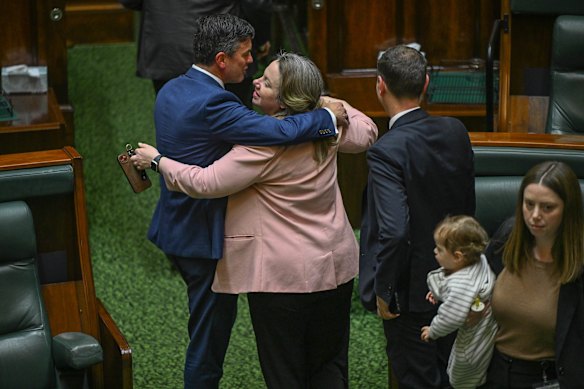
Opposition Leader Brad Battin, hugging Labor’s Emma Vulin after the vote passed, said his views about assisted dying were changed by personal experience. Credit: Joe Armao
Mostly, they thanked Emma Vulin, a Labor MP with motor neurone disease who was brought to tears on Tuesday when she spoke to parliament through text-to-speech technology.
“I may one day choose voluntary assisted dying,” she said. “It is not about giving up; it is about retaining agency over the most personal decision any person can ever make: how they leave this world.
“I do not know how my journey with MND will end, but I do know this: the knowledge that I may have voluntary assisted dying as an option gives me strength. It allows me to live with more peace, to focus on the moments that matter and to spare my loved ones from witnessing my prolonged suffering, which serves no purpose.”
It was almost 8.30pm on Wednesday by the time they voted to support the bill, 67 to 13, to applause.
“I do not know how my journey with MND will end, but I do know this: the knowledge that I may have voluntary assisted dying as an option gives me strength.”
Labor MP Emma Vulin
Vulin and Health Minister Mary-Anne Thomas took turns hugging their colleagues, from both sides of the chamber.
At least a dozen Coalition MPs supported the bill while five Labor MPs crossed the floor to vote against it, including Anthony Carbines and Natalie Suleyman.
Many Coalition MPs had spoken about how their minds had changed since voting against assisted dying eight years ago.
Opposition Leader Brad Battin has since seen his best friend’s wife die of cancer. He also watched his groomsman’s father choose assisted dying after a pancreatic cancer diagnosis.
“I agree with the premier. Because it is about people, it is not about politics,” Battin said. “Overall my position has changed on the facts of what I have done and what I have seen.”
About 1683 Victorians have died using voluntary assisted dying since it became accessible.
The free vote meant a slew of amendments was thrown up, but all failed.
Greenvale MP Iwan Walters – from Labor’s Catholic-influenced SDA union sub-faction – moved to block the bill until unintended consequences could be further considered and more consultation done.
Loading
Walters claimed the bill eroded the right for doctors to conscientiously object because of a proposed requirement to provide minimum information. He also argued the proposal would allow any health practitioner – “such as podiatrists and optometrists” – to raise assisted dying with their patients. (The clause specifies this must be in the course of a discussion about end-of-life care, and that abuses would constitute unprofessional conduct.)
Walters said the changes were a “slippery slope” after assurances were made in 2017 about how tough the legislation’s guardrails were. “Here we are only a few years later, within the life of the same government, where those guardrails are now barriers and those essential protections apparently undue hindrances for Victorians to be able to be euthanised by a health practitioner or to access self-administered assisted suicide.”
His contribution prompted a retort from Vulin.
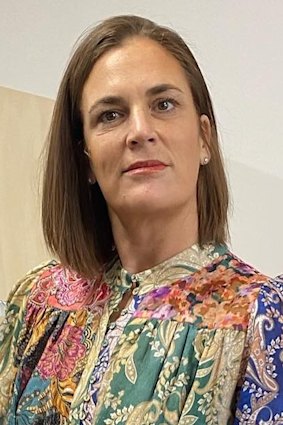
Nationals MP Jade BenhamCredit: Facebook
“On a point of order, Acting Speaker, sorry to interrupt, but I would like the member on his feet to stop referring to it as ‘assisted suicide’,” Vulin said.
Thomas, the health minister, also pulled him up, saying “words matter”.
“We do not have an assisted suicide framework … We have a voluntary assisted dying framework here in the state of Victoria that seeks to give dignity and compassion to people who are seeking choice at their end of life. This is not about whether to die but how, where and with whom. And I would ask respectfully that the member for Greenvale, in his contributions, reflect on the hurt that his words are causing to some in this chamber and consider how he discusses this for the remainder of the debate.”
Late on Tuesday evening, Nationals MP Jade Benham made clear that voluntary assisted dying and suicide were not the same.
“Voluntary assisted dying is not suicide. I have been to that edge, twice,” Benham told the chamber.
“[VAD] is something that takes a large amount of rational thought, consideration and conversation with loved ones. I can tell you when you are on the edge of suicide none of that is present. You are not of sound mind. You are not of rational thinking. You are not in a mood to have conversations with anyone.”
It is illegal to incite suicide over a carriage service under the Commonwealth Criminal Code, blocking voluntary assisted dying appointments by telehealth.
Thomas has been advocating for the Commonwealth to allow telehealth services for assisted dying.
Benham and her Nationals colleague, Annabelle Cleeland, both raised this as a barrier for people in the regions, as did former Labor MP turned crossbencher Will Fowles, who has loudly pushed for change.
The bill will move to the upper house, where Labor does not have a majority. From the Coalition, only Opposition health spokeswoman Georgie Crozier has said publicly she would vote for the bill.
Nationals deputy leader Emma Kealy on Tuesday had thanked the government for the comprehensive information circulated to all members of the parliament.
“In some ways, I wish that that was something that was provided on every piece of legislation. It may make for a more harmonious place and for the passage of legislation to be perhaps more productive through both houses.”
Start the day with a summary of the day’s most important and interesting stories, analysis and insights. Sign up for our Morning Edition newsletter.