
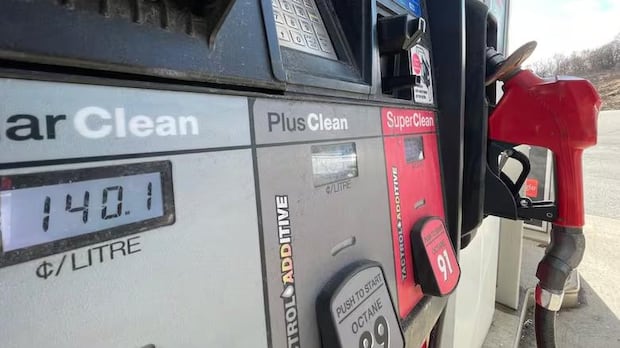
New Brunswickers will see an eight-cent surcharge on a litre of gas eliminated on Dec. 1 after the Holt Liberal government repeals legislation that created the charge.
It fulfils a key promise on affordability that Premier Susan Holt made during last year’s provincial election campaign.
“This will save you money at the pumps,” Holt told a news conference, estimating the average household that fills up once a week will save $150 to $200 a year.
The “cost of carbon adjuster” was adopted by the previous Progressive Conservative government.
It required the Energy and Utilities Board to develop a formula so that the cost to producers of federal clean fuel regulations could be passed down through the pricing system to consumers.
The amount this week is 8.24 cents per litre.
Retailers say they’ll have to absorb costs
Gas retailers and wholesalers have warned that eliminating the adjuster will mean they’ll have to absorb those costs instead, and this could put some small gas stations in rural areas out of business.
“There’s no doubt that with such a big number, some retailers will not be able to make ends meet. No doubt,” said Carol Montreuil, the vice-president of the Canadian Fuels Association for eastern Canada.
 Carol Montreuil, the vice-president of the Canadian Fuels Association for Eastern Canada, says some retailers will not be able to absorb the cost. (Radio-Canada)
The association represents fuel producers, distributors, wholesalers and retailers.
“This is very clear that there will be supply issues in the province of New Brunswick.”
Opposition Progressive Conservative Leader Glen Savoie echoed that in question period in the legislature.
“This political promise is going to do nothing but close gas stations, hurt small businesses and make gas availability a problem for everyone, especially in rural New Brunswick,” he said.
But Energy Minister René Legacy and Natural Resources Minister John Herron said the Dec. 1 date gives the EUB the time to use the regulatory tools it has to ensure that doesn’t happen.
The board “has the tools and ability to consider legitimate cost pressures and make fair, cost-based adjustments” to the price-setting formula to avoid closures, Legacy said.
Herron said the government opted not to repeal the adjustor immediately, and to set Dec. 1 as the date, to give the EUB time to do that — if the industry can present data to back up its claims.
“They need to get at it,” he said.
Herron called the ad hoc formula adopted by the EUB to estimate the cost of the federal regulations “esoteric” and said he believes it overestimated the cost.
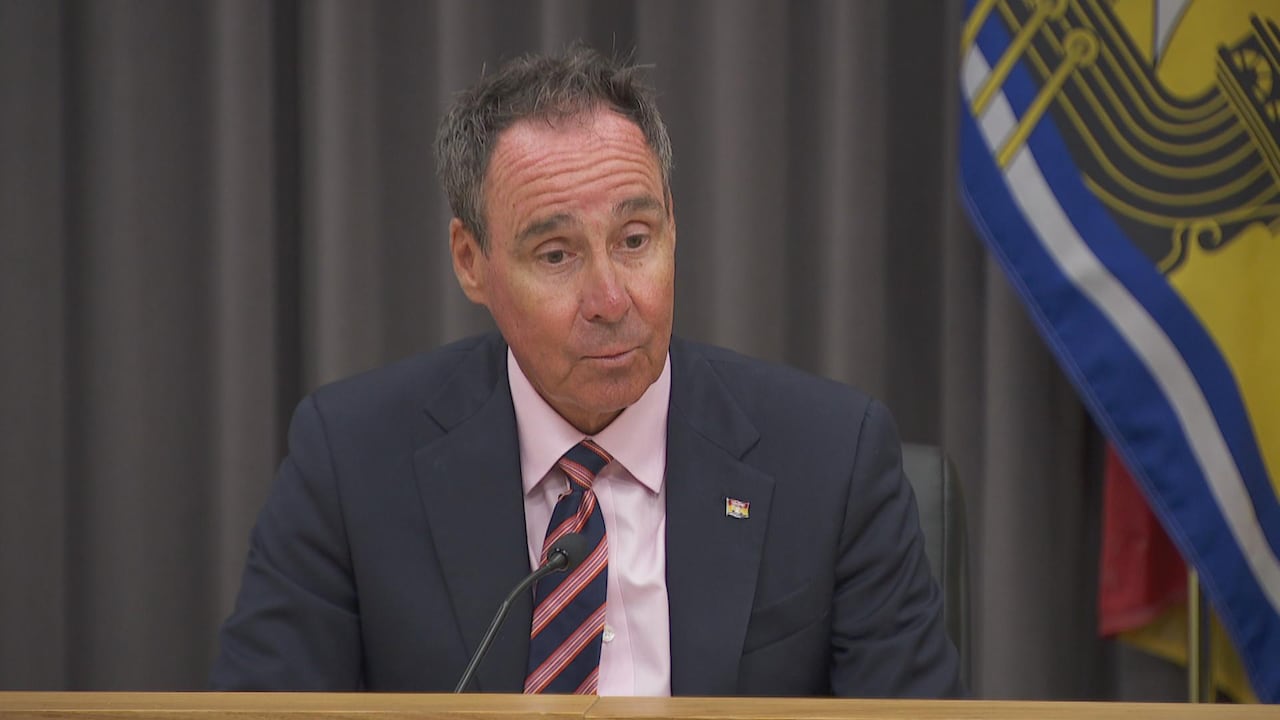 Natural Resources Minister John Herron calls the formula the EUB adopted to estimate the cost of federal regulations ‘esoteric’ and says he believes it overestimated the cost. (Chad Ingraham/CBC)
That means the impact on retailers won’t be as severe as predicted, he suggested.
But Montreuil said there are some estimates that the real impact is closer to 17 cents per litre — a cost many retailers with thin profit margins won’t be able to absorb.
He said the time allowed for the EUB to consider the impact on retailers “seems really short.”
Alain Chiasson, the public intervener at board hearings, said it was unlikely the EUB could assess the impact on retailers by Dec. 1, and it might take until the first quarter of 2026 to get an answer.
“I doubt from my own experience that the board can do this in 32 days.”
New Brunswickers may not see the full benefit of the repeal.
The EUB is also adjusting the allowable profit margins for gas retailers and wholesalers under its regulatory price-setting formula.
Those increases could offset some of the savings for consumers but Herron suggested they won’t entirely eliminate them.