
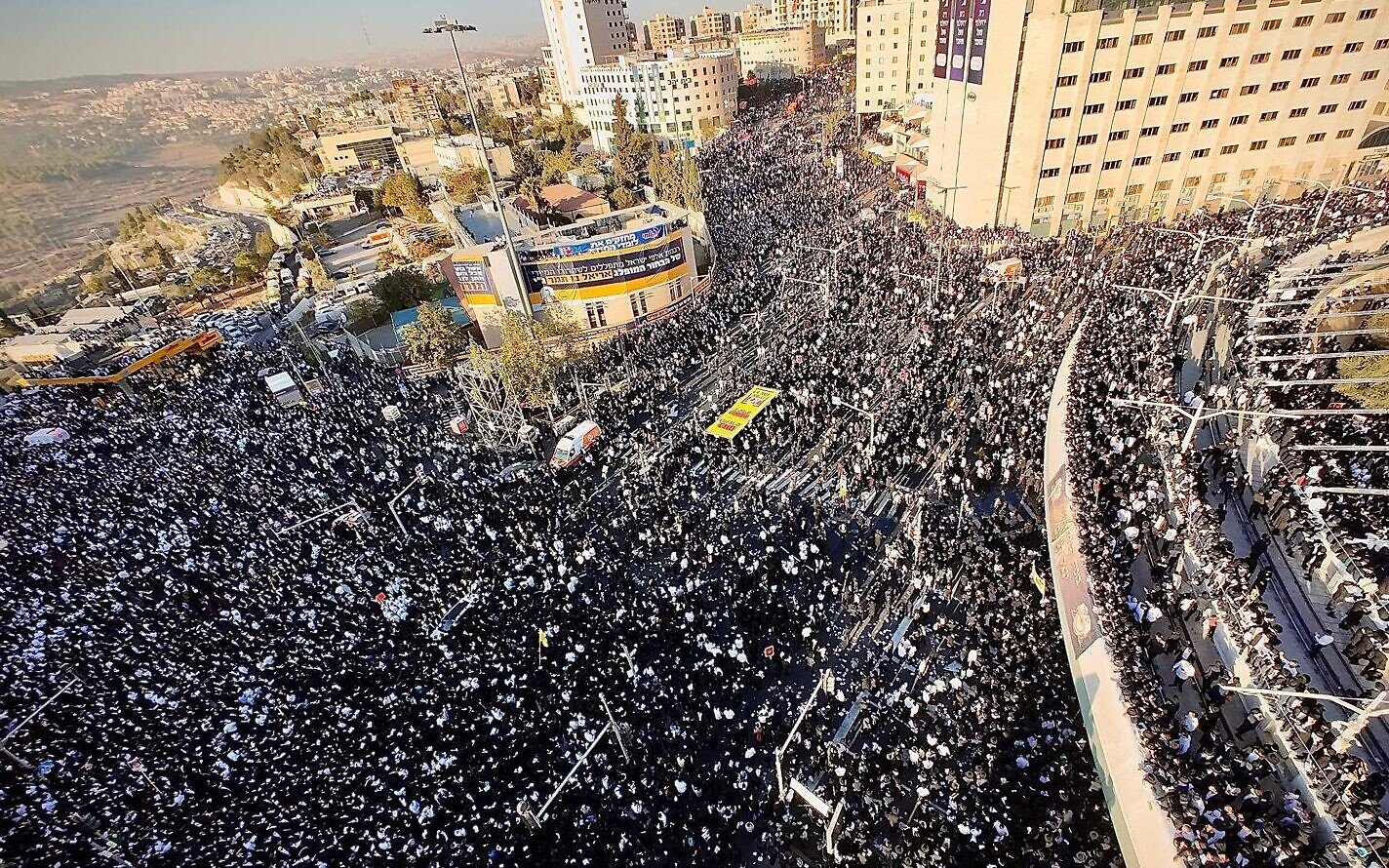
While the Haredi “million man” protest in Jerusalem on Thursday was widely billed as a demonstration against serving in the Israel Defense Forces — with the Supreme Court having ruled their decades-long exclusion illegal, and the Netanyahu government scrambling to advance a legislative compromise — many of the yeshiva students, rabbis, and others who participated described the event in somewhat different terms.
They highlighted their commitment to Torah study and asserted, in some cases, that it was their fealty to the study of holy texts that was keeping Israel safe. One man suggested the struggle was itself a harbinger of the coming of the messiah. Unsurprisingly, however, nobody with whom The Times of Israel spoke was prepared to contemplate conscription.
The two-hour protest, which blocked the entrance and disrupted traffic throughout Israel’s capital, drew an estimated 200,000 overwhelmingly male and largely young participants. It featured mass prayers, some clashes with police and attacks on journalists by a minority, and virtually no speeches.
A counter-protest nearby by a group of IDF reservists drew several hundred people, waving Israeli flags and demanding equal service for all Israelis; some 80,000 ultra-Orthodox males are currently eligible for military service, thousands have been sent draft orders, and very few have reported for duty.
The latest version of the conscription bill, set to be presented to lawmakers on Monday, is softer than previous iterations and includes incentives and loopholes that would allow many ultra-Orthodox young men to continue to avoid service entirely and most to avoid service in combat units. Some of those attending the rally seemed oblivious to such details and quite uninterested in them.
Get The Times of Israel’s Daily Edition
by email and never miss our top stories
By signing up, you agree to the terms
Several of those who spoke to The Times of Israel said they had come to show solidarity with their community and loyalty to their spiritual leaders rather than protest or argue.
“What is important is that we come with a united voice and say loud and clear that Torah learning is the source of our strength,” said Zev, a man with a long white beard. “We follow the instructions of our rabbis. [History has shown that] those in our past who did not believe this are no longer with us. There is no way around it.”
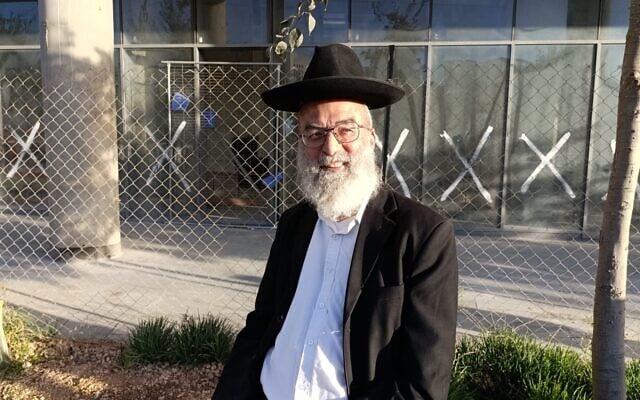
Zev, a Haredi man, at the ultra-Orthodox protest in Jerusalem on October 30, 2025. (Zev Stub/Times of Israel)
Others expressed frustration at what they felt was second-class treatment by the government.
“The Haredi community believes that it is not getting the respect that other civilians receive,” said Eyal from Jerusalem. “It has been like this for many years. The government gives money to the rabbis, but it doesn’t have any for us. This puts all of the yeshivot at risk.”
Still others advanced the widely held Haredi argument that learning Torah strengthens the IDF, and that their study is on equal par with army service.
“All of the miracles that have occurred in the past two years are thanks to the yeshiva world,” said Moshe Aharon Toledano of Jerusalem, apparently referring to the Israeli military’s achievements in Gaza, facing Hezbollah and against Iran since Hamas’s October 7, 2023, invasion and massacre in southern Israel.
“It’s thanks to those who studied Torah from morning until evening and prayed for the [return of the hostages] kidnapped [by Hamas]. There are people here who have not stopped crying and praying for the hostages to come home. It pained us, and we have been fighting in the way that our ancestors taught us, through prayer and Torah study.
“It cannot be that in the Holy Land, they take a student who studies Torah and arrest him with handcuffs, just like in Russia,” he added, referring to the IDF’s arrests of some ultra-Orthodox draft evaders.
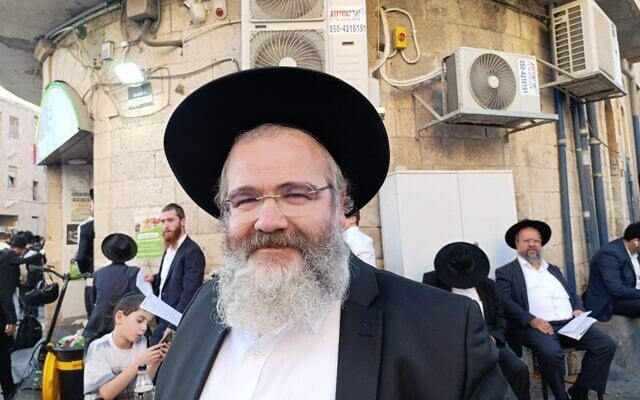
Moshe Aharon Toledano, a Haredi man, at the ultra-Orthodox protest in Jerusalem on October 30, 2025 (Zev Stub/Times of Israel)
Eliezer Falk, who runs a kollel in northern Jerusalem, told The Times of Israel that all his children are “prepared to go to jail rather than enlist.” He said that his son, who is now married and lives in Pisgat Ze’ev, spent three months in the Beit Lid military prison after he refused a draft order.
The protest was organized in response to a crackdown on Haredi draft dodgers in recent months, leading to over 870 arrests, amounting to 7% of the 6,975 ultra-Orthodox men who have been declared draft dodgers.
Falk said he believed the ongoing political struggle over Haredi enlistment to be a prelude to the messianic age. “In birth, before the baby is born, there are pains, the mother yells, suffers. Redemption is just like giving birth. God willing, it will end and the messiah will come,” he said.
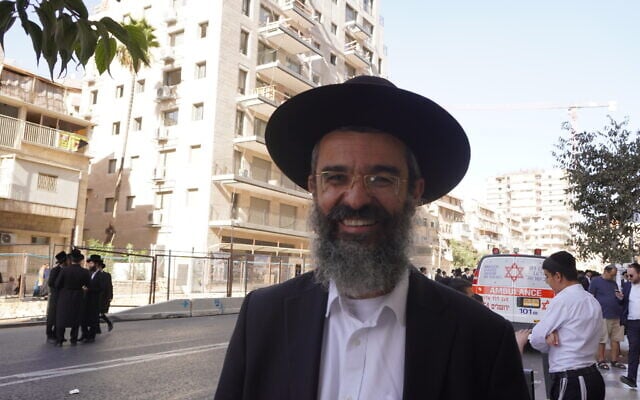
Eliezer Falk, a Haredi man, at the ultra-Orthodox protest in Jerusalem on October 30, 2025 (Charlie Summers/Times of Israel)
Others argued that the IDF already has all the soldiers it needs, despite the IDF repeatedly stating that it urgently needs 12,000 more recruits, and reservists serving hundreds of days at the front during the two-year war against Hamas in Gaza.
“The reason they want Haredim in the army is not because they need us,” said Shmuel, a Jerusalem resident attending with two of his sons. “They have plenty of people. It’s because our community is growing rapidly, and they are afraid of us. They are afraid that the whole country is going to become Haredi. They just want to have us come and peel potatoes so they can control us.”
Fighting back
Nearby, in front of the International Convention Center (Binyanei Hauma), at a counter-protest by a group of IDF reservists waving Israeli flags, several hundred people arrived to make the opposite argument.
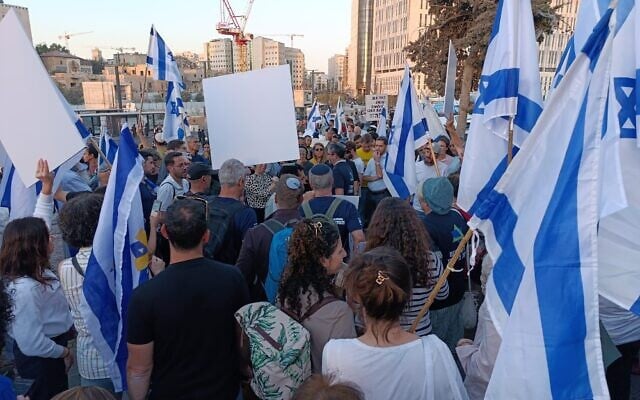
A reservist counterprotest to the ultra-Orthodox protest in Jerusalem on October 30, 2025 (Zev Stub/Times of Israel)
“I’m here to support the soldiers that serve our country and have been protecting us and making tremendous sacrifices over the last two years,” said Jerusalem resident Daniel Green.
“We have to show our respect to those who have paid the ultimate price so we can be here in our country as free Jews. It is critically important to send a message to our leaders that national service is something that all of us have to do. We have to say that the buck stops here.”
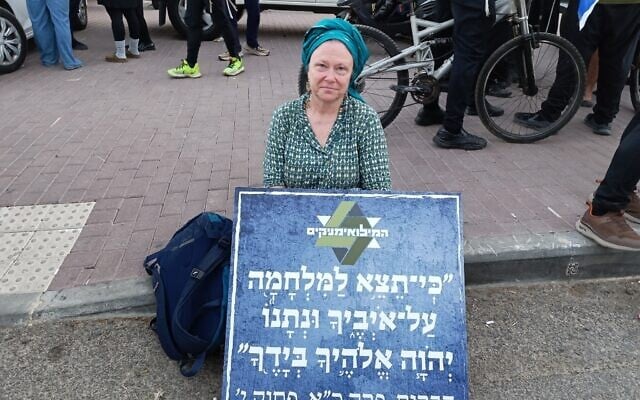
Ayelet Hashachar, a counter-protester against the ultra-Orthodox protest in Jerusalem on October 30, 2025 (Zev Stub/Times of Israel)
Ayelet Hashachar, who lives in the settlement of Kochav Hashachar, shared a more personal connection.
“I’m here because my daughter just got her draft order, and she plans to enlist,” she said. “I’m supporting her, and my son-in-law, and his seven brothers, all of whom serve in the IDF. I teach third grade, and nearly everybody has lost a brother, a father, or an uncle. You can’t stand by while your brother’s blood is being spilled defending our people.”