
UKRAINE, NVIDIA:
The US leader said the subject of Russia’s war had come up ‘very strongly,’ while Jenson Huang was hoping that the conversation was good
AFP, ABOARD AIR FORCE ONE,
and AP, BANGKOK
Chinese President Xi Jinping (習近平) and US President Donald Trump had differing takes following their meeting in Busan, South Korea, yesterday.
Xi said that the two sides should complete follow-up work as soon as possible to deliver tangible results that would provide “peace of mind” to China, the US and the rest of the world, while Trump hailed the “great success” of the talks.
The two discussed trade, including a deal to reduce tariffs slapped on China for its role in the fentanyl trade, as well as cooperation in ending the war in Ukraine, among other issues, but they did not mention Taiwan.
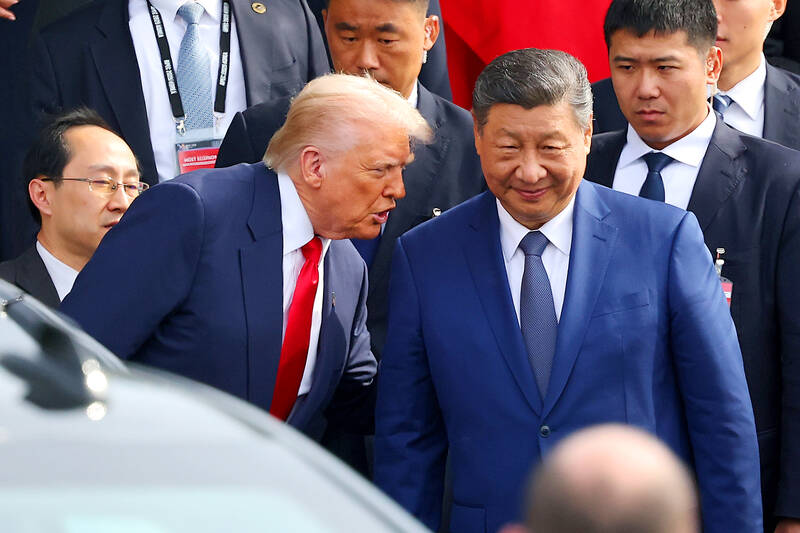
Photo: EPA
Trump said after the talks that US tariffs would be reduced to 10 percent — bringing overall US tariffs on Chinese goods to 47 percent.
Trump said Xi “agreed that he was going to work very hard to stop the flow” of the powerful opioid, which has killed thousands of Americans.
“I believe he’s going to work very hard to stop the death that’s coming in,” Trump told reporters on Air Force One.
Regarding Ukraine, the two reportedly agreed to cooperate more on seeking an end to the war with Russia.
China says it is a neutral party in the conflict, but Kyiv and Western governments have long accused Beijing of providing political and economic support to Moscow.
Trump told reporters that the subject had come up “very strongly” during his talks with Xi.
“He’s going to help us, and we’re going to work together on Ukraine,” Trump said.
Separately, Nvidia chief executive officer Jensen Huang (黃仁勳) said he was confident that Trump and Xi had a good conversation.
Huang was speaking as he arrived at a restaurant in Seoul with Samsung Electronics chairman Jay Y. Lee and Hyundai Motor Group executive chairman Chung Eui-sun.
Huang said that he was looking forward to meeting with South Korean President Lee Jae-myung, and that his company and South Korea had many announcements to make.
Beijing has ramped up its chip industry to beat Washington’s export restrictions on components used to power artificial intelligence (AI) systems.
US chip giant Nvidia has been caught in the middle of that geopolitical tussle.
Nvidia’s chips are not sold in China due to a combination of Beijing government bans, US national security concerns and trade tensions.
“We did discuss chips,” Trump said after meeting Xi, adding that Huang would speak to Beijing about the dispute.
“We’re sort of the arbitrator or the referee,” Trump said.
That would not include the firm’s next-generation Blackwell AI graphics processing unit architecture, he said, “but a lot of the chips.”
“We make great chips,” Trump told reporters on Air Force One. “Nvidia’s the leader.”
Beijing also said it would work with the US administration to resolve issues of TokTok’s ownership.
“China will work with the US to properly resolve issues related to TikTok,” the Chinese Ministry of Commerce said after the meeting.
Xi said that negotiating teams from both countries had reached a consensus, a likely reference to talks held in Malaysia last weekend, Chinese state media reported.
The recent twists and turns in the relationship offer lessons for the US and China, Xi said.
The US and China should have positive interactions on the global stage that demonstrate their responsibility as major powers to achieve positive results for their countries and the world, he said.
“Both sides should take the long-term perspective into account, focusing on the benefits of cooperation rather than falling into a vicious cycle of mutual retaliation,” he added.
Additional reporting by Reuters and staff writer