
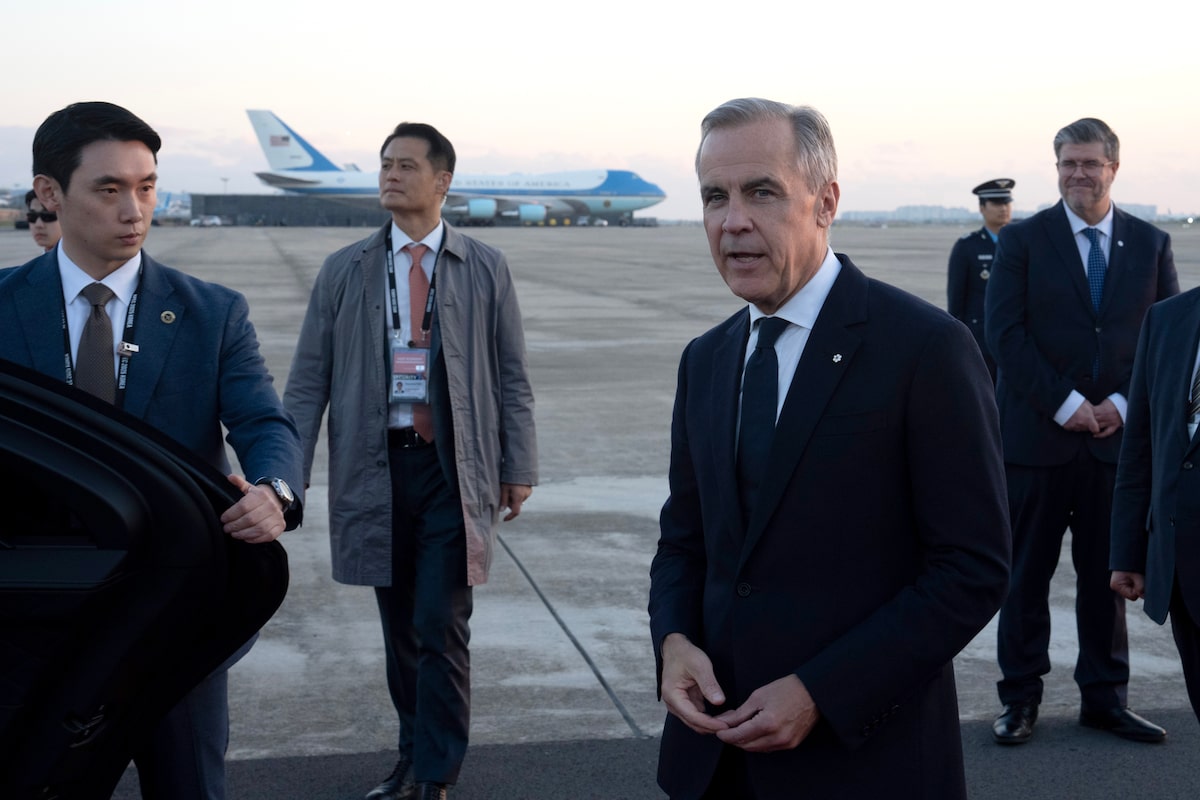
Mark Carney’s meeting with Xi Jinping on Friday will mark the first formal sit-down since 2017 between a Canadian prime minister and Chinese president.Adrian Wyld/The Canadian Press
One of the last meetings on Mark Carney’s whirlwind tour of Asia may be his most important: a Friday sit-down with Chinese President Xi Jinping, as the Prime Minister seeks new markets to offset the economic damage that Donald Trump is doing to Canada.
Mr. Carney’s tête-à-tête with Mr. Xi during the Asia-Pacific Economic Cooperation summit in South Korea will be the first formal get-together between a Canadian Prime Minister and the Chinese President since 2017.
Relations have been in a severe diplomatic chill since 2018, when Canada arrested a Chinese tech executive at the request of the United States, and China jailed two Canadians in response.
Mr. Carney’s courting of Mr. Xi is an abrupt change of course in Ottawa’s approach to China, a country Ottawa publicly characterized less than three years ago as an “increasingly disruptive” global power.
But Trump protectionism is driving U.S. allies to look far and wide for new markets, including those that countries such as Canada have often criticized for human-rights abuses.
China urges co-operation as Trump, Xi agree to pause trade war
It was just last year that former prime minister Justin Trudeau’s government followed Washington’s lead and imposed 100-per-cent tariffs on Chinese electric vehicles, starting a trade war with Beijing that is now hurting Canadian farmers and fishermen, with China imposing retaliatory levies on canola, pork and seafood.
Just prior to the Friday meeting with Mr. Xi, Kody Blois, the parliamentary secretary to the Prime Minister, flew to Beijing and, after meetings there, joined Mr. Carney at the APEC summit. Also in the Chinese capital this week was Agriculture Minister Heath MacDonald.
Chris White, the president of the Canadian Meat Advocacy Office in Beijing, said he expects the Carney-Xi meeting will be businesslike – “without the drama or lecturing that was the approach, at times, of the previous Canadian prime minister,” which he said often aggravated Mr. Xi.
Jeff Nankivell, a former Canadian diplomat who heads the Asia Pacific Foundation, said Ottawa’s shift on both China and India under Mr. Carney has been rapid. “It’s a fairly quick progression of events after a fairly long period of deep freeze.”
The Xi meeting will cap a week of Mr. Carney pitching Asian leaders on Canada as an “energy superpower,” from natural gas to small modular nuclear reactors, including meetings with Malaysia, the Philippines, Vietnam, Singapore and South Korea, among others, and pressing to expedite a trade deal with the Association of Southeast Asian Nations.
Mr. Xi, centre, at a meeting on the sidelines of the APEC summit. The two countries could make early progress on putting Canada back on the list of approved destinations for Chinese group tours, experts say.Evelyn Hockstein/Reuters
Just two weeks ago, Canada and China formally resurrected a “strategic partnership” that was first struck in 2005: a communications channel that amounts to a hotline between countries so they can work through disagreements or build ties.
Mr. White said Mr. Xi’s meeting with Mr. Carney also sends a message throughout China’s political apparatus. It “indicates a political willingness to re-engage, and in China’s system, that signal carries weight across ministries and provinces.”
Experts do not expect the meeting to lead to Canada immediately scaling back tariffs on Chinese EVs – an approach opposed by Ontario Premier Doug Ford – but former Canadian ambassador to China Guy Saint-Jacques says such a measure is being “seriously considered in Ottawa.”
G7 critical minerals pact will take aim at China market manipulation, Minister Hodgson says
It’s possible early progress could include China putting Canada back on the list of approved destinations for Chinese group tours, which would be a boon for Canadian tourism operators. Beijing took Canada off the list as relations deteriorated, effectively lumping it in the same group as high-risk countries such as North Korea and Sudan.
What does China get out of more engagement with Canada? Better prospects for exports to Canada and investments here. “China needs foreign markets and investment. Twenty per cent of its GDP is exports, the housing sector has not yet recovered, and youth unemployment is high,” Mr. Saint-Jacques said.
Though relations with Beijing have chilled, China is purchasing record amounts of Canadian oil.DARRYL DYCK/The Canadian Press
Lynette Ong, a professor of Chinese politics at the University of Toronto, said China’s economy has not recovered to its prepandemic levels. “I am not sure if it ever will,” Prof. Ong said, and Mr. Xi “has been eager to patch up relations with a number of countries where the bilateral relations had soured, such as Australia, in order to boost export growth.”
Despite the chill that still hangs over the Canada-China relationship, trade is booming in some sectors. China is purchasing record amounts of Canadian oil as it cuts U.S. purchases amid rising trade tensions with the United States.
Roland Paris, a University of Ottawa professor of international affairs and former foreign policy adviser to Justin Trudeau, said Beijing sees Canada as a valuable source of food and energy, but also “as a Group of Seven country and close U.S. ally made more vulnerable by Trump’s economic policies.”
China has been working hard around the globe to “take advantage of the alienation that many countries are now feeling toward the U.S.,” he said.
Nevertheless, Prof. Paris said, it’s in Canada’s own interest to restore dialogue with China at the highest levels.
Economists and China experts offer a reality check, however. China, despite its mammoth economy, will not be able to replace the export market that Canada stands to lose under Mr. Trump’s protectionism.
More than 5 per cent of Canadian exports head to China, making it among the country’s top foreign markets, but that’s still far less than the 75 per cent of exports purchased by the United States.
“The bottom line is that unless and until China opens more, prioritizes spending and allows its currency to strengthen, it’s not realistic to expect it to make a serious dent in what Canada may lose in U.S. market share,” said Doug Porter, chief economist at BMO.
Mr. Saint-Jacques said he also expects Mr. Carney to revise Ottawa’s policy toward Chinese investment in Canada. Over the past 10 years, Canada has imposed restrictions on Chinese capital, particularly companies with any connections to the Chinese state or in transactions that have national security implications.
Goldy Hyder, the president of the Business Council of Canada, said that while China could never replace Canada’s trade with the U.S., “in certain specific sectors – such as energy and agriculture – we could offset a loss of some exports to the U.S. if we were able to sell more to China.”
In August, China imposed a 75.8-per-cent duty on Canadian canola seed, a major crop in Alberta, Saskatchewan and Manitoba, in retaliation for Ottawa’s tariffs on Chinese EVs and 25-per-cent levies on Chinese steel and aluminum. That was on top of a 100-per-cent tariff on Canadian canola oil, canola meal and peas imposed in March and a 25-per-cent tariff on Canadian seafood and pork products.
China has made no secret of its wish for Canada to drop the tariffs on EVs, saying it would then drop its retaliatory levies.