
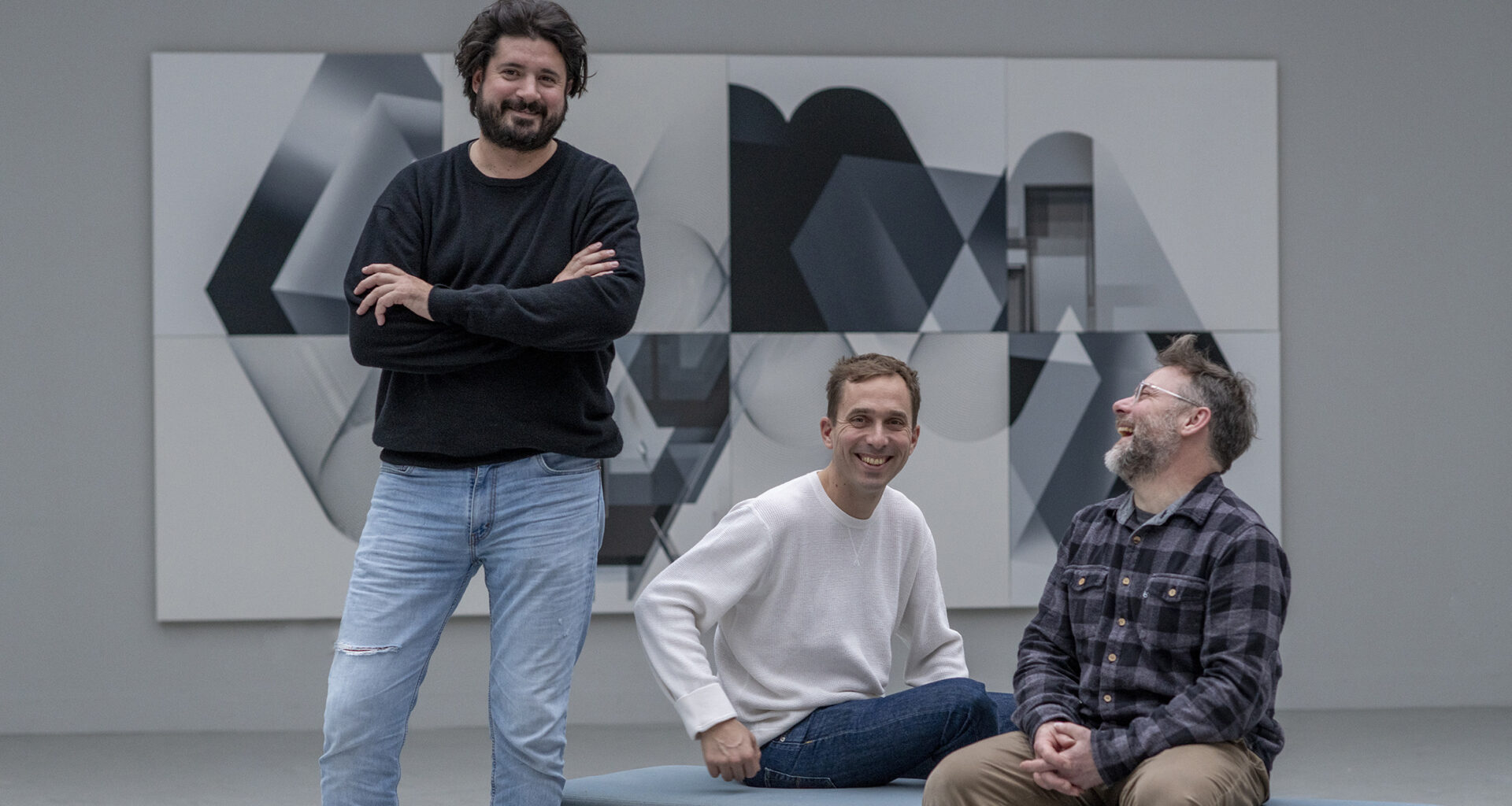
Boulogne-Billancourt – October 31, 2025 – Created in June 2024 by Renault Group, the Renault Fund for Art and Culture aims to support contemporary urban creation while promoting the Group’s rich artistic and cultural heritage. With the exhibition Dialogues with the Diamond, the Fund highlights the resonance between Victor Vasarely’s visionary legacy and its own roadmap dedicated to contemporary urban art. This exhibition embodies the correspondences between art, industry, and innovation, through a common and unifying symbol: the diamond.
Renault & Vasarely: a shared story
To celebrate the diamond’s logo centenary, the Renault Fund for Art and Culture reaffirms its commitment to creation by initiating Dialogues avec le losange. This exhibition marks a new milestone in the long-standing partnership between art and industry, reconnecting with the visionary spirit of this artistic and industrial adventure. By bringing together new creators around Vasarely’s work, the Renault Fund for Art continues this creative dynamic.
Since the 1960s, the Renault Collection has defended a pioneering conviction: art and industry, far from opposing each other, can together transform the contemporary environment.
This vision found its most emblematic expression in the collaboration with Victor Vasarely, who designed the brand’s diamond logo in 1972. More than a graphic gesture, this choice embodied a shared philosophy—an art integrated into everyday life, capable of accompanying the transformations of a rapidly changing industrial society.
Vasarely’s visionary legacy at the heart of contemporary urban creation
In 1955, in his Yellow Manifesto, Victor Vasarely expressed a bold dream: a “polychrome city of happiness” where art would no longer be confined to museum walls but integrated into architecture, present in the streets, and accessible to all. A democratic and reproducible art, capable of transforming daily life through color, form, and movement. A modernist utopia that challenged the conventions of an art world still largely elitist at the time.
Seventy years later, this vision has found an unexpected echo. Art has taken over public space. A generation of artists has invested the city walls, turning the city into the open-air museum he envisioned—though in ways he might not have anticipated.
In this conquest of the urban realm, some have chosen, like him, geometric abstraction and optical and kinetic art. Curated by Karim Boukercha, an expert in urban art and author of several reference books on the subject, Dialogues with the Diamond celebrates this reimagined heritage by inviting three contemporary artists aware of these filiations.
Olivier Swiz, drawing from his roots in graffiti, deconstructs letters to create graphic architectures that open onto a language of geometric abstraction. Through both in situ interventions and studio work, he develops an architectural writing based on repetition, rhythm, and fragmentation, in a quasi-mathematical approach that responds to the urban environment and viewer perception.
Sébastien Preschoux, whose work is deeply influenced by optical art and Bauhaus ideals, has been developing since the 2000s a visual language grounded in manual tracing and measured repetition. His geometric drawings and thread installations generate subtle vibratory effects, creating a delicate optical interplay between color and light. From studio paintings to thread installations in public space, he pursues the same exploration of perceptual phenomena.
Arthur Dorval, known for his work on color geometry, has been exploring since 2010 the relationships between form, color, and depth, in the lineage of geometric abstraction and Op Art. His compositions, halfway between sculpture and painting, play with optical illusions and volumes. Color acts as a generative principle, giving birth to his “Geometric Blossoms”—pictorial architectures vibrant with sensitivity.
The exhibition creates a dialogue between three complementary approaches that, heirs to geometric abstraction, extend Vasarely’s spirit around vibration, perception, and pure form.
The diamond as a point of convergence
For this exhibition, the trio was invited to explore this emblematic figure. A founding element of Vasarely’s “plastic alphabet” and Renault’s graphic identity, the diamond acts as a bridge between generations, crystallizing the pioneer’s research while offering an infinite field of exploration to contemporary creators.
It is around this form that the project unfolds, transforming the Vasarely Foundation into a living creative laboratory where art renews itself through experimentation, transmission, and the confrontation of practices.
An unprecedented journey
At the heart of the exhibition, a rare event: for the first time, Victor Vasarely’s personal office—usually closed to the public—will be opened. This intimate space hosts a kaleidoscopic installation born from the dialogue between the three artists. Within it, wall paintings, floor interventions, and thread structures transform the office into an immersive optical experience. The geometric figure becomes a medium for exploration, echoing the pioneer’s universe. This creative sanctuary is transformed into a transgenerational meeting place, where intimate creation inspires new works.
In contrast, Room 14 H hosts three monumental polyptychs measuring 2 x 4 meters, composed of eight canvases each, in black and white. Reduced to essentials, this monochromatic approach celebrates the power of contrast. A video projection reveals the interchangeability of the twenty-four canvases that assemble and recombine to generate new forms, following a combinatorial principle reminiscent of Vasarely’s “plastic alphabet.” Through these multiplied variations, movement and optical-kinetic effects emerge, extending the perceptual experience beyond the canvas.
In the monumental hexagonal halls of the Foundation, each artist presents a sculpture resonating with Vasarely’s architectural integrations. By confronting their research with this universe, they continue the spatial, perceptual, and chromatic concerns that run through geometric abstraction, demonstrating its ongoing vitality.
A living heritage
Dialogues avec le losange celebrates an artistic heritage renewed through movement, reinterpretation, and generous transmission. By connecting Vasarely and today’s artists, the exhibition asserts the vitality of a legacy that, far from being frozen in historical contemplation, continues to inspire creation and question our relationship to space, movement, and perception. Seventy years after the Yellow Manifesto, the polychrome city truly exists—it is the contemporary city.
The Renault Fund for Art and Culture supports contemporary urban creation
Since the 1930s, Renault has built an art collection that embodies the spirit of industrial patronage in France. The collection was conceived as a dialogue between art and industry, inviting artists into factories and commissioning works. The department collaborated with more than fifty contemporary artists. The project reflects a unique approach that has attracted many now-renowned creators.
The first major collaboration was with the artist Arman, who worked with materials provided by Renault. Each artist posed different questions and sought artistic and technical solutions from Renault. The collaboration with Victor Vasarely gave rise to an emblematic symbol: the optical-kinetic diamond that became Renault’s logo and shaped the brand’s visual identity until 1992.
Today, the Renault Fund for Art and Culture reconnects with the philosophy of the Collection—supporting artistic movements such as, in its time, optical art or new realism, and today urban art—a popular art form that, like our vehicles, belongs to the streets, where creativity and audacity thrive.