
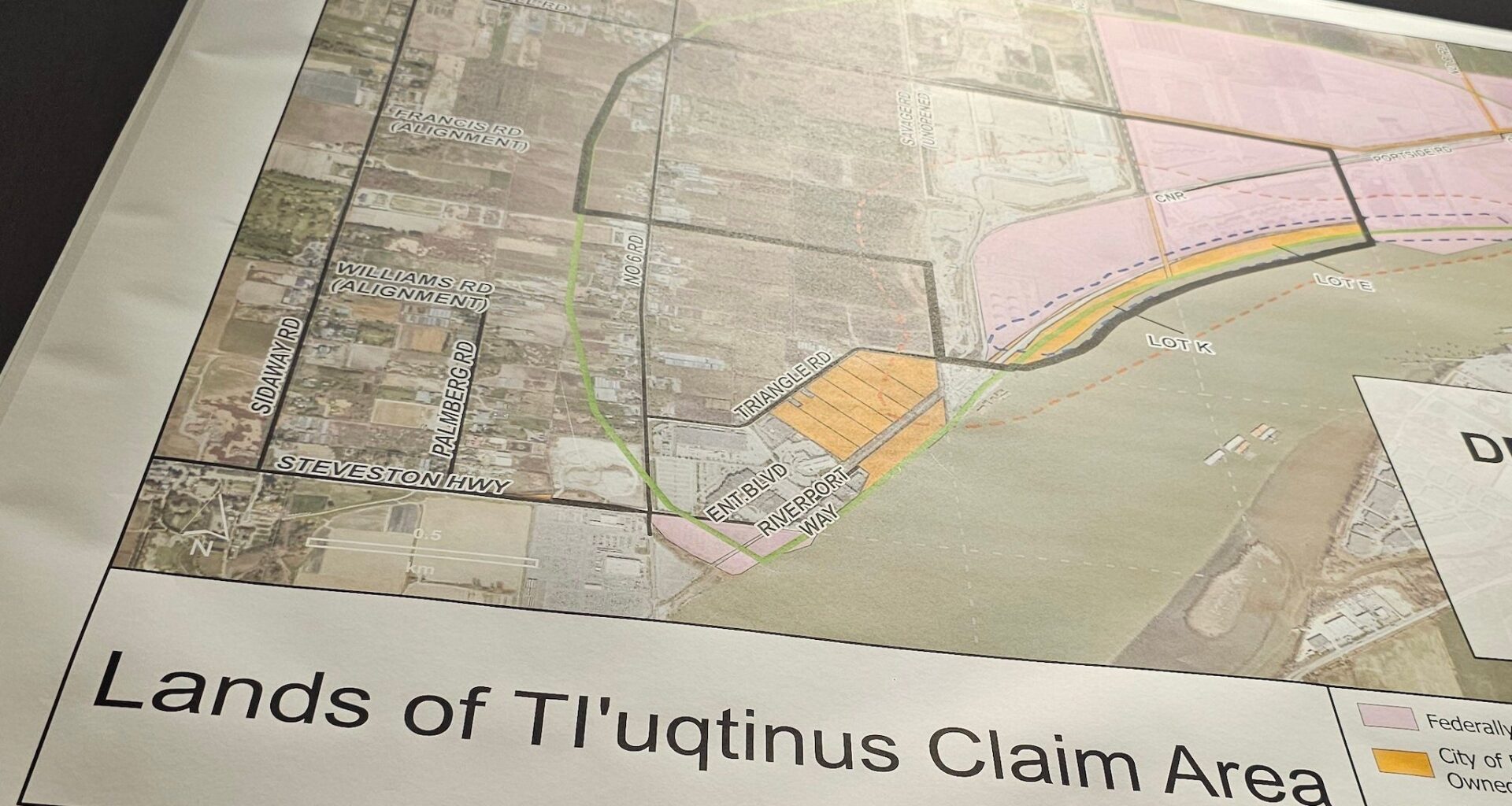
As City of Richmond officials cautioned during a public information session earlier this week, the Supreme Court of British Columbia’s Aboriginal title ruling in favour of the Cowichan Tribes — granting them a large area in southeast Richmond — will have significant negative impacts on fee-simple title property owners within the land claim area.
These include difficulties obtaining mortgages, challenges in selling properties, reduced access to insurance, and declines in property values and equity. The implications of the ruling also provide the Cowichan Tribes with the final approval over property transactions.
Trial judge Justice Barbara Young designated 732 acres or 40 per cent of the 1,846 acres sought by the Cowichan Tribes as Aboriginal title — an area that includes municipal and federal property, including port terminal and airport jet fuel facilities, as well as residential and agricultural uses, and major industrial and commercial businesses.
The provincial and municipal governments and the Musqueam Indian Band are appealing against Justice Young’s decision. The Cowichan Tribes have also indicated they will make an appeal of their own to have all 1,846 acres be under Aboriginal title, which would span additional homes, agricultural businesses, major industrial and commercial properties, and even Riverport Sports & Entertainment Complex — entailing Cineplex’s SilverCity Riverport Cinemas, Splitsville Riverport bowling alley, Extreme Air Park, Watermania aquatic centre and Richmond Ice Centre, which was acquired by the City of Richmond in 2019.
So far, much of the attention has focused on the effects on homeowners — some have already told the City that they are running into mortgage challenges — but the impact on local businesses is also becoming increasingly evident.
Some sources wishing anonymity also told Daily Hive Urbanized that some businesses — which were not named — are going as far as planning their relocation from the area. There is a real concern that new investments in the area will not only be put on hold from the chilling effect, but numerous existing businesses will also move out.
In an interview with Daily Hive Urbanized, Richmond city councillor Alexa Loo shed more light, sharing that one company with major operations in the area had a $100-million shovel project completely derailed after a major bank withdrew its loan solely because of the property’s legal uncertainty arising from the August 2025 ruling. She said the project would have created hundreds of jobs.
“They were quite excited about it. Now they’re quite disappointed,” she said.
Loo noted that 1.5 million sq. ft. of new industrial warehouse space had been built in the area in recent years, including massive distribution and logistics facilities for Canadian Tire, Wayfair, Coca-Cola, and Amazon.
Loo said that a hotel project and several nearby developments — including one located next to the Riverport movie theatre and bowling alley — have been caught within the so-called “green circle” area affected by the Aboriginal title litigation, where the Cowichan Tribes intend to appeal to add to their land claims. Because these properties fall within that zone, they are now under appeal and effectively subject to ongoing litigation, creating uncertainty about whether the developments will proceed.
Even a push by the City to work with TransLink to improve public transit services in the area is now impacted.
With the recent opening of major businesses in the industrial properties and expanded port facilities, the area now sees a new critical mass of employees, with highly apparent transportation demand. But without more optimal bus services, the employees largely depend on their own cars to get to their workplace. In recent years, TransLink has reported that industrial areas south of the Fraser River have experienced some of the highest growth in bus ridership — but only when service is convenient and sufficient to meet demand.
Loo had been counting on a new development to provide a new road connection, enabling vehicle traffic to exit onto Triangle Road and then access Steveston Highway. It would have allowed buses and other vehicles to move through the area much more efficiently, but those plans are also on hold due to the uncertainty.
“It kicks it down the road. I’ve been trying to talk to TransLink to see if we can come up with some matching dollars because they often give us funding to do various projects. This would have really opened up a huge transit route because right now, it’s very poorly served by transit because it dead ends,” she says.
When discussing the impact on residential properties, Loo said she spoke with a real estate agent earlier this week who is trying to sell a home within the “black circle” land claim area, who reported significant difficulty finding a buyer. The agent attributed the property’s 29 per cent price drop — from $900,000 to $700,000 — to the ongoing legal uncertainty.
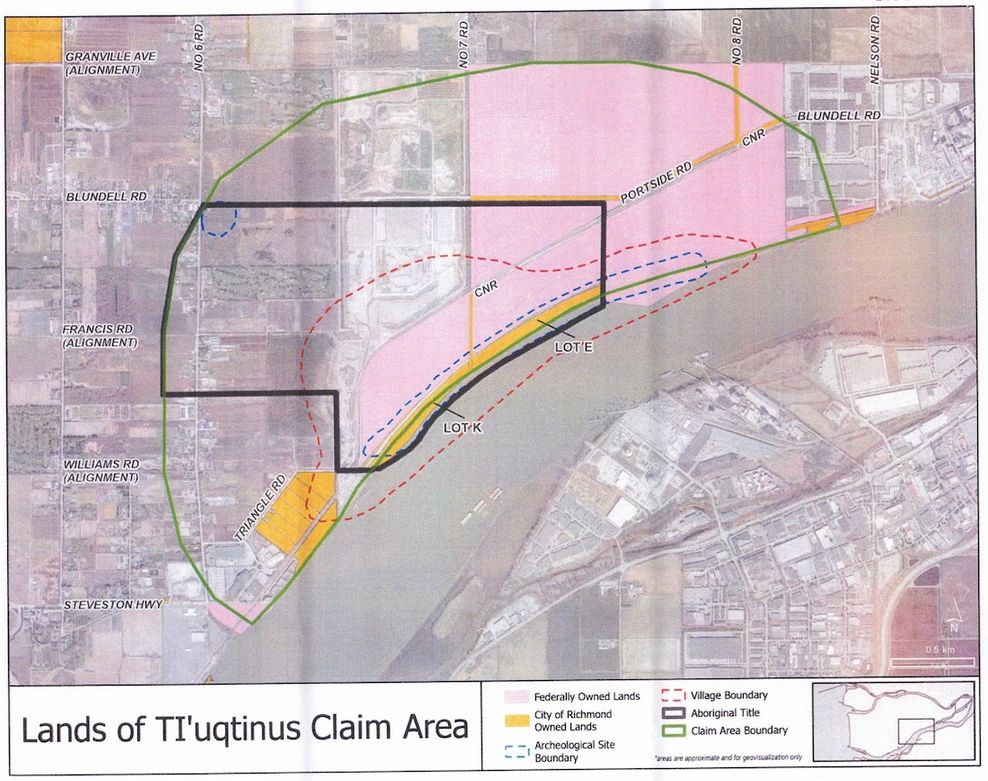
Cowichan Tribes’ land claim area in southeast Richmond. (City of Richmond)
Loo emphasized that while the City will do what it can to support impacted residents and businesses and their properties — such as holding the public information session for over 700 people at a hotel ballroom earlier this week — it comes down to the provincial and federal governments to take the lead in the appeal processes, and provide interim support for the property owners.
On Nov. 17, 2025, she will be asking Richmond City Council to approve her member motion to formally ask both senior governments to financially backstop the area’s property owners while the case remains under appeal — a long process that may drag on for years through the top courts of both British Columbia and Canada.
“They’re not hitting everyone right at once, so it’s not a tidal wave, but there is uncertainty, and it does create confusion and distress. And who backstops it and who takes on the risk? Richmond didn’t cause this problem,” she said.
“Nobody should lose their home because of the unintended consequences of this ruling. The province and the feds are the ones that put us here… What’s happening to individual businesses and the fears that people are having — and when we see the banks pull their funding, then we also know that the banks are taking this very seriously. And if the banks are taking it seriously, it’s serious. And the only ones that can backstop that kind of enormity are the federal and provincial governments. They need to help create some certainty and provide some financial assurances for people.”
It was also noted by B.C. Attorney General Niki Sharma earlier this week that the government defendants are potentially working on a stay application to at least temporarily pause the enforcement of the court’s decision during the appeal process.
During this week’s session, the City faced criticism from property owners for not alerting them sooner to the potential risks arising from the ongoing litigation. While such notification is typically the responsibility of the plaintiff — in this case, the Cowichan Tribes — Loo reiterated that it was the court’s decision, made a decade ago, not to formally notify affected property owners, even though the government defendants wanted owners to be informed. As a result, many only became aware of the situation earlier this month, when the City sent letters to all approximately 150 fee-simple title holders outlining the implications of the case and inviting them to the information session.
“Back in 2015, we said, ‘Hey, all these people in the circle should be notified.’ But they said, ‘No, no, don’t worry, they shouldn’t be notified.’ It’s like, well, if the court told us that they shouldn’t be notified, but we then went ahead and still notified people, it wouldn’t look good on our part either, right? To go running around, ‘Penny! Penny! The sky is falling. It’s a lawsuit. Wait, those people weren’t named in the lawsuit,’” she said.
But in 2015, the judge did not want property owners to be informed over concerns that all impacted owners might apply to take part in the case, which would overwhelm the court and bring the process to a complete standstill.
Over the past decade, Loo says, the City has already spent over $2 million in legal fees to protect the property rights of its residents and businesses, and the major assets of the municipal government in the area.
She estimates tens of millions of dollars in legal and court fees have already been expended by all parties involved. The actual trial period began in September 2019 and spanned a total of 513 court hearings and trial days, making it the longest in Canadian history.
“We’re just trying to build roads, sewers, and sidewalks. We’re trying to protect the land, the City of Richmond’s land. It’s owned by the taxpayers of Richmond. That’s why we obviously went to court and appealed,” Loo told Daily Hive Urbanized.
“We had land that we bought in what we thought was a fair deal, or a legal deal. You could say it’s unfair for whatever reason, but we bought it in a legal deal over 100 years ago. We had no reason to think that it wasn’t in good faith. And so that land is owned by the people of Richmond. And so, what we do with it is things like build a dike on it to protect everybody’s land and family’s enrichment.”
Loo also highlighted that there are competing land claims in the area between three First Nations. Even during the trial, the Musqueam Indian Band and Tsawwassen First Nation questioned the very existence and legitimacy of the Cowichan Tribes as part of their arguments. The Tsawwassen First Nation is also supporting the appeal efforts of the Musqueam Indian Band.
“Which First Nation has Aboriginal title, if there is in fact Aboriginal title here? Because the Musqueam are saying, ‘Well, actually, it should be us.’ And the Tsawwassen First Nation is saying, ‘Well, maybe it should be us.’ We’re not really further ahead if we get the sign off from one group and not all three,” Loo told Daily Hive Urbanized.
“We still haven’t figured out who is holding the bag at the end of the day.”
There are also real concerns that this case could set the precedent for millions of fee-simple title properties across the province, and elsewhere in Canada, where there are land claims.