

Two-thirds of Israelis believe the United States, not Israel, is now steering military operations in Gaza, according to a new survey by Channel 12 released Friday evening.
The poll found that 67 percent of respondents think the US is the main decision-maker when it comes to Israel’s policy and IDF actions in the Strip.
Just 24% said Israel is the one calling the shots, while 9% were unsure.
The survey also asked whether Israel has effectively become a “client state” of the US, a notion both Prime Minister Benjamin Netanyahu and senior American officials — including US Vice President JD Vance while visiting Israel — have rejected. On Sunday, Netanyahu insisted that Israel remains a “sovereign state,” describing its ties with Washington as a “partnership” rather than dependency.
Still, nearly seven in ten respondents (69%) agreed with the characterization, including 23% who said they “strongly agree,” while only 25% disagreed.
Get The Times of Israel’s Daily Edition
by email and never miss our top stories
By signing up, you agree to the terms
Beyond the US-Israel power dynamic, the poll conducted with the Midgam Institute also painted a picture of a public deeply divided on key political and social issues.
A slim majority of Israelis (51%) said they support revoking voting rights for citizens who do not perform military or national service, with 32% saying they “strongly support” the idea. Forty-two percent opposed it.

Israeli soldiers at the Western Wall in Jerusalem’s Old City, June 11, 2025. (Chaim Goldberg/FLASH90)
Opposition voters showed overwhelming backing for the proposal (68%), while coalition supporters were more evenly split, with nearly half (49%) opposing it.
On the contentious ultra-Orthodox draft issue, 40% said Likud MK Boaz Bismuth’s proposed conscription bill is intended mainly to bring Haredi parties back into the governing coalition, compared to 28% who believe the aim is genuinely to draft ultra-Orthodox men into the IDF.
Among coalition voters, 37% said they believe in the bill’s stated purpose; among opposition voters, 60% viewed it as a political maneuver.
The survey’s findings came amid escalating tensions over military draft exemptions for the ultra-Orthodox community. On Thursday, some 200,000 Haredi men jammed the entrance to Jerusalem for what organizers called a “million man” protest against conscription.
The rally followed a recent crackdown on ultra-Orthodox draft evasion, during which more than 870 apparently Haredi men have been arrested — a small fraction, roughly 7%, of the 6,975 officially classified as draft dodgers in recent months.

Tens of thousands of ultra-Orthodox men attend a protest against mandatory military conscription in Jerusalem, October 30, 2025. (Yonatan Sindel/Flash90)
A majority of respondents to the Channel 12 poll (53%) said they would not vote for a party that supports legislation allowing Haredim to avoid military service, compared to just 24% who said they would.
The sentiment was especially pronounced among opposition voters, with 81% saying they would refuse to back any party promoting such an exemption.
Marking three decades since the assassination of then-prime minister Yitzhak Rabin, 67% of Israelis told pollsters they fear the country could see another political murder.
Concern levels were consistent across political lines, hovering around 70% among both right-wing and center-left voters.
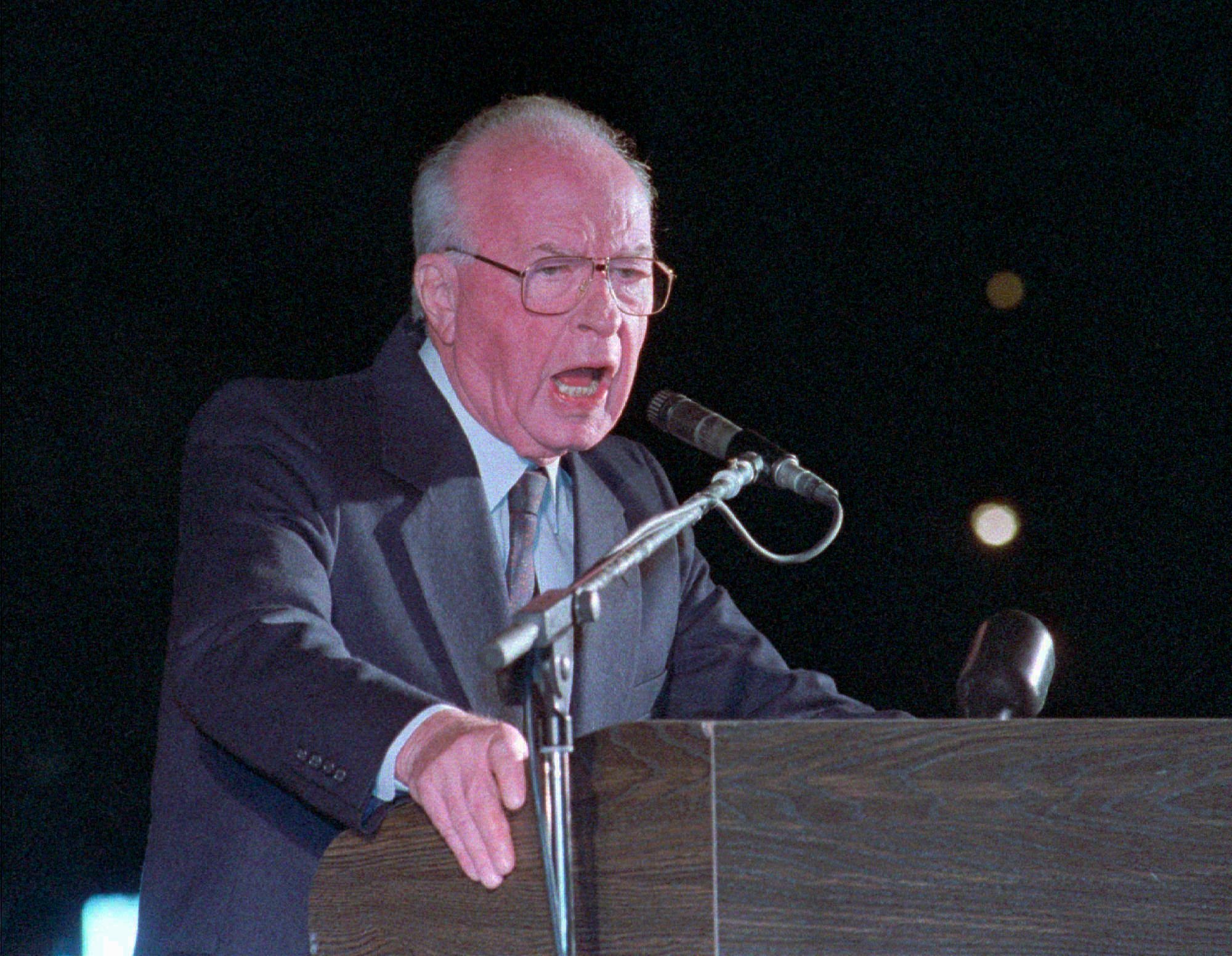
Prime Minister Yitzhak Rabin speaks to a crowd of more than 100,000 Israelis at a peace rally in Tel Aviv on November 4, 1995. Rabin, 73, was assassinated minutes later. (AP Photo/Nati Harnik, File)
Asked to reflect on Rabin’s legacy, 51% said they view his contribution to the state as positive, while 28% described it as negative. One-third (33%) said Israel would be in better shape today had he not been killed; 22% said the opposite.
Finally, the poll addressed reports about the possible appointment of Yair Netanyahu, the prime minister’s son, who has a history of inflammatory comments, to a senior post in the World Zionist Organization.
Three-quarters of respondents (75%) said such an appointment would be inappropriate, including 61% who called it “completely inappropriate.” Even among coalition voters, 58% opposed the idea.
Watch DocuNation Season 3: The Heart of Israel
when you join the ToI Community
Support The Times of Israel’s independent journalism and receive access to our documentary series, DocuNation: The Heart of Israel.

In this season of DocuNation, you can stream eight outstanding Israeli documentaries with English subtitles and then join a live online discussion with the filmmakers. The selected films show Israel beyond the conflict: a place of storytellers and musicians, of dreamers, makers, and communities rooted in meaning and trust.
When you watch DocuNation, you’re also supporting Israeli creators at a time when it’s increasingly difficult for them to share their work globally.
To learn more about DocuNation: The Heart of Israel, click here.
Support ToI and get DocuNation
Support ToI and get DocuNation
Already a member? Sign in to stop seeing this
You appreciate our journalism

You clearly find our careful reporting valuable, in a time when facts are often distorted and news coverage often lacks context.
Your support is essential to continue our work. We want to continue delivering the professional journalism you value, even as the demands on our newsroom have grown dramatically since October 7.
So today, please consider joining our reader support group, The Times of Israel Community. For as little as $6 a month you’ll become our partners while enjoying The Times of Israel AD-FREE, as well as accessing exclusive content available only to Times of Israel Community members.
Thank you,
David Horovitz, Founding Editor of The Times of Israel