
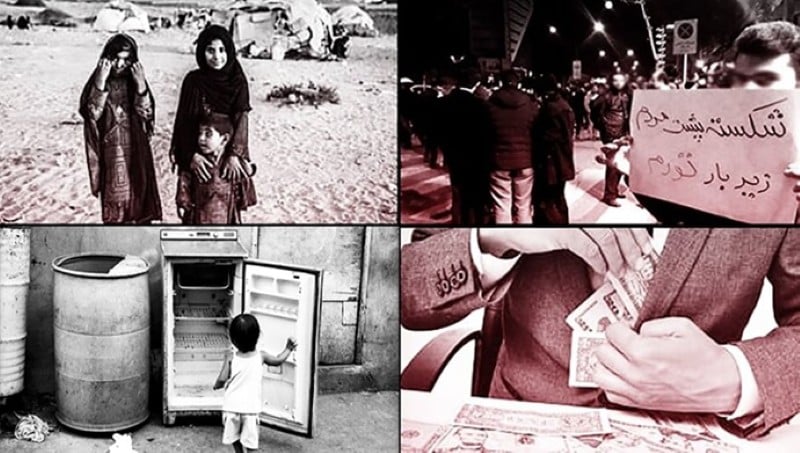
Decades after seizing power, the Iranian regime faces deep internal fractures, growing isolation, and a society that no longer accepts its rule.
Forty-six years after taking power, the Iranian regime is still struggling to secure its political and social legitimacy within society.
Once claiming broad public support, the regime now survives on a fraction of it. Even official figures from the 2023 and 2024 elections — despite being heavily manipulated — revealed that at least 60 percent of Iranians reject the ruling system. Regime-affiliated analysts have gone further, admitting that its real base of support does not exceed 10 percent of the population.
The regime is well aware that over 90 percent of Iranians are relieved by the failure of its regional expansionist policies and wish for further setbacks. Across the country, the public message is clear: “Our enemy is right here — they lie, it’s not America.”
Inside the establishment, deep cracks and rivalries have widened. Yet the so-called “reformist” faction continues to promote the illusion that the system can change from within, aiming to cloud public perception and preserve the regime’s façade of political diversity.
At the same time, Tehran has been forced to confront a new geopolitical reality: the era of Western appeasement is over. In recent weeks, the circle of the regime’s international isolation has grown steadily tighter.
The ruling elite also knows that the space for political, social, and cultural repression is narrowing. Neither the Iranian people nor the international community will continue to tolerate crimes cloaked in religion and false sanctity. Such tactics are increasingly backfiring — turning into a threat to the regime’s own survival. Nonetheless, it still relies on executions to instill fear and on policies of economic impoverishment to keep society subdued — mechanisms that fuel its authoritarian machinery.
Forty-seven years ago, Khomeini replaced the Iranian people’s demand for freedom with the absolute rule of the Velayat-e Faqih (Guardianship of the Islamic Jurist). He discarded the principle of political representation and placed a rigid clerical ideology at the center of governance and the economy. Science, reason, and expertise were subordinated to dogma — planting the seeds of systemic corruption that now consumes the regime from within.
Today, even regime-aligned economists have been forced to acknowledge this collapse. One of them recently admitted:
“Politics has taken science hostage, and ideology is eroding the very foundations of the economy.”
He added:
“Is Iran on the brink of economic collapse? The answer lies in decades of misguided policies. From 1979 to the end of 2024, Iran earned roughly $1.7 trillion in oil revenues. Had even one-third been invested in infrastructure, the country would not be in this condition. Now Iran faces severe imbalances across all sectors — economy, society, environment, and culture — requiring hundreds of billions in investment to correct, while existing resources have been squandered.”
The roots of Iran’s crises lie within the regime’s own structure. Genuine solutions to its political and economic problems demand a fundamental transformation in both domestic and foreign policy — starting with the abolition of the Velayat-e Faqih system itself.
As the state-run newspaper Jahan-e San’at recently wrote:
“As long as ideological policies and the central bank’s lack of independence dominate Iran’s economy, inflation will not be controlled and public welfare will not return. The vast amount of unbacked money in circulation equates to inflation of 80 to 90 percent, directly burdening the people. The economy is at an impasse without genuine dialogue. Reducing the expenses of supranational and extraterritorial institutions is essential, but these areas are beyond the government’s control — fueling budget deficits and further inflation. Everything depends on a paradigm shift among policymakers — a recognition that Iran’s vast resources must serve national development and the welfare of its people, not endless political gamesmanship.”