
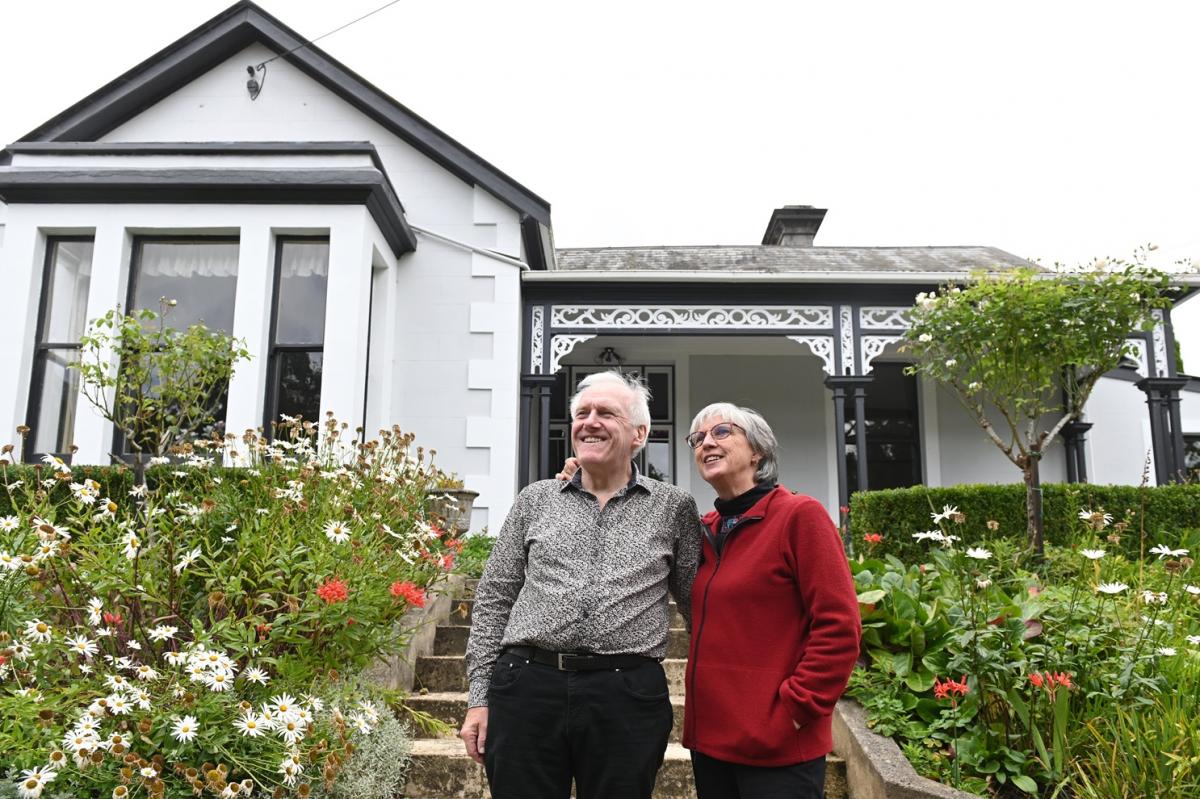
When a Dunedin couple saw this house, it was love at first sight and their carefully prepared checklist went out the window. Kim Dungey reports.
Brian Cox and Mary Jane Sneyd could barely believe what they were being told.
A wood pigeon had been blown through their dining room window, breaking vintage cups and saucers before dying on the table.
And if that wasn’t bad enough, the storm that spooked the bird had also caused damage inside.
As the couple made their way home from overseas, a bolt of lightning was hitting the house, blowing the mains and putting the heat pumps, hot-water heating and underfloor heating out of action. A shattered floor tile was sent flying into the air; meanwhile, heavy hail blocked the central gutter, which overflowed and caused flooding in the hall.
Despite setbacks such as these, they enjoyed living in the secluded Pine Hill property until selling it earlier this month, and still remember the moment they first set eyes on it.
The winding drive and native bush reminded them of the old road into Milford, while the garden boasted hundreds of azaleas, rhododendrons and hydrangeas.
Built in the early 1880s, the house was for many years surrounded by a fruit and berry farm. The last owner before them was Peter Johnstone, of The Orchid Florist, who had been there 20 years.
Dr Cox said buying the 3ha property was a “passion purchase” and it met none of the criteria they had set for their first home together.
However, they thought it would be “an adventure and a challenge”, and that had proved to be the case.
Slightly daunted by its size, they decided to give it two years and if they couldn’t manage, they would leave.
That was 20 years ago and it was only recently they moved out, to be closer to family in the North Island.
It’s not difficult to see why the couple fell in love with the place. The gardens alone were impressive enough but the house featured spacious rooms, high ceilings, original fireplaces and a grand hallway.
However, there was still the opportunity to make improvements.
Because there were hardly any north-facing windows, they opened up that side of the house by adding French doors in their bedroom and an architecturally designed conservatory.
They also renovated the kitchen and bathroom, added an en suite, redecorated and searched for furniture at auctions — their dining table, which came from the Cadbury’s boardroom, was just one of many pieces bought under the hammer.
The home’s plaster over double brick construction blocked noise from the Northern Motorway, said Dr Cox, a world expert on cancer screening and the recently retired director of the Hugh Adam Cancer Epidemiology unit. The slate roof is original and it was only in recent years they had to replace some of the timber flooring.
Outside, they built a separate 50sq m building, complete with a woodburner and doors that open to the garden. The space was meant as accommodation for extended family but soon became an art studio for Dr Sneyd, a cancer epidemiologist who was also a professional viola player for 30 years before becoming a full-time textile artist.
While the pair established the English-style gardens close to the house, it was the late Mr Johnstone who landscaped the grounds, adding ponds, glasshouses and a large fruit cage shrouded in bird-proof netting.
Even after he left, the well-known florist would call them regularly, asking for bits and pieces from the garden — golden totara leaf for a funeral, for instance, or 15 bunches of white hydrangeas for a wedding. Hearing the uncertainty in their voices, he’d then tell them exactly where to find them.
Each year for 15 years, they also supplied up to 10,000 laurel leaves for Anzac wreaths, carefully picking, counting and quality-checking each of them individually.
“The first year, we picked bay leaves by mistake,” Dr Sneyd said, adding in their defence that they belong to the same family.
“We got rid of them through [wholesalers] and quickly went out and picked the proper thing.
“We’ve learned an awful lot.”
Eighty years ago, the farm included the next property up the gully and a fernery that drew members of the public. In 1950, a local church held a garden party there, encouraging Dunedin residents to take the opportunity to see “West Coast scenery in miniature” in their own town.
The previous year, owner and fruitgrower George Chipp reported that as there was a sugar shortage in Dunedin, he had been advised not to send any more fruit to the market. His raspberries were going to waste and he’d had to dismiss 16 pickers.
The property still produces all sorts of fruit, from blueberries and blackcurrants to pears and persimmons, and the couple said even after giving much of it away, they were often overwhelmed by the sheer quantity.
“We’ve had big problems at Christmas time trying to eat 25 kilograms of cherries in six weeks.”
At first, they watered the plants by hand but after a few years they put in watering systems and timers.
As they both worked full-time, they also employed gardeners, and students to mow the sloping lawns.
Sheep were brought in to help keep the grass down; they have also kept chickens, ducks and kune kune pigs and dealt to rats, rabbits and mice.
In the first year alone, Dr Cox trapped 126 possums: “Many days before I’d go to work, I’d have to dispose of them somewhere. And then it became, ‘Where have I buried them?’ I didn’t want to plant the potatoes in the same place.”
Other animals have featured too: a morepork hunted outside the conservatory at night, glow worms live on the cliffs near by and they once took one of their lambs to work in nappies so they could keep it fed during the day.
Speaking to the Otago Daily Times just before they shifted to a smaller property in Whangarei, the couple said they were looking forward to having less work to do.
Dr Sneyd added she liked the space and character of an old house but not the “lack of efficiency”.
“I’ll miss the wide range of stuff that we have here — the fruit and the veges and the wildlife. But we’ll plant our [next] garden with different stuff and there will be new things to learn.”
“We’ve had a great time for 20 years but now it’s time to pass it on to some younger people.”