
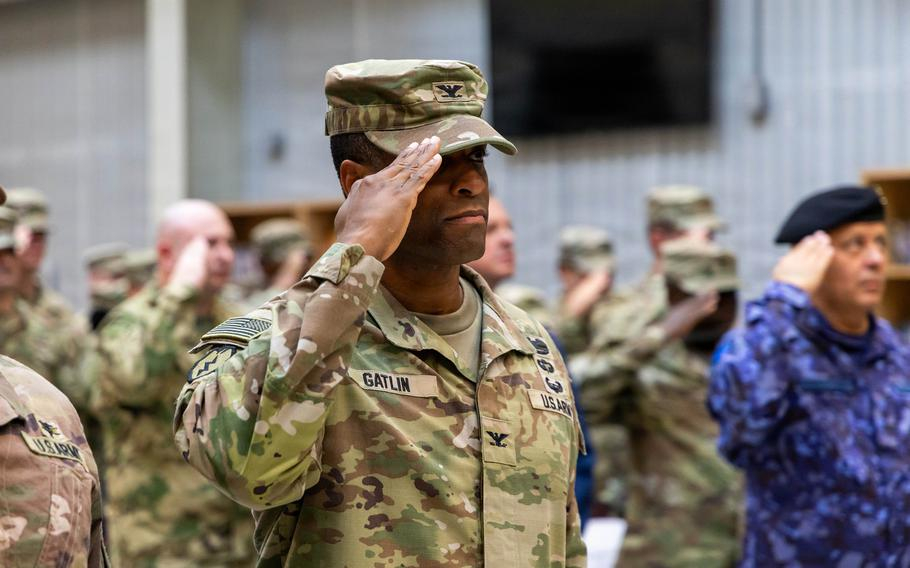
WASHINGTON DC – The Trump administration’s decision to withdraw a rotational US Army brigade from Romania and other NATO allies on Russia’s doorstep has drawn fierce criticism from veterans who see the move as a strategic blunder that weakens the alliance’s deterrence and plays directly into Russian President Vladimir Putin’s hands.
First reported by Kyiv Post on Tuesday, the decision to end the 101st Airborne Division’s deployment comes as Russian aggression in the Black Sea region surges and NATO allies face mounting pressure to stay on alert.
JOIN US ON TELEGRAM
Follow our coverage of the war on the @Kyivpost_official.
The Pentagon has framed the move as a “strategic adjustment” to free up resources for the Indo-Pacific, but critics on both sides of the aisle argue that the timing couldn’t be worse and that it contradicts the White House’s own “peace through strength” doctrine.
“Timing couldn’t be worse”
Veterans On Duty (VOD), a national security advocacy group led by former service members, issued a statement condemning the Pentagon’s decision.
Leading the charge against the withdrawal is Jeremy Hunt, a former US Army intelligence captain who served in Eastern Europe and now chairs VOD.
In an interview with Kyiv Post on Friday, Hunt warned that the decision sends a disastrous signal of American retreat at the very moment Putin is testing NATO’s resolve.
“It’s a critical piece of deterring Putin – and the timing couldn’t be any worse,” Hunt said, adding, “In the last few weeks, we’ve seen him probing the defenses of countries on the Eastern Front.”
Other Topics of Interest
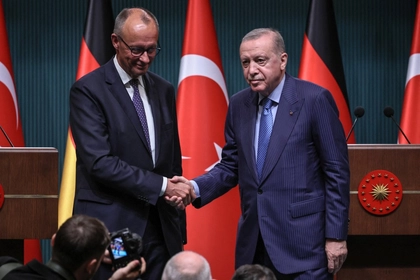
Erdoğan and Merz are Opening a New Chapter in Relations Between the Two Countries
Merz arrived in Ankara with a clear plan: to renew communication on defence cooperation. Erdoğan responded immediately by declaring that it is time for Germany and Turkey to start joint projects.”
For Hunt, American leadership is fundamentally about presence: “It’s about being there to deter and to reassure. I can’t think of another time when it’s been more important to show our allies in the region that we are here, and that we are deterring Putin at a time when he is more emboldened than ever in a lot of ways,” he emphasized.
Ultimately, he argued that the the Pentagon’s decision represents not just a tactical misstep but a symbolic retreat.
Hunt argues that US military presence in Eastern Europe has always carried dual weight: as a training force for allies and a visible warning to Moscow.
“When we were training Ukrainian forces back in 2016, it wasn’t just about tactics,” he recalled, explaining, it was a signal to Putin that the US stands firm on the sovereignty of its allies.
Pulling back now sends the opposite message – that “we’re easing our guard when Putin is more emboldened than ever,” he emphasized.
Fueling the fire, not finding peace
The 2nd Infantry Brigade Combat Team of the 101st Airborne Division, which has been stationed in Romania since 2022, will return to its home base in Kentucky with no announced replacement.
US officials have emphasized that troop levels in Poland and the Baltics will remain unchanged, but European military sources told Kyiv Post that further reductions are expected in Bulgaria, Hungary, and Slovakia by mid-December.
For veterans like Hunt, the decision risks creating a vacuum in a region already bracing for escalation.
Recent weeks have seen a spike in Russian drone and aircraft incursions into the airspace of NATO members such as Romania, Poland, and Estonia – a pattern Hunt says underscores the “immediacy” of the threat.
An invitation for miscalculation
The decision has rattled Eastern European governments already anxious about wavering US commitment to NATO.
Hunt said that removing the brigade will inevitably sow “consternation” among allies like Romania and Poland, who may now question whether Washington’s commitment to Article 5 – the cornerstone of NATO’s mutual defense pact – is ironclad.
“When we start pulling brigades, allies naturally wonder: is this the beginning of something bigger? Is this a signal of more to come?” he said. “We can’t afford that kind of uncertainty on NATO’s eastern flank – not now.”
The Pentagon has promised additional clarity in the coming weeks, but on Capitol Hill, skepticism is growing.
Several key Senators, including the Republican chairs of the Senate and House Armed Services Committees, blasted the move as one that “sends the wrong signal to Russia” and “undermines deterrence at a critical moment.”
Some US officials have privately argued that European militaries are in better shape now than they were before Russia’s full-scale invasion of Ukraine, allowing Washington to “pass the torch.”
Hunt doesn’t disagree that progress has been made – but he cautions that readiness should not be mistaken for parity.
“I applaud our European allies – Romania, in particular – for increasing defense spending and investing in their militaries,” he said, adding, however, stronger allies are not a reason to retreat – they’re a reason to double down on partnership.
“We should be reinforcing the Eastern Flank, not reducing our visibility,” he emphasized.
As the 101st Airborne prepares to depart, anxiety is rising in Bucharest, Brussels, and beyond. For veterans like Hunt, who spent years reinforcing NATO’s front lines, the decision feels less like a recalibration than an invitation for miscalculation.
“When we pull back, we give Putin room to maneuver,” Hunt concluded. “At a time when the world is watching whether the US still leads, that’s not just a bad message – it’s a disastrous one.”