
US Ambassador Tom Barrack had blunt words for Lebanon on Saturday, repeatedly calling the country a “failed state,” dubbing its leaders “dinosaurs” and saying that it probably won’t be able to comply with the central US demand that it disarm Hezbollah.
Barrack, who serves as the US envoy for Syria and the ambassador to Turkey, while also handling some diplomacy with Beirut, made the remarks in an appearance at the International Institute for Strategic Studies Manama Dialogue, a diplomatic and security conference in Bahrain.
He also repeatedly urged Lebanon and Syria to forge accords with Israel as part of what he called a greater regional “realignment.” But tensions between Israel and Lebanon have risen as Hezbollah appears to be rearming, and Israel continues to carry out strikes in southern Lebanon, targeting what it says are ceasefire violations by the terror group.
“Lebanon is a failed state,” Barrack said near the beginning of a question-and-answer session, proceeding to enumerate problems in Lebanon’s banking sector and basic infrastructure. Near the end of the appearance, he added, “You’ve had abject chaos and war for 40 years. You’ve had four failed governments… And you’ve had six wars in the time that anybody can remember. So I’m not sure what the state is.”
“So what’s the state?” he said near the beginning of the session. “The state is Hezbollah. You go south, Hezbollah gives you water. It gives you an education, gives you a stipend, has 40,000 soldiers. The LAF, Lebanese Armed Forces, has 60,000 soldiers. The only problem is that Hezbollah soldiers make $2,200 a month. The LAF soldiers make $275 a month.”
Get The Times of Israel’s Daily Edition
by email and never miss our top stories
By signing up, you agree to the terms
He went on to say that Hezbollah, a terror group that effectively controlled southern Lebanon for decades before being decimated in a 2023-2024 war with Israel, still holds some 15,000 to 20,000 rockets and missiles that threaten Israel. The United States has pressed the Lebanese government to disarm Hezbollah, and the government has committed to doing so, but Barrack said the goal was unrealistic.
“The idea of disarming Hezbollah — in our opinion, it’s not reasonable to tell Lebanon, ‘Forcibly disarm one of your political parties,’” he said. “Everybody’s scared to death to go into a civil war. The idea is, what can you do to have Hezbollah not utilize those rockets and missiles?”
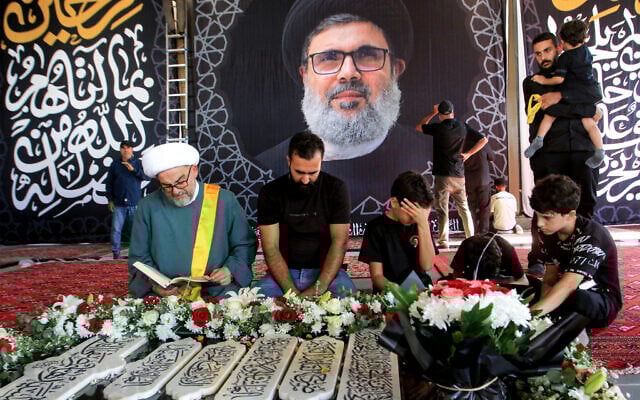
Mourners pray by the grave of Hashem Safieddine, the slain leader of Hezbollah, during a ceremony marking the first anniversary of Israel’s assassination of Safieddine alongside the group’s longtime leader Hassan Nasrallah and other officials, at Safieddine’s shrine in the town of Deir Qanoun al-Nahr near Tyre in southern Lebanon on September 27, 2025. (Mahmoud ZAYYAT / AFP)
The best path forward for Lebanon, Barrack argued repeatedly, was to begin a dialogue with Israel, with the hope of signing a diplomatic accord. He said the time was ripe for expanding regional normalization with Israel due to a variety of factors, among them the ceasefire in Gaza and the fall of Syrian dictator Bashar al-Assad last year.
In addition, he said, Israel “owes America a favor” because the US joined in Israel’s June attack on Iran’s nuclear facilities.
“You have Israel, who is sitting ready to make border and boundary agreements with all its neighbors, and it owes America a favor,” Barrack said. “You can’t say the word Israel in Lebanon… It’s illegal to have a conversation with Israel. What era are we living in?”
He added, “The Lebanese leadership today is solid. President Aoun, [Prime Minister] Nawaf [Salam], even Speaker [Nabih Mustafa] Berri. They’re trying, but they’re dinosaurs.”
“You have that conversation on the Blue Line, the Lebanon-Israel border,” he said. “You have the conversation with Syria, and in four months, you could end all of this.”
He said the model for Lebanon should be the Abraham Accords, the normalization deals signed in 2020 between Israel and several Arab countries, including Bahrain.
“It’s clear that Israel has become a dominant ally in this repositioning of the chessboard of what happens in the Middle East,” he said. “And the Abraham Accords, at least for what we have in front of us, seems to be the road that everybody needs to jump on.”
While he espoused non-violent efforts to disarm terrorists, Hezbollah-allied daily Al Akhbar reported in recent days that Barrack was warning Lebanese officials it was their “last chance” to reach an agreement with Israel.
The newspaper, citing unidentified knowledgeable sources, said Barrack had stated: “Either they learn the lesson and decide to enter into direct negotiations with Israel under the auspices of the United States, to set a timetable and mechanism for disarming Hezbollah, or Lebanon will be left to its fate, and will remain so for a long time, and no one will care about it, neither in America nor in the region, and no one will be able to pressure Israel to prevent it from doing whatever it sees fit to carry out the disarmament by force.”
The veracity of the report could not be immediately confirmed.
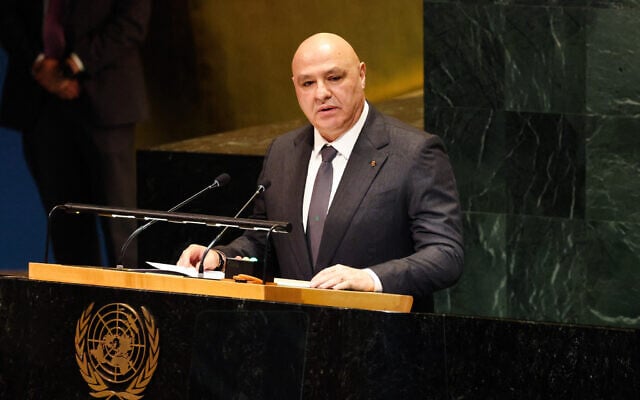
Lebanese President Joseph Aoun addresses the United Nations General Assembly at UN headquarters, in New York City, on September 23, 2025. (Ludovic MARIN / AFP)
Barrack also hailed Turkey’s role as a mediator in the Gaza war, arguing that the recent ceasefire and hostage deal wouldn’t have happened without Ankara’s efforts and pressure on Hamas.
He acknowledged the volatile relationship between Israel and Turkey, and argued that each side’s fear of the other’s perceived expansionism was unfounded.
US Envoy Tom Barrack:
The Gaza ceasefire wouldn’t have happened without Türkiye.
Its ties with Hamas—not declaring them a terrorist group—helped push the final holdouts to agree.
Israel fears Türkiye’s role due to rhetoric between Erdogan and Netanyahu, each accusing the… pic.twitter.com/L79INJo2sD
— Clash Report (@clashreport) November 1, 2025
Barrack’s statements come amid rising tensions in the border area and beyond.
Israel’s war with Hezbollah began on October 8, 2023, when the terror group began firing missiles at Israel a day after the Hamas-led onslaught in the south. It continued until a ceasefire in November 2024, with Hezbollah left severely weakened.
Since then, the Lebanese army has drawn up a plan to disarm the terror group and has reportedly expended so much ordnance to blow up Hezbollah stockpiles that it has run out of explosives. Hezbollah, which is backed by Iran, has vowed not to lay down its arms.
The IDF, meanwhile, has kept troops stationed at five points in Lebanon, and regularly strikes what it says are Hezbollah’s attempts to rearm.
But despite those efforts, Israel reportedly believes Hezbollah has managed to amass some new weapons, raising the possibility of renewed conflict. Meanwhile, Lebanon claims that Israel rejected its overture to begin talks last month on an IDF withdrawal.
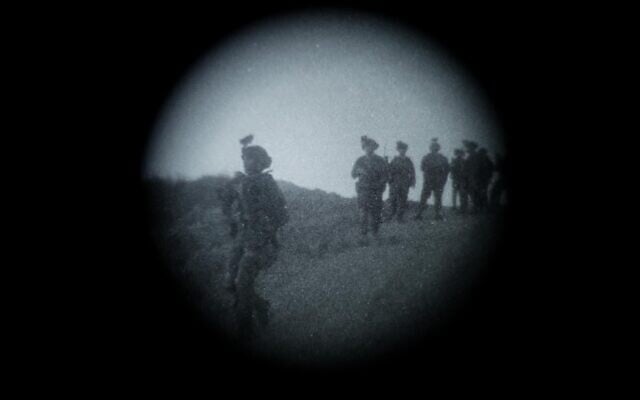
Troops of the Alon Reserve Infantry Brigade operate in the southern Lebanon town of Yaroun to demolish a building used by Hezbollah, late October 16, 2025. (Israel Defense Forces)
This is not the first time Barrack has had harsh words for Lebanon. He sparked backlash in August when he told Lebanese reporters at a press conference not to act “animalistic” and to “act civilized, act kind, act tolerant, because this is the problem with what’s happening in the region.”
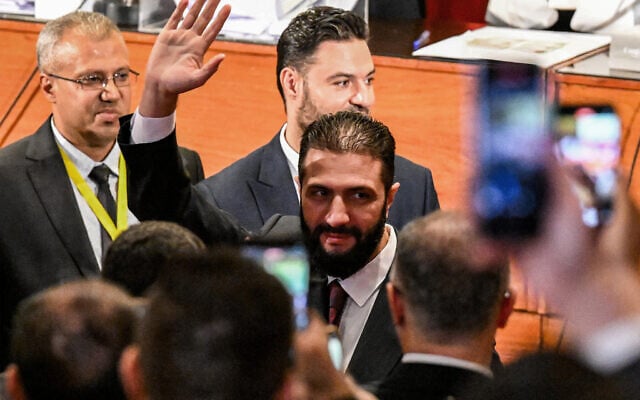
Syria’s interim President Ahmed al-Sharaa visits a polling station where members of Syrian local committees cast their votes in the country’s selection process to designate an interim parliament, in Damascus on October 5, 2025 (LOUAI BESHARA / AFP)
Barrack was more bullish on the prospects for an accord between Israel and Syria, which have engaged in successive rounds of dialogue. He praised the government of interim Syrian President Ahmed al-Sharaa, who deposed Assad.
“The Al-Sharaa regime steps into place and in 10 months is speed-dating towards something we’ve never seen, perhaps even towards the road of normalization with Israel,” Barrack said. “So, we have countries all uniting and saying, “Great, we’ve had an issue with Israel since 1928. We’ve had real issues with Israel since 1948. How do we put all that behind us?”
He added, “We’re on our fifth set of discussions with Israel, border and boundary discussions, de-escalation. You could very quickly have a realignment of a tapestry that we haven’t seen in the Middle East.”
He said Lebanon would do well to follow suit.
“It’s simple. Lebanon can do what it wants to do,” he said. “The path is very clear that it needs to be to Jerusalem or Tel Aviv for a conversation, along with Syria. Syria is showing the way. Syria will get there first.”