

Following reports on Monday that Israel was considering granting terrorists hiding in tunnels safe passage from Israeli-controlled areas of the Gaza Strip to the Hamas-run zone, a statement attributed to an “Israeli official” — often a euphemism for Prime Minister Benjamin Netanyahu’s office — said the premier “is not allowing safe passage for 200 Hamas terrorists.”
According to Israeli estimates, some 200 Hamas gunmen are currently located in the tunnels underneath the IDF-controlled parts of southern Gaza, especially in Rafah, and are unable to retreat to the Hamas-controlled areas without emerging from their tunnels and being spotted by Israeli troops.
Channel 12 news reported earlier on Monday that Israel would approve the fighters’ safe passage if they agreed to give up their weapons.
According to the outlet, IDF sources confirmed that Israel was likely to grant passage, but said they would only be allowed to pass into Hamas-controlled territory if the terror group gave up more bodies of slain hostages.
After the Channel 12 initial report was met with heavy criticism from both sides of the political spectrum, the “Israeli official” vehemently denied that Netanyahu would grant such passage to Hamas operatives stuck in Rafah.
Get The Times of Israel’s Daily Edition
by email and never miss our top stories
By signing up, you agree to the terms
“The prime minister persists in his firm stance on the disarmament of Hamas and the demilitarization of the Strip while eliminating terrorist threats to our forces,” said the official.
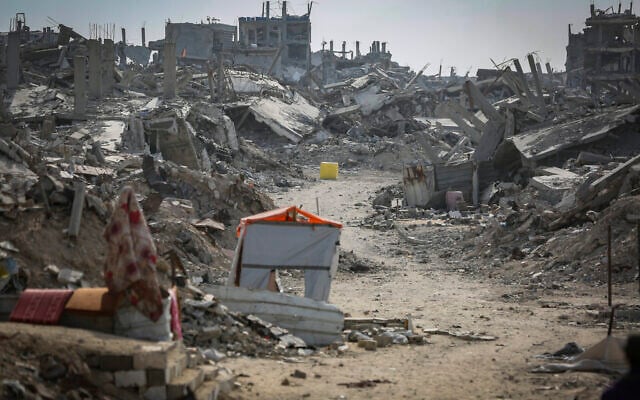
A yellow concrete block demarcating the Yellow Line, the line of ceasefire, east of Jabalia in the northern Gaza Strip, November 2, 2025 (Fathi Ibrahim/Flash90)
‘Utter madness’: Politicians from both sides of aisle decry report
“Mr. Prime Minister,” wrote Finance Minister Bezalel Smotrich on X about his opposition to the reported plan before the official’s denial. “This is utter madness. Stop this.”
Fellow party member Orit Strock, the settlement and national missions minister, also took to X, calling the reported plan a disgrace and saying it would be “turning our back on the fallen, the soldiers and the war’s objectives.”
National Security Minister Itamar Ben Gvir also railed against the report, saying he was “demanding that all 200 terrorists who are beyond the Yellow Line be killed or imprisoned.”
The far-right minister called their presence in the IDF-controlled area “an opportunity to destroy or arrest” them, demanding that they not be released “under ridiculous conditions.”

National Security Minister Itamar Ben Gvir (left) with MK Zvika Fogel at a National Security Committee meeting at the Knesset, November 3, 2025. (Chaim Goldberg/Flash90)
Criticism also came from the opposition, with Blue and White party leader Benny Gantz saying such a plan would mean “we’ve gone back to October 6,” the day before Hamas’s massive onslaught on Israel in 2023 — meaning, to the faulty strategic stance minimizing the threat posed by Hamas.
“The terrorists outside of Gaza City violated the ceasefire, and some of them have taken part in attacks against our soldiers,” Gantz wrote on X. “We mustn’t let them out of the tunnels and reorganize — especially not when we still have hostages in Gaza.”
Yisrael Beytenu party leader Avigdor Liberman said the plan was “total insanity from a weak and pressured government” and that it couldn’t be allowed to happen.
“They’re letting the terrorists who murdered us free passage and a governmental license to keep committing terrorism,” he wrote on X.
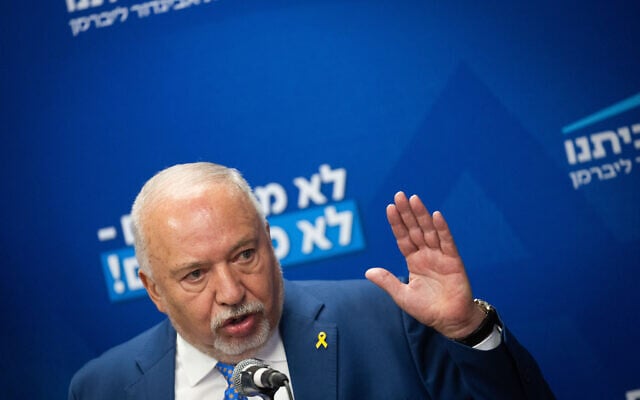
Yisrael Beiteinu party chairman MK Avigdor Liberman leads a faction meeting at the Knesset, the Israeli parliament in Jerusalem, on October 27, 2025. (Yonatan Sindel/Flash90)
Former prime minister Naftali Bennett also weighed in, saying the report “is unprecedented even on a global level.”
“IDF soldiers managed to trap dozens of terrorists in tunnels in the Rafah sector. Their choice is to surrender or die,” Bennett wrote on X.
“These are terrorists with blood on their hands. Some of them probably raided Israel on October 7, while others only recently murdered three of our precious sons,” he said, referring to recent deadly incidents in Rafah where Hamas operatives killed three IDF soldiers on the Israeli side of the Yellow Line.
‘Yellow Line’ troubles
Meanwhile, the IDF on Monday said it killed several terror operatives who crossed the Yellow Line and approached troops in the southern Gaza Strip earlier in the day.
The operatives had “posed an immediate threat” to the forces stationed in the area, the military said, adding that shortly after they were identified, the Israeli Air Force struck and killed them “to remove the threat.” The IDF said it remains deployed in Gaza “in accordance with the ceasefire agreement and will continue to operate to remove any immediate threat.”
The Yellow Line marks the roughly 53 percent of the Strip controlled by the IDF after its initial October 10 withdrawal as part of the ceasefire. While the IDF-held areas are largely empty, Israel believes that some “pockets” of Hamas operatives remain underground, especially in Rafah, and that they have been there since before the ceasefire.
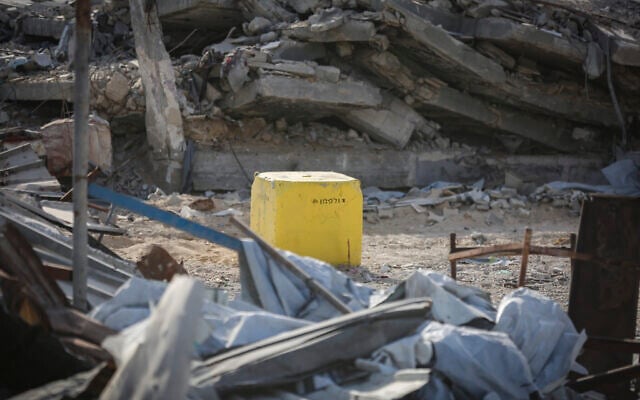
A yellow concrete block demarcating the ceasefire line, east of Jabalia in the northern Gaza Strip, November 2, 2025 (Fathi Ibrahim/Flash90)
A source familiar with the matter told The Times of Israel that the demarcation had not been fully enforced to date and that it was not always clear to troops on the ground where the line ran in various parts of Gaza, given that it was only drawn up several weeks ago for the ceasefire deal.
On Wednesday, Egyptian and Qatari mediators had notified Hamas that the group had 24 hours to evacuate its fighters or risk being exposed to IDF fire, a US official told The Times of Israel. That deadline expired on Thursday evening, at which point Israel had the approval of the US, Egypt and Qatar to engage Hamas targets on the Israeli side of the Yellow Line, the US official said.
Israel had already publicly warned Hamas operatives holed up on the eastern side of the Yellow Line to withdraw last week. The military has assessed that there are Hamas operatives still in the terror group’s tunnels in areas under IDF control, and that they have been there since before the ceasefire.
Two deadly attacks on Israeli troops in Rafah during the ceasefire were carried out by terror operatives. Hamas denied responsibility, saying “communication has been cut off” with its operatives in zones under Israeli control. Israel accused Hamas in both cases of violating the ceasefire.
After the latest attack on Tuesday, the IDF launched a series of strikes that killed over 100 people, according to Hamas, before saying on Wednesday that it was resuming the ceasefire.
You appreciate our journalism

You clearly find our careful reporting valuable, in a time when facts are often distorted and news coverage often lacks context.
Your support is essential to continue our work. We want to continue delivering the professional journalism you value, even as the demands on our newsroom have grown dramatically since October 7.
So today, please consider joining our reader support group, The Times of Israel Community. For as little as $6 a month you’ll become our partners while enjoying The Times of Israel AD-FREE, as well as accessing exclusive content available only to Times of Israel Community members.
Thank you,
David Horovitz, Founding Editor of The Times of Israel