
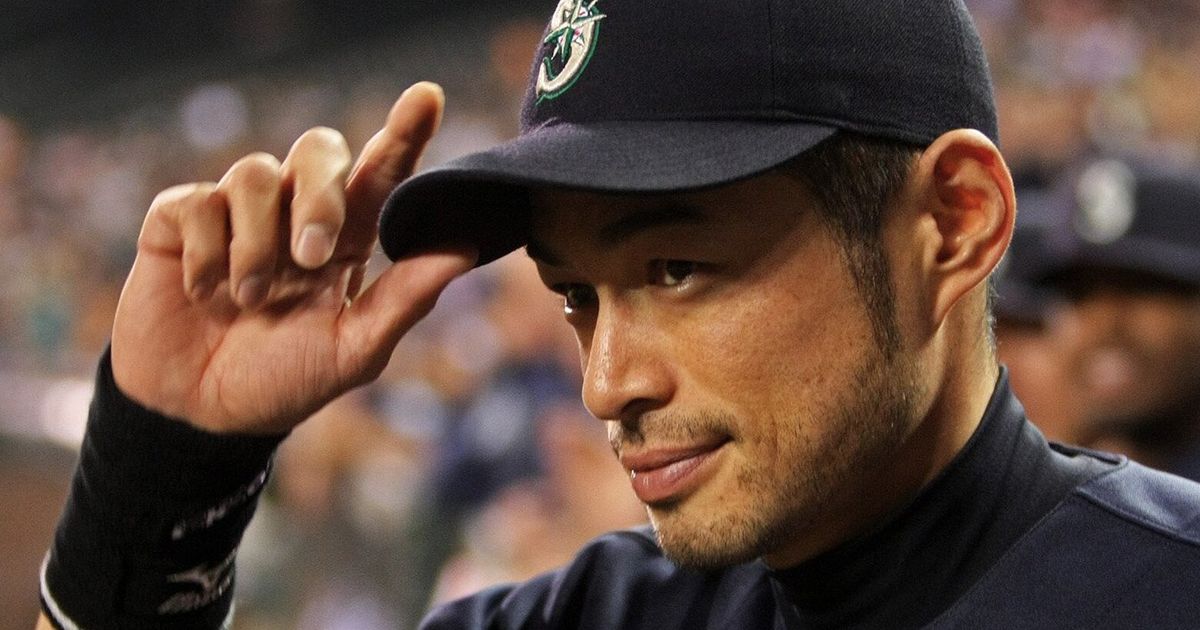
Ichiro arrived in Seattle in 2001, via Peoria, Ariz., as an enigma wrapped in flashy outfits. No Japanese position player had conquered Major League Baseball, and significant doubt throughout the league surrounded his ability to do so, despite glittering credentials and demigod status in Japan.
He goes into the Baseball Hall of Fame on Sunday with an impeccable body of work that long ago emphatically solved the mystery of his MLB worthiness in the affirmative. You probably can remove the “demi” qualifier in his homeland. Yet to some non-Japanese-speaking observers, Ichiro remains an enigma, with two-plus decades of translated interviews obscuring a personality that teammates will tell you is just as singular and robust as his skill set.
We came to first respect and then revere his game, the idiosyncratic style of slap and splendor that was an absolute revelation (or revolution) in the heart of the steroid era. But the meaning of Ichiro, to cite the 2004 book title by Robert Whiting? That remains far more elusive to some.
I can’t tell you that I knew Ichiro in any intimate way, because he didn’t allow many to break through the barriers he willfully put up, mostly for self-preservation.
This is a man, after all, who was scrutinized to an almost absurd level by the Japanese media, which in that initial spring of 2001 found profound meaning in the number of swings Ichiro took in batting practice. But having been there for the entirety of Ichiro’s two Mariners stints, 14 total years’ worth with countless one-on-one interviews in that span and beyond, I feel I at least got a measure of the man.
read more
ichiro’s hall of fame induction
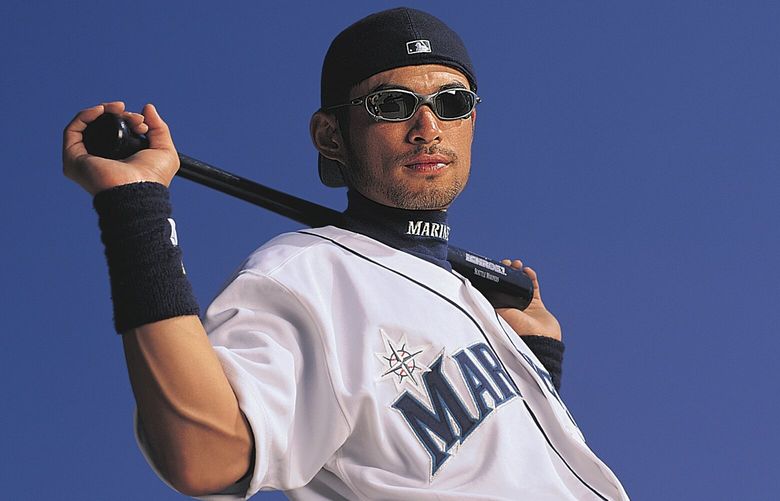
More
All the cliches about Ichiro’s maniacal work ethic, unyielding devotion to routine and painstaking care of his equipment were absolutely true.
He could be quite brusque in interview settings, sometimes sitting on a stool with his back to the gathered media after games, fanning himself while practically inside his locker and staring straight ahead as he answered questions. But he could also be amazingly insightful and dryly hilarious, when he put his mind to it.
His quote about going to Cleveland for a makeup game — “If I ever saw myself saying I’m excited going to Cleveland, I’d punch myself in the face, because I’m lying”— is an Ichiro classic, but there were countless others over the years, often dropped nonchalantly into otherwise mundane interviews.
I often felt that the quality of his quips and insights was largely dependent on the whim of his translators, some of whom seemed intent on dumbing down (or boring down) his comments.
Not many ballplayers over my four decades of sportswriting dropped wisdom like this: “Each hit has its own character. No pitch is ever the same, so no hit is ever the same.” Also: “When I am hitting well, I feel as if I hit the ball with my body before I hit it with the bat.”
Once, when it was pointed out to Ichiro that he had homered at will in batting practice, so why couldn’t he produce more power in the game, he replied, “In batting practice, every pitch is 3-0.”
Ichiro seemed to dig particularly deep into his soul at the All-Star Game. I covered all 10 of his Mariners appearances and came to call his obligatory media sessions “the state of Ichiro address” because of the depth of his answers.
One year, he obliquely likened the Mariners organization to a tree with diseased roots, causing a bit of a furor and a guessing game about what (and especially who) he was referring to. A contract extension was announced during the 2007 All-Star Game, just two weeks after the mysterious resignation of manager Mike Hargrove, with whom Ichiro reportedly clashed. Ichiro went on to be the most valuable player of the game that year in San Francisco after hitting the first and still only inside-the-park home run in All-Star history.
The day before the 2008 All-Star Game at Yankee Stadium, Ichiro’s 45-minute media availability was dominated by the Japanese reporters, with answers that weren’t translated. The English-speaking press was traditionally allotted half the time, but that year, we were given maybe five minutes. I was visibly upset, worried about how I was going to produce the story my newspaper expected. When the clubhouse opened a short while later before the American League workout, I entered to work on other interviews I needed. Ichiro called my name and waved me over to his locker. Through his interpreter, he apologized for cutting me short during the earlier session. He told me he would give me all the time I needed right then. And that’s what he did for half an hour, a delightful interview that allowed me to write a thorough and compelling story. When other reporters approached Ichiro at his locker, he waved them off until I had all I needed.
That was a prime example of another side of Ichiro that not many people got to see. He had a reputation for being aloof with the media, but in my experience, he could be friendly and accommodating when he got to know you.
I feel more grace should have been given to the tremendous amount of pressure Ichiro faced throughout his career, starting with the immense burden of proving that a Japanese position player could indeed succeed in MLB. There was considerable skepticism from the baseball establishment, much of it emanating within the Mariners organization; specifically, in the manager’s office of Lou Piniella.
The story of Piniella fretting over Ichiro’s inability to drive the ball in spring training is an essential part of the Ichiro canon, as is his breakout game when he drove a ball deep into the right-field berm at Peoria Stadium and said to Piniella, “Is that turning on the ball, Skip?”
But Ichiro knew what was at stake if he succeeded … and especially if he didn’t. As he said in January upon being voted into the Hall of Fame with all but one vote of the Baseball Writers’ Association of America: “I had just finished seven years of being the leading hitter in that league coming over. I felt like there was going to be judgment on especially the hitter that hit for a high average. I felt like there was going to be judgment on Japanese baseball. And so there was definitely that pressure. I knew that how I performed was going to be really looked at as, ‘This is Japanese baseball.’ “
Even when he proved beyond a shadow of a doubt that Japanese baseball translated in dazzling fashion — at least, his version did — the pressure merely shifted. Now he had to sustain that success. In 2003, when Ichiro suffered a late-season slump that caused him to lose 26 points off his batting average, he told the Seattle Post-Intelligencer’s John Hickey, “I felt nauseated, sick. Sometimes I felt short of breath. Those kinds of things had never happened to me before, so it was tough to handle.”
The pursuit of the all-time hits record in 2004 seemed to weigh on him (although not enough to thwart him), and in 2009 Ichiro missed the first two weeks of the season because of a bleeding ulcer, his first stint on the disabled list (now called the injured list). Team doctor Mitch Storey said the stress of playing in the World Baseball Classic for Team Japan could have been a contributing factor.
Ichiro was often described, somewhat stereotypically, as “inscrutable” or “impervious,” but I think that underplays just how deep his drive was to succeed. As he once said, “Every day I’m nervous. There is no day when I’m not nervous, but I might not show it on the outside.”
The sheer amount of will it took to conquer MLB should be a key part of the Ichiro story. It was fascinating as well to see his evolution in the eyes of his teammates.
Initially, the relationship was marked by affectionate interaction as they taught him all the English dirty words and offbeat phrases like, “What’s up, home slice?” that were hilarious when incongruously uttered by Ichiro. The 2001 team, and the others that followed, fully embraced the newcomer and, of course, reveled in his unorthodox style of play.
“Other hitters see fielders. Ichiro sees holes,” said Hall of Famer Paul Molitor, the Mariners’ hitting coach during Ichiro’s 262-hit season of 2004.
When the Mariners’ success waned in the mid-2000s and the nucleus of the 2001 juggernaut slowly departed, the next wave of players wasn’t nearly as accepting. Some chafed at Ichiro’s style of play, scoffing at his refusal to dive after balls or run into walls (criticisms, by the way, that Ichiro systematically countered in a long interview I did with him). They felt he was too protective of his 200-hit streak (at the expense of providing power) and that he wouldn’t always steal a base when the team needed it over fear of being thrown out.
In 2008, Seattle Times beat writer Geoff Baker quoted a clubhouse insider: “I just can’t believe the number of guys who really dislike him. It got to a point early on when I thought they were going to get together and go after him.”
But by the time Ichiro returned to Seattle in 2018, after stints in New York and Miami, all remnants of resentment were long gone, and Ichiro had morphed into a beloved elder statesman, manifested most poignantly by the outpouring of love and tears when he trotted off the field for the final time in Tokyo.
I have a feeling those emotions will be replicated this weekend in Cooperstown. If he’s still a mystery to some, he’s now an enigma wrapped in history.
Larry Stone: lstone@seattletimes.com. Longtime columnist Larry Stone, a three-time winner of the Washington Sportswriter of the Year Award, retired from The Seattle Times in 2023. He is a past president of the Baseball Writers’ Association of America and co-authored the autobiography of Mariners Hall of Famer Edgar Martinez.