
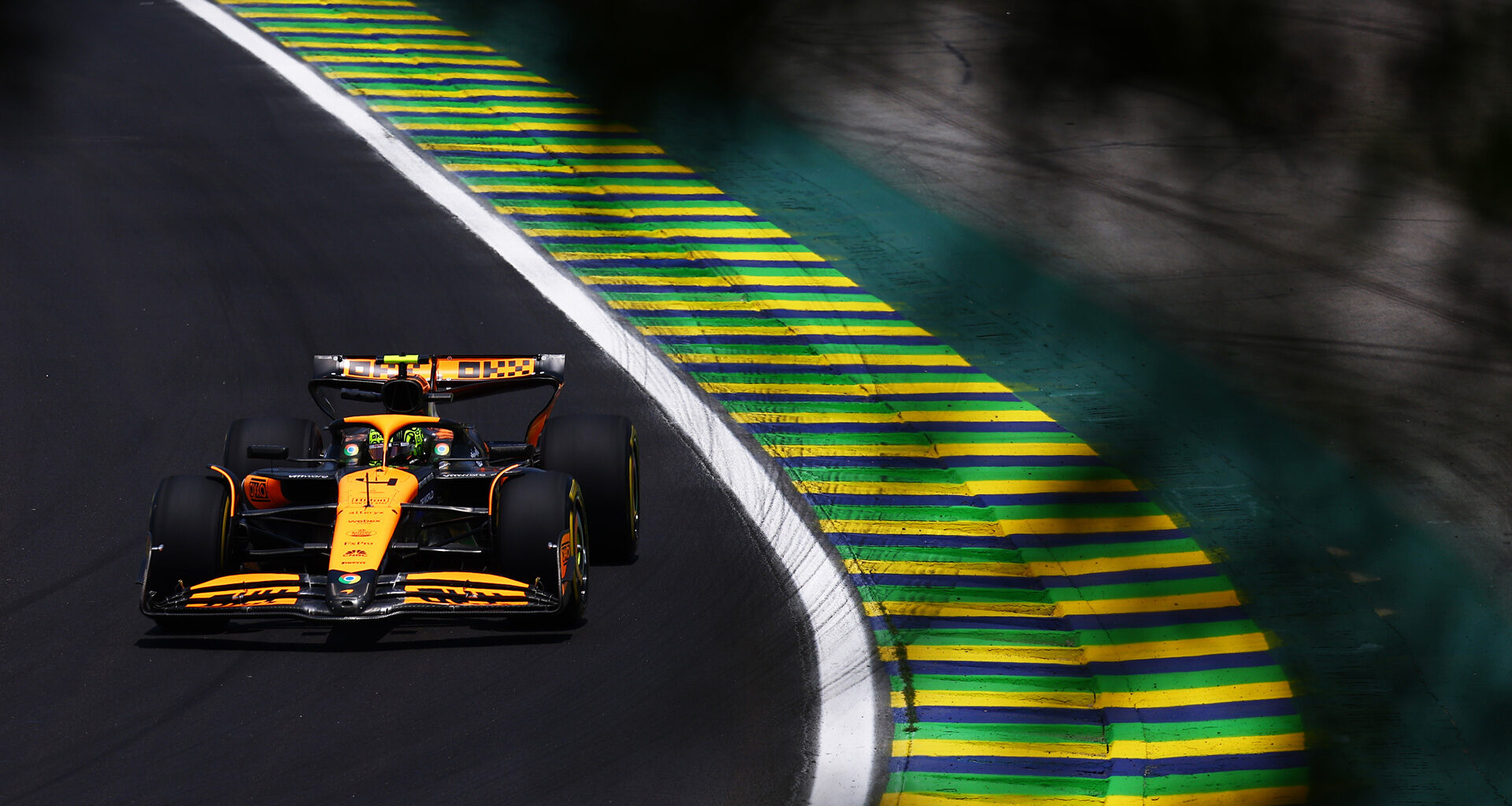
What are the challenges?
The Autódromo José Carlos Pace provides a demanding and highly physical lap. Coming off the back of another gruelling race in Mexico City, the drivers arrive well-prepared for the challenge, but Interlagos has its own unique tests.
While its altitude of 800 metres above sea level is far lower than Mexico City’s Autódromo Hermanos Rodríguez, it’s still higher than any other circuit on the calendar.
Although the impact is less significant, the high altitude makes it an exhausting lap, with less oxygen in the air. It also impacts the aerodynamic performance, reducing downforce and grip while placing greater stress on the turbo and cooling systems.
It’s also a relatively short track, at 4.309km, which impacts racing more than you might expect. Like racing at high altitude, there is a greater demand placed on cooling, as drivers are braking and accelerating more frequently than on longer tracks, where the gaps between corners are larger.
At shorter tracks, there is less room and fewer opportunities to gain time, meaning the field often runs closely together, and getting stuck in dirty air becomes a real challenge. With roughly 68% of the lap taken at full throttle, it’s an intense and physically draining lap for those inside the car.
Despite a recent resurfacing, Interlagos remains notoriously bumpy, which adds to the track’s physicality – as do the banked corners, which increase the vertical G-forces on entry and exit.
The season so far
Lando achieved his 10th win and our 13th of the season last time out in Mexico. It was a good recovery drive from Oscar, with the Aussie finishing 5th.
With four races remaining, Lando leads the Drivers’ standings, with Oscar behind by one point in second.