
More from this theme
Recent articles
The government is proposing sweeping reforms to progress 8, the main league table measure for secondary schools, in a bid to boost arts take-up – and will ditch the EBacc from this academic year.
However ministers’ response to the curriculum and assessment review, published this morning, ignores Professor Becky Francis’s recommendation that the subject make-up of progress 8 be left alone.
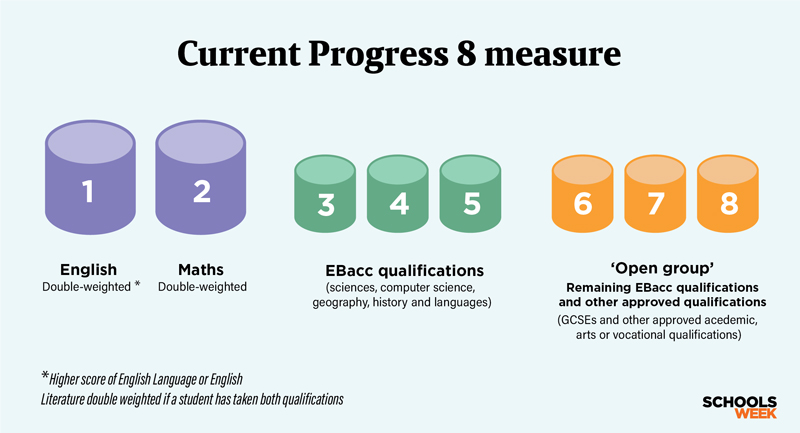
At present, schools are given a progress score based on pupils’ improvement since primary school in eight subject “buckets”.
The first two are English and maths, and three more have to be EBacc subjects – including sciences, languages or humanities. The remaining three are “open” buckets for any other qualifications.
But ministers have announced this week they will scrap the EBacc with immediate effect, meaning it won’t appear in league tables for next summer’s GCSEs.
The government has also announced it will “develop and consult on an improved version of progress 8 and attainment 8 that balances a strong academic core with breadth and student choice”.
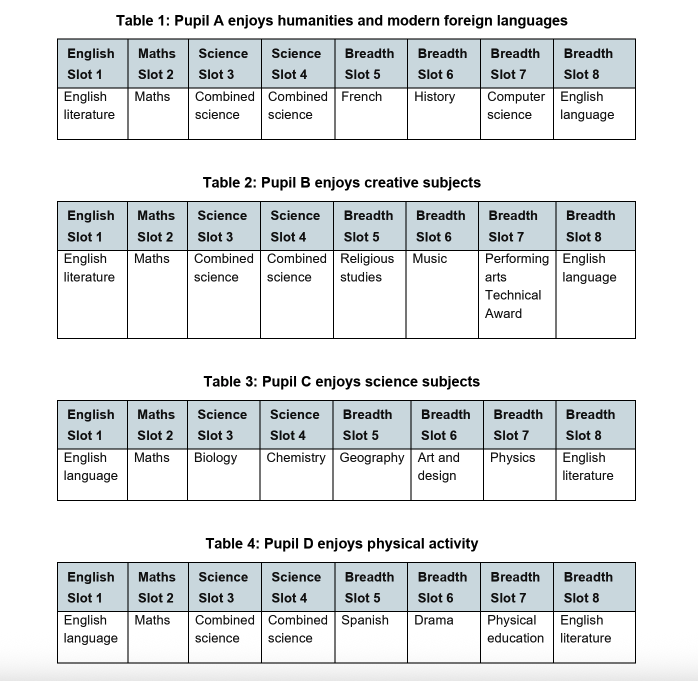
Under the government’s proposal, English and maths will remain the first two buckets, but two buckets will be created specifically for science qualifications, including double science, the separate sciences and computing.
New ‘breadth’ buckets
The remaining four would be new “breadth” buckets, and these would have to include a subject from two of the three categories of humanities, creative subjects and languages.
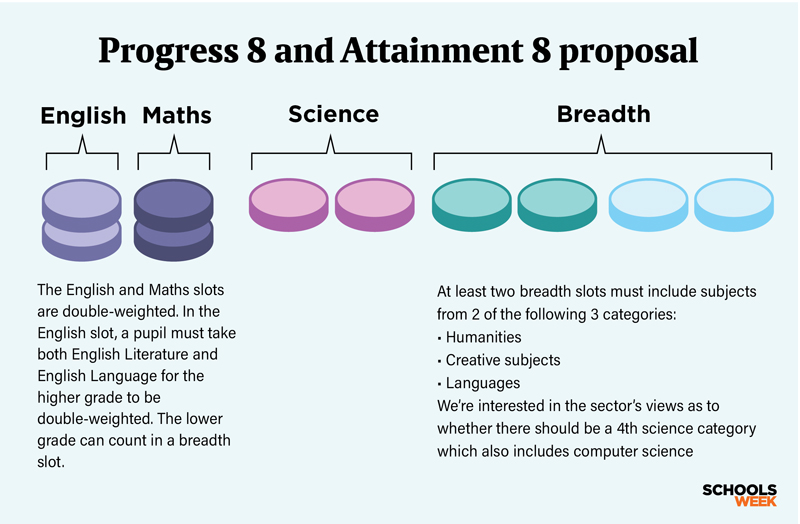
The Department for Education said it would also seek views on the need for fourth category of science subjects, which would “allow more choice and specialisation in science”.
But the department said it was “also mindful it may weaken the incentives to study a broad curriculum and subjects from the other three categories”. Government is also proposing that design and technology move from the creative to science category.
The government said it was “essential that all students retain this academic core, but we believe the current structure has hampered progress in subjects which strengthen our economy and society, for example the arts”.
The government will “consult in due course” and publish its response in the summer term next year “so that schools can take the revised measure into account when determining subject choices for pupils who will start their GCSEs in September 2027”.
DfE diverges from review recommendations
The proposals for progress 8 reform represent a divergence from Francis’s recommendations.
Her review stated that “our view remains that it supports both students’ progress and curriculum breadth.
“We therefore recommend making no changes to the structure of progress 8 or the composition of the ‘buckets’.
We recommend only that the ‘EBacc’ bucket is renamed ‘academic breadth’.”
DfE goes its own way on year 8 tests
The DfE has also not fully accepted Francis’s recommendation that new diagnostic test in English and maths be brought in for year 8 pupils.
Instead it is focusing on its previously-announced plan to create a mandatory reading check in the second year of secondary school.
The DfE also said it would “expect all schools to assess pupil progress in writing and maths in year 8 and will support them to select the right products to do this”.
Elsewhere, the government response also goes further than Francis’s reviews on languages, stating that it will also “explore the feasibility of developing a new qualification which enables all pupils to have their achievements acknowledged when they are ready rather than at fixed points.
“We will learn from models such as the Languages Ladder, which supported and recognised progress in languages. We will optimise the use of technology to minimise teacher workload and make assessment more engaging for pupils.
“We are working closely with stakeholders to establish the viability of such a qualification, making sure it meets the needs of schools and pupils, before making any decision on whether to introduce it.”
The response also pledges to “explore introducing a new level 3 qualification in data science and AI, to ensure that more young people can secure high value skills for the future and that we cement the UK’s position as a global leader in AI and technology”.
Neither qualification was recommended in the review.
Helen Hayes, education select committee chair, said she was “concerned that in a number of areas, the government’s approach differs” from the “independent, evidence-based recommendations”.
“It is important that government set out why this is the case and their own evidence that they have relied on in reaching a different conclusion.”