
The northern lights and southern lights could receive a considerable boost again tonight as Earth braces for impact from a powerful coronal mass ejection (CME) hurled from the sun during yesterday’s M7.4 solar flare.
The speedy CME is forecast to arrive late tonight or early Friday (Nov. 7) morning (UTC) and could trigger strong (G3) geomagnetic storm conditions, according to NOAA’s Space Weather Prediction Center. This follows a surprise round of auroras overnight when a glancing CME arrival combined with lingering effects from a high-speed solar wind stream, and pushed geomagnetic activity to G3 levels, sparking auroras across the northern U.S., Canada and Europe.
You may like
Space weather physicist Tamitha Skov described the current forecast as “an aurora photographer’s dream starting now and lasting at least through the weekend,” adding that G3 to G4 storm levels are possible by Friday as multiple CMEs interact with Earth’s magnetic field.
A whole train of big #solarstorms are on their way, along with some smaller storms hitting now, and some fast solar wind! It is an #aurora photographers dream starting now and lasting at least through the weekend. Right now, the biggest of the storms should hit late Thursday or… pic.twitter.com/OL50yH72y7November 5, 2025
Where and when can you see the northern lights tonight?
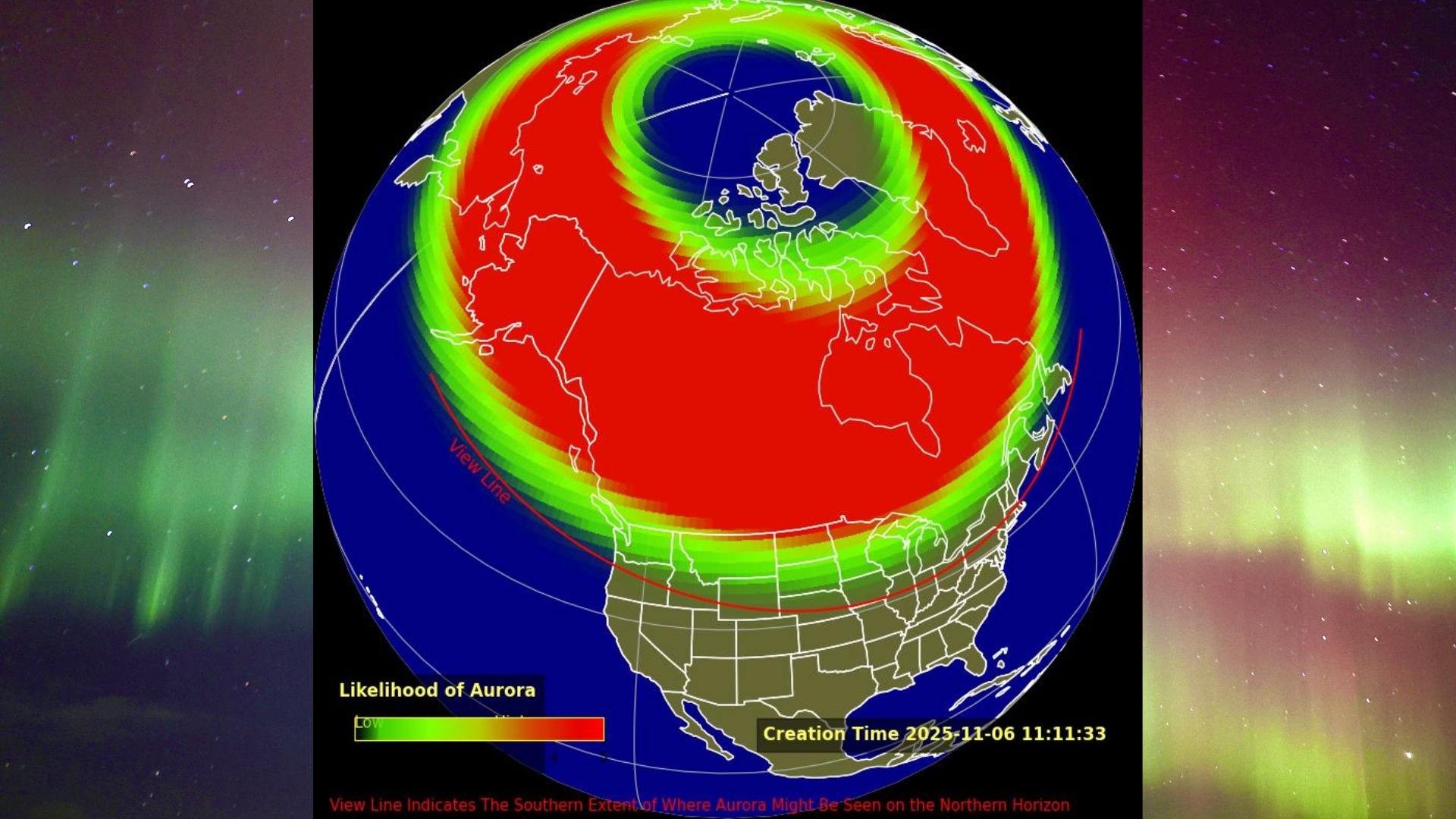
Aurora forecast for tonight (Nov. 6) courtesy of NOAA. (Image credit: Map: NOAA SWPC, northern lights: Daisy Dobrijevic)
According to NOAA’s Kp index forecast, geomagnetic storming is expected to last between Nov 6 and Nov. 7, with the highest activity predicted for tonight.
Based on the latest NOAA aurora forecast map, the following 22 U.S. States appear fully or partially above the aurora view line:
AlaskaWashingtonOregonIdahoMontanaWyomingNorth DakotaSouth DakotaNebraskaMinnesotaIowaWisconsinIllinoisIndianaOhioMichiganNew YorkPennsylvaniaVermontNew HampshireMassachusettsMaine
But remember, that auroras are highly unpredictable, so even if you’re within the view line, you’ll still need cloud-free skies, minimal light pollution, a clear view northward and a little bit of luck to catch the show.
Northern Hemisphere aurora forecast courtesy of the Met OfficeHow to see the northern lights where you live
If you’re in one of the 22 U.S. states listed above, here are some tips for catching a glimpse of the display.
Head to a dark location far from city lights and light pollution.Find a north-facing view with a clear horizon.Look up around midnight to 2 a.m. local time, but keep watch as soon as skies darken.Be patient. Auroras often come in waves and can appear faint at first.
We recommend downloading a space weather app that provides aurora forecasts based on your location. One option I use is “My Aurora Forecast & Alerts,” available for both iOS and Android. However, any similar app should work well. I also use the “Space Weather Live” app, which is available on iOS and Android, to get a deeper understanding of whether the current space weather conditions are favorable for aurora sightings.
What’s causing the aurora activity?
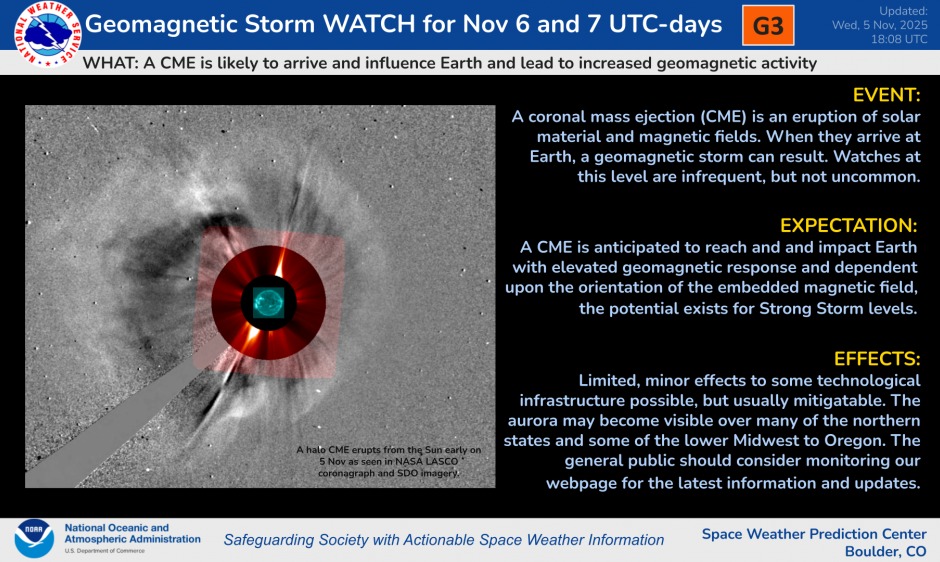
NOAA’s G3 storm watch for Nov 6 and Nov. 7. (Image credit: NOAA Space Weather Prediction Center)
Tonight’s storm is being driven by a CME launched by an M7.4 solar flare on Nov. 5 from active region AR4274 — a large and magnetically complex sunspot that continues to rotate into better view of Earth. The CME is traveling at speeds of 1,100 to 1,400 km/s (around 2.5–3.1 million mph) and is expected to arrive late Nov. 6 or early Nov. 7 (UTC). It follows an earlier CME that likely triggered the overnight storm, which combined with lingering fast solar wind to temporarily push Earth’s magnetic field to G3 conditions.
You may like
Solar wind is expected to remain elevated over the next couple of days due to a mix of CME activity and incoming coronal hole high-speed streams according to NOAA forecasters. The current G3 geomagnetic storm watch reflects a moderate to high level of confidence in timing, but the actual intensity will depend on the speed and magnetic field orientation of the CME when it reaches Earth.
What else could be coming?
Region AR4274 remains highly active and is still rotating to directly face Earth. Multiple significant flares have erupted from this region over the past 48 hours, some with associated CMEs still being analyzed. The U.K. Met Office warns that elevated geomagnetic activity could continue into the weekend and even into Nov. 9, especially if additional CMEs are launched in Earth‘s direction.
NOAA also notes that another flare from the same region (an M8.6) may have produced an additional CME, which could result in further storming depending on how it interacts with solar wind conditions.
If you’re an aurora enthusiast, keep your camera batteries charged; the show may be far from over.