
Unlock the Editor’s Digest for free
Roula Khalaf, Editor of the FT, selects her favourite stories in this weekly newsletter.
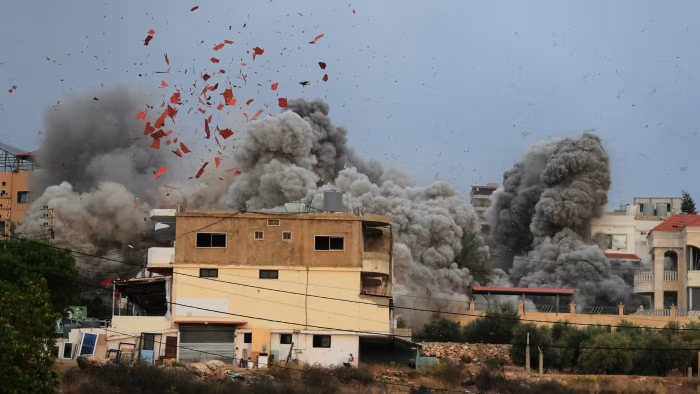
Israeli jets carried out a wave of heavy strikes on southern Lebanon on Thursday as Israel’s military accused militant group Hizbollah of seeking to rebuild its capabilities in the area.
The strikes, part of a broader intensification of Israeli activity in recent weeks, have given further fuel to fears in Lebanon that Israel and Hizbollah could be heading towards a renewed escalation of hostilities.
The two sides finally agreed to a US-brokered ceasefire last November after a year of cross-border exchanges that began when Hizbollah began firing at Israel in the wake of Hamas’s October 7 attack on Israel escalated into a two-month ground war.
But Israel has continued to carry out near-daily strikes in its northern neighbour despite the truce, and Prime Minister Benjamin Netanyahu warned earlier this week that Israel was prepared to ratchet up its strikes further if the Lebanese army did not do more to disarm Hizbollah.
The Israeli military said the strikes on Thursday targeted Hizbollah assets, including a site making equipment for the militant group. It issued a string of evacuation orders for buildings in Tayba, Tayr Debba — which lies east of the coastal city of Tyre — Aita al-Jabal and Zawtar al-Sharqiyah.
There were no immediate reports from Lebanese authorities of casualties caused by Israel’s strikes.
Hizbollah suffered the worst battering in its history in last year’s war with Israel, which left swaths of Lebanon in ruins.
Under the terms of the truce brokered by the Biden administration last November, Hizbollah agreed to withdraw its fighters and assets behind the Litani river, which runs 40km from Lebanon’s southern border with Israel.
The militant group has not opposed the Lebanese army’s efforts to dismantle its infrastructure and weapons caches in the south. But it has resisted pressure from Israel and the Trump administration to give up its weapons completely, stating that the ceasefire only applies to southern Lebanon.
Recommended

In a statement earlier on Thursday, Hizbollah said that it remained committed to the ceasefire, but had a “legitimate right to resist Israeli occupation”, and was not required to be drawn into political negotiations with Israel.
The statement followed comments by Lebanon’s President Joseph Aoun who — while critical of Israel’s actions — has said he is open to negotiations with Israel to ease the tensions.
There has been mounting anger in Lebanon at the repeated Israeli attacks since the ceasefire, which have killed hundreds of people — including more than 100 civilians, according to a recent UN tally.
In addition to its air strikes, Israel has also continued to occupy a handful of military outposts inside southern Lebanon, and has also carried out cross-border raids into the country, including one last week that killed a municipal worker in Blida in southern Lebanon.