
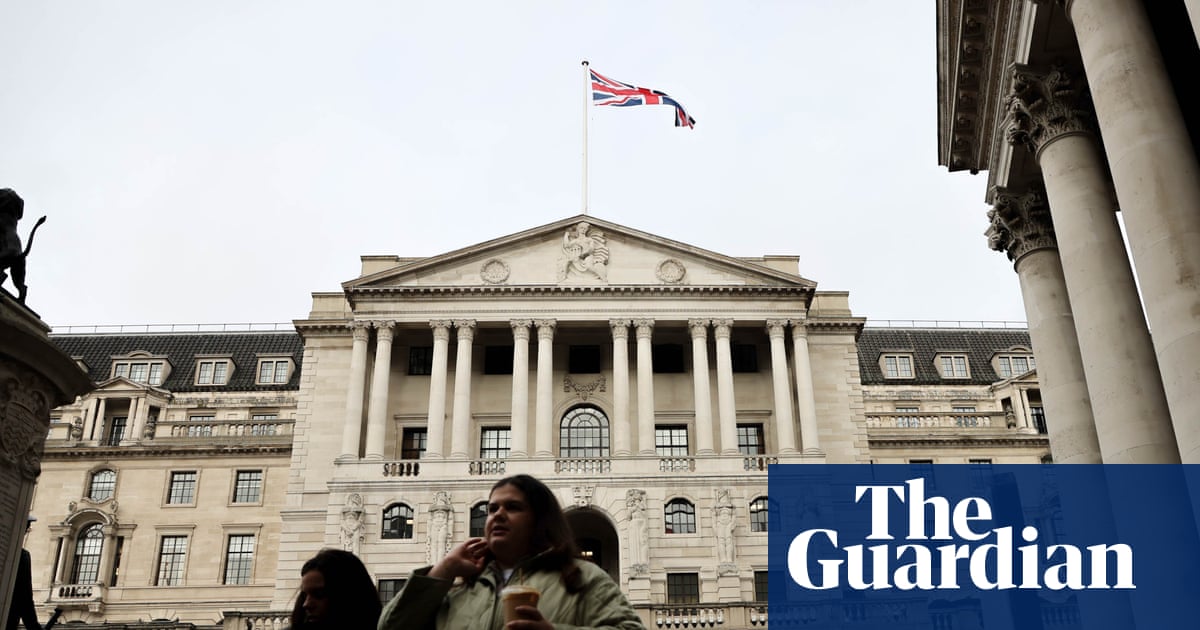
The Bank of England has opened the door to a December interest rate cut after signalling that inflation had peaked, as it kept borrowing costs unchanged before Rachel Reeves’s make-or-break budget.
With less than three weeks before the chancellor’s tax and spending statement, the Bank’s monetary policy committee (MPC) voted by a narrow five-four majority to keep borrowing costs unchanged for a second consecutive meeting.
However, City economists said the knife-edge decision and the Bank’s latest predictions for a fall in inflation from 3.8% would pave the way for the Bank to cut rates after the budget.
Holding the casting vote, Andrew Bailey, the Bank’s governor, said he wanted to “wait and see” whether inflationary pressures would continue to fade and if Reeves’s budget would have an impact.
“We held interest rates at 4% today. We still think rates are on a gradual path downwards, but we need to be sure that inflation is on track to return to our 2% target before we cut them again,” he said.
Borrowing costs have been cut five times since Labour came to power in July 2024, easing pressure on households and businesses, with the last reduction made in August. Meanwhile, inflation is running at 3.8% – almost twice the Bank’s 2% target.
In her 26 November fiscal statement the chancellor is expected to increase taxes, potentially slowing the economy, alongside measures taking action against the rising cost of living.
Reeves welcomed the Bank’s updated forecast showing inflation falling back at a faster-than-anticipated rate. “At the budget later this month I will take the fair choices that are necessary to build the strong foundations for our economy so we can continue to cut waiting lists, cut the national debt and cut the cost of living,” she said.
After the vote to hold, which was closer than the City expected, Bailey suggested the MPC would have an “opportunity to consider the budget” before its 18 December meeting. Financial markets shifted after the vote to indicate an almost 60% chance of a quarter-point reduction in rates next month.
Economists said tax increases could encourage Threadneedle Street to take action. “There is a plausible case for even weaker demand, hence pushing inflation lower from 2026,” said Janet Mui, the head of market analysis at the wealth manager RBC Brewin Dolphin.
“[We will] only get more clarity post-budget, and governor Bailey’s vote will be crucial. Overall, markets believe the BoE has opened the door for a rate cut in December and has priced in that happening.”
Five members of the MPC voted to keep rates unchanged at 4%, including Bailey, while a minority of four pushed for a quarter-point reduction.
Expressing growing concern over the strength of the economy, the Bank said unemployment was poised to climb to a higher peak above 5% early next year – from 4.8% now – amid subdued hiring demand.
skip past newsletter promotion
Sign up to Business Today
Get set for the working day – we’ll point you to all the business news and analysis you need every morning
Privacy Notice: Newsletters may contain information about charities, online ads, and content funded by outside parties. If you do not have an account, we will create a guest account for you on theguardian.com to send you this newsletter. You can complete full registration at any time. For more information about how we use your data see our Privacy Policy. We use Google reCaptcha to protect our website and the Google Privacy Policy and Terms of Service apply.
after newsletter promotion
It said inflation was likely to have already peaked at 3.8%, below its previous prediction for a peak of 4% this autumn. It forecast the rate would fall back to about 2.5% next year, before returning to its 2% target over the course of 2027.
In the minutes of its decision the MPC said that speculation over Reeves’s budget had probably contributed to weakness in the economy in recent months, while households had kept a lid on spending amid heightened pressures on living costs.
It also found weaker exports to the US and disruption to Britain’s manufacturing base linked to the Jaguar Land Rover cyber-attack had pulled down output in the third quarter, forecasting a weaker growth rate of 0.2%.
The Bank forecast GDP growth would slow from 1.5% this year to 1.2% in 2026, before picking up to 1.6% in 2027 and 1.8% in 2028.
However, policymakers warned that inflationary pressures could continue to weigh on households and businesses. Huw Pill, the Bank’s chief economist, said there were signs that the UK could be suffering from “intrinsic inflation persistence” because workers and businesses were responding to current rates of inflation by demanding higher pay settlements and raising their prices.
But Bailey said the risk of inflation becoming entrenched at high levels was diminishing as a risk, and signalled “if disinflation becomes more clearly established in the period ahead” he would vote for a cut.