

Released: 2025-11-07
Select geography
Canada
Newfoundland and Labrador
Prince Edward Island
Nova Scotia
New Brunswick
Quebec
Ontario
Manitoba
Saskatchewan
Alberta
British Columbia
Employment level — Canada
21,082,000
October 2025
0.3% 
(monthly change)
Unemployment rate — Canada
6.9%
October 2025
-0.2 pts 
(monthly change)
Employment level — N.L.
245,000
October 2025
1.8%
(monthly change)
Unemployment rate — N.L.
10.1%
October 2025
-0.5 pts
(monthly change)
Employment level — P.E.I.
93,000
October 2025
0.4%
(monthly change)
Unemployment rate — P.E.I.
8.5%
October 2025
-1.2 pts
(monthly change)
Employment level — N.S.
521,000
October 2025
-0.8%
(monthly change)
Unemployment rate — N.S.
6.7%
October 2025
0.5 pts
(monthly change)
Employment level — N.B.
404,000
October 2025
-0.4%
(monthly change)
Unemployment rate — N.B.
7.9%
October 2025
-0.2 pts
(monthly change)
Employment level — Que.
4,651,000
October 2025
0.2%
(monthly change)
Unemployment rate — Que.
5.3%
October 2025
-0.4 pts
(monthly change)
Employment level — Ont.
8,254,000
October 2025
0.7%
(monthly change)
Unemployment rate — Ont.
7.6%
October 2025
-0.3 pts
(monthly change)
Employment level — Man.
736,000
October 2025
-0.5%
(monthly change)
Unemployment rate — Man.
5.8%
October 2025
-0.4 pts
(monthly change)
Employment level — Sask.
619,000
October 2025
-0.2%
(monthly change)
Unemployment rate — Sask.
5.5%
October 2025
-0.5 pts
(monthly change)
Employment level — Alta.
2,616,000
October 2025
0.4%
(monthly change)
Unemployment rate — Alta.
7.8%
October 2025
0.0 pts
(monthly change)
Employment level — B.C.
2,942,000
October 2025
-0.1%
(monthly change)
Unemployment rate — B.C.
6.6%
October 2025
0.2 pts
(monthly change)
Highlights
Employment increased by 67,000 (+0.3%) in October, the second consecutive monthly increase, and the employment rate rose 0.2 percentage points to 60.8%. The unemployment rate declined 0.2 percentage points to 6.9%.
Employment growth was concentrated among men aged 25 to 54 years old (+33,000; +0.5%) and youth aged 15 to 24 years old (+21,000; +0.8%).
There were more people working in wholesale and retail trade (+41,000; +1.4%), transportation and warehousing (+30,000; +2.8%), information, culture, and recreation (+25,000; +3.0%), and utilities (+7,600; +4.6%). On the other hand, employment declined in construction (-15,000; -0.9%).
Employment increased in Ontario (+55,000; +0.7%) and in Newfoundland and Labrador (+4,400; +1.8%), while it declined in Nova Scotia (-4,400; -0.8%) and Manitoba (-4,000; -0.5%).
Average hourly wages among employees increased 3.5% (+$1.27 to $37.06) on a year-over-year basis in October, following growth of 3.3% in September (not seasonally adjusted).
Employment increases in October, building on gain in September
Employment rose by 67,000 (+0.3%) in October, the second consecutive monthly increase. Cumulative gains in September and October (+127,000; +0.6%) have offset cumulative declines observed in July and August (-106,000; -0.5%).
The employment rate—the proportion of the population aged 15 and older who are employed—rose by 0.2 percentage points to 60.8% in October, also the second consecutive monthly increase. The employment rate in October was unchanged on a year-over-year basis but remained below the recent high of 61.1% recorded in January and February 2025.
Chart 1

Employment rate rises for the second consecutive month
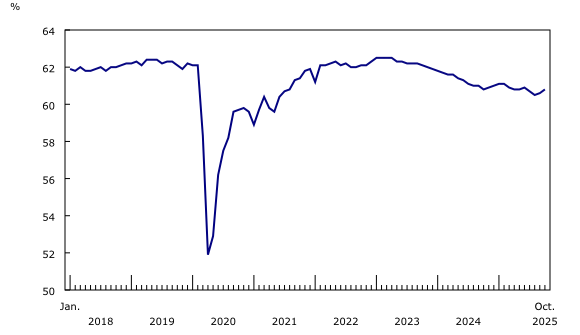
The employment increase in October was driven by part-time work (+85,000; +2.3%). This follows an increase in full-time work in September (+106,000; +0.6%). On a year-over-year basis, employment was up in both full-time work (+199,000; +1.2%) and part-time work (+101,000; +2.7%).
Private sector employment rose by 73,000 (+0.5%) in October, the first increase since June. There was little change in the number of public sector employees and in the number of self-employed workers in October.
Labour disputes lead to lost work hours among employees
Despite the employment increase in October, total actual hours edged down (-0.2%) in the month as an elevated number of employees lost work hours due to labour disputes occurring during the Labour Force Survey reference week (October 12 to 18).
An estimated 87,000 employees across the provinces lost work hours due to labour disputes during this period (not seasonally adjusted). This was particularly notable in Alberta where a teachers’ strike, and a subsequent lock-out, led to the closure of most elementary and secondary schools in the province.
On a year-over-year basis, total actual hours were up 0.7% in October.
Employment rises among core-aged men and youth
Employment rose among core-aged men (25 to 54 years old) in October (+33,000; +0.5%), marking a second consecutive monthly increase. Among core-aged women, employment was little changed, following a gain in September (+76,000; +1.2%).
Infographic 1
Employment rate by age group, October 2025
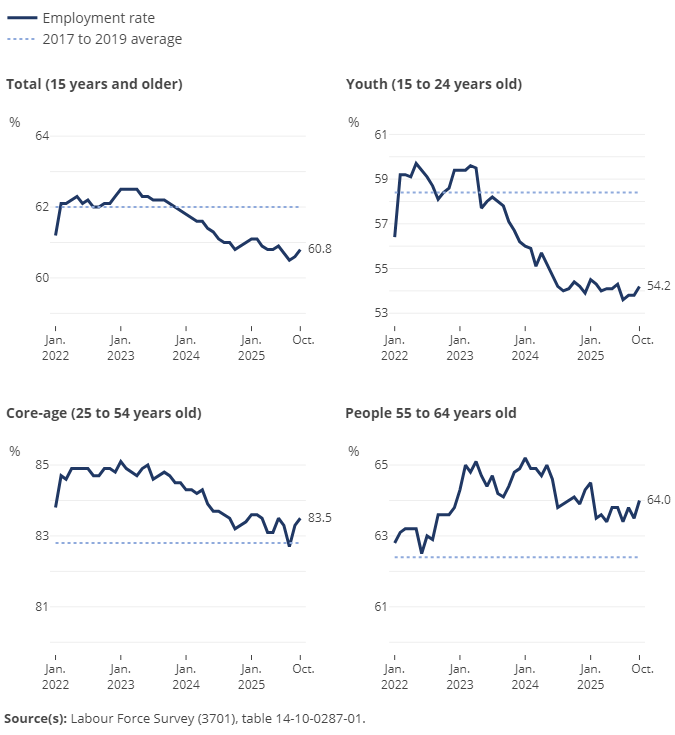
The employment rate of core-aged men rose 0.3 percentage points to 86.4% in October, while that of core-aged women held steady at 80.4%. For both groups, the employment rate in October was virtually unchanged compared with 12 months earlier.
Among youth (aged 15 to 24), employment rose by 21,000 (+0.8%) in October, the first increase since January. This pushed the youth employment rate up 0.4 percentage points to 54.2%. Despite this increase, the youth employment rate remained significantly below the recent high of 59.6% recorded in March 2023, as youth continue to face difficult labour market conditions.
Unemployment rate declines to 6.9%
The unemployment rate fell 0.2 percentage points to 6.9% in October. Prior to this decline, the unemployment rate had reached 7.1% in August and September, the highest level since May 2016 (excluding 2020 and 2021 during the COVID-19 pandemic).
Nearly one in five (19.8%) unemployed people in September had found work in October. This proportion (referred to as the job finding rate) was up from 12 months earlier (16.5%) but was lower than the average for the same months from 2017 to 2019 (24.6%) (not seasonally adjusted).
Chart 2
Unemployment rate decreases to 6.9% in October
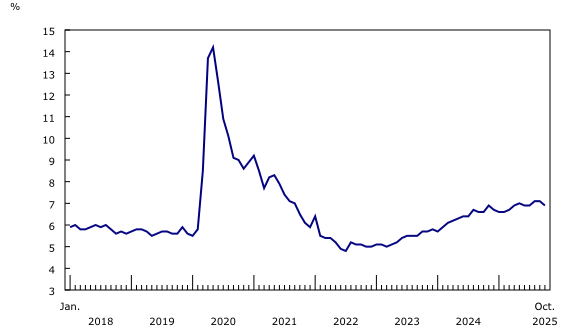
The layoff rate in October (0.6%) was virtually unchanged compared with 12 months earlier (0.7%) (not seasonally adjusted). This represents the proportion of people who were employed in September but had become unemployed in October as a result of a layoff.
Long-term unemployment—the proportion of unemployed people who had been continuously searching for work for 27 weeks or more—stood at 21.3% in October, little changed from 21.2% in October 2024.
Youth unemployment rate falls for the first time since February
The unemployment rate for youth aged 15 to 24 fell by 0.6 percentage points to 14.1% in October, coinciding with an increase in employment for this group. This was the first decline in the youth unemployment rate since February. The youth unemployment rate had been on an upward trend from the beginning of 2023, reaching a 15-year high in September 2025 (excluding 2020 and 2021).
Infographic 2
Unemployment rate by age group, October 2025
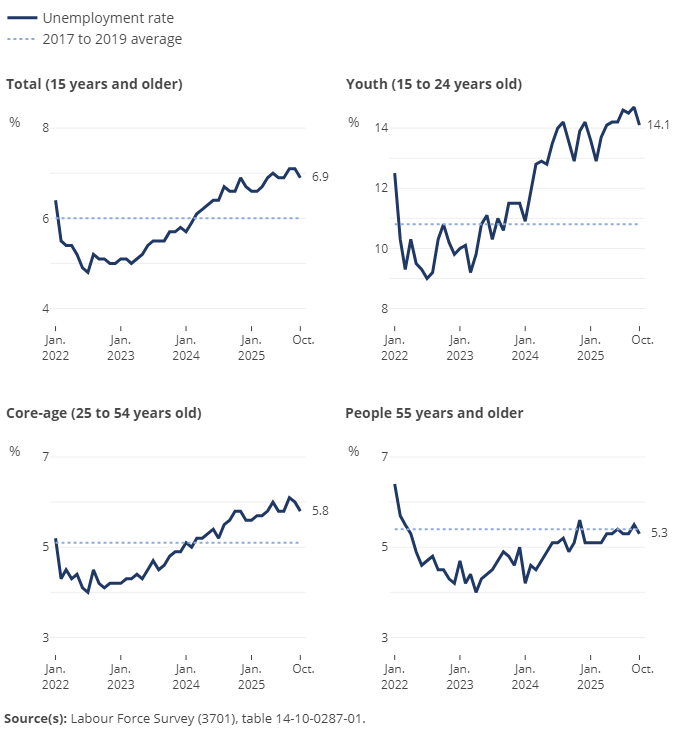
The unemployment rate for core-aged men fell by 0.2 percentage points to 6.0% in October, while it was little changed at 5.7% for core-aged women. For both groups, the unemployment rate was little changed on a year-over-year basis.
The unemployment rate also fell for people aged 55 and older in October (-0.2 percentage points to 5.3%), offsetting a similar-sized increase in September. The unemployment rate for this age group was little changed on a year-over-year basis.
Employment gains led by services-producing industries
Employment increased in wholesale and retail trade in October (+41,000; +1.4%), more than offsetting a decline in September (-21,000; -0.7%). On a year-over-year basis, employment in the industry was up by 108,000 (+3.7%).
Employment also increased in transportation and warehousing (+30,000; +2.8%) and in information, culture and recreation (+25,000; +3.0%) in October. In both these industries, employment was little changed compared with 12 months earlier.
Chart 3
Employment change by industry, October 2025
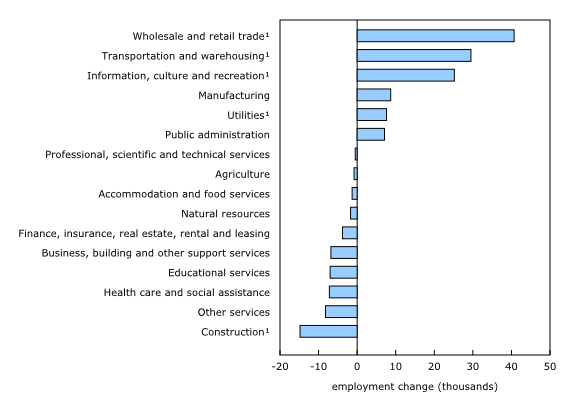
In construction, employment fell by 15,000 (-0.9%) in October, following little change in September. Employment in this industry was virtually unchanged from a year earlier but was down 38,000 (-2.3%) from a recent high in January 2025.
From January to October 2025, employment in goods-producing industries recorded a net decline of 54,000 (-1.3%), largely reflecting decreases in construction and manufacturing. In comparison, employment in services-producing industries increased by 142,000 (+0.8%) over that period.
Employment increases led by Ontario
Overall employment growth in October was concentrated in Ontario (+55,000; +0.7%). The increase was the first for the province since June. The unemployment rate in Ontario fell 0.3 percentage points to 7.6% in October.
The employment increase in October in Ontario has offset declines recorded earlier in the year. These declines coincided with uncertainty related to trade and tariffs which disproportionately impacted regions in Southern Ontario. Notably, the unemployment rate in the census metropolitan area (CMA) of Windsor reached a high of 11.2% in June, before trending down to 9.6% in October (three-month moving averages).
Employment also increased in Newfoundland and Labrador (+4,400; +1.8%) in October, offsetting two consecutive monthly declines in August and September. The unemployment rate in the province was little changed at 10.1% in October.
Map 1
Unemployment rate by province and territory, October 2025
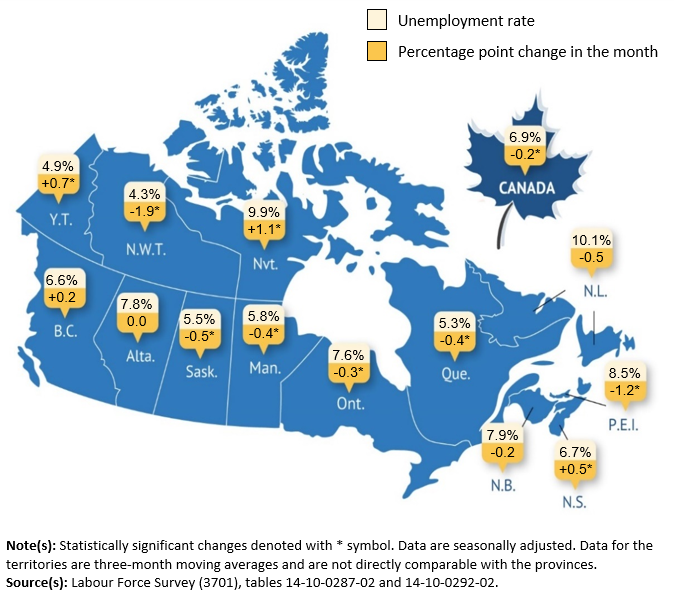
On the other hand, fewer people worked in Nova Scotia (-4,400; -0.8%) and in Manitoba (-4,000; -0.5%) in October. In Nova Scotia, the unemployment rate rose by 0.5 percentage points to 6.7% while in Manitoba, it fell 0.4 percentage points to 5.8%, as fewer Manitobans searched for work.
In Quebec, employment was little changed for a fourth consecutive month in October. With fewer people searching for work, the unemployment rate in Quebec declined 0.4 percentage points to 5.3%.
In the spotlight: Over one in four Canadians live in a household experiencing financial difficulties
In October 2025, 27.7% of Canadians aged 15 and older were living in a household that found it difficult to meet its financial needs in terms of transportation, housing, food, clothing and other necessary expenses. This proportion has been on a downward trend since the high recorded in October 2022 (35.5%).
In October 2025, people living in rented dwellings remained more likely to experience household financial difficulties (37.0%) than those living in a dwelling owned by a household member (23.6%). The proportion experiencing difficulties was down among both renters (-2.2 percentage points) and owners (-0.7 percentage points) from a year earlier.
Chart 4
Proportion of core-aged Canadians living in a household experiencing difficulties meeting its financial needs, by select family type
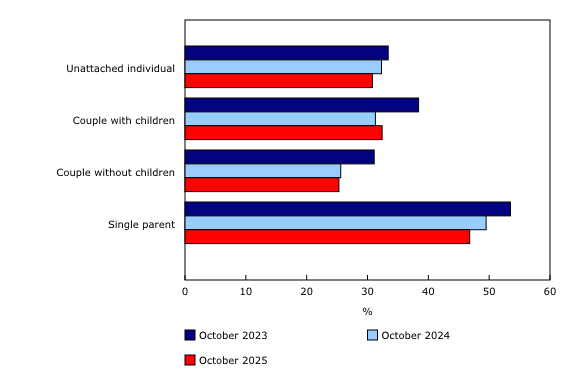
Youth aged 15 to 24 (31.0%) were about as likely as core-aged (25 to 54 years old) people (30.7%) to belong to a household that found it difficult or very difficult to meet its financial needs. On the other hand, the proportion was lower among people aged 55 and older (22.5%).
The proportion of core-aged Canadians living in a household experiencing difficulties meeting its financial needs differed notably depending on household composition. For example, the proportion among couples with children (32.4%) in October was higher than among couples without children (25.3%). Among core-aged single parents, the figure rose to 46.8%.
Infographic 3
Household financial insecurity and unemployment rate among the 20 largest census metropolitan areas (CMAs), October 2025
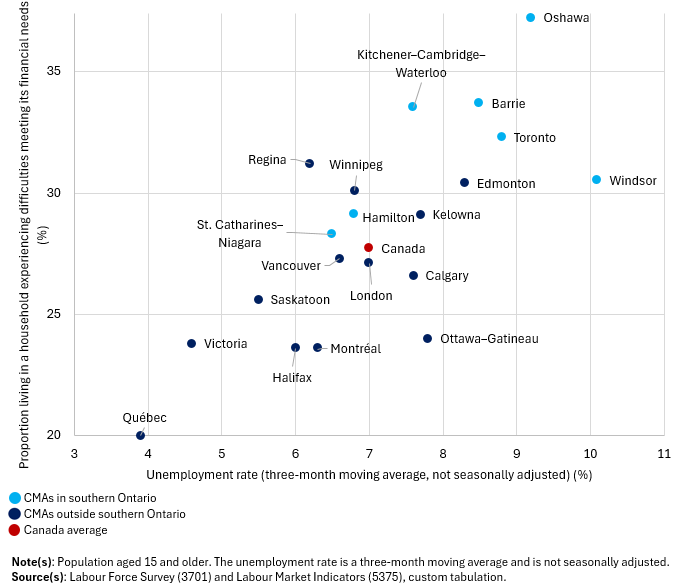
Unemployment can be associated with a greater risk of financial hardship. In October 2025, people aged 15 and older living in households with at least one unemployed person (46.1%) were more likely to report difficulties meeting their financial needs compared with persons living in households with no unemployed people (25.8%).
Among the 20 largest CMAs, the share of people living in households experiencing financial difficulties was higher in areas of Southern Ontario where the unemployment rate was above the national average. These areas included Oshawa (37.2%), Barrie (33.7%), Kitchener–Cambridge–Waterloo (33.5%) and Toronto (32.3%). On the other hand, the proportion was lowest in Québec (20.0%), Montréal (23.6%), Halifax (23.6%) and Victoria (23.8%), where the unemployment rate was lower than the national average.
Sustainable Development Goals
On January 1, 2016, the world officially began implementation of the 2030 Agenda for Sustainable Development—the United Nations’ transformative plan of action that addresses urgent global challenges over the next 15 years. The plan is based on 17 specific sustainable development goals.
The Labour Force Survey is an example of how Statistics Canada supports the reporting on the Global Goals for Sustainable Development. This release will be used in helping to measure the following goals:


Note to readers
The Labour Force Survey (LFS) estimates for October reflect labour market conditions during the reference week of October 12 to 18, 2025.
The sample size of the LFS is approximately 65,000 households, representing over 100,000 respondents each month. For more information, see the Guide to the Labour Force Survey.
This analysis focuses on differences between estimates that are statistically significant at the 68% confidence level. Monthly estimates may show more sampling variability than trends observed over longer periods. For more information, see “Interpreting Monthly Changes in Employment from the Labour Force Survey.”
LFS estimates at the Canada level do not include the territories.
The LFS estimates are the first in a series of labour market indicators released by Statistics Canada, which includes indicators from programs such as the Survey of Employment, Payrolls and Hours (SEPH); Employment Insurance Statistics; and the Job Vacancy and Wage Survey. For more information on the conceptual differences between employment measures from the LFS and those from the SEPH, refer to section 8 of the Guide to the Labour Force Survey.
An article presenting the results of two collection initiatives that are underway to restore LFS response rates to the greatest extent possible, entitled “Adapting to change: Online first collection initiatives to improve the Labour Force Survey response rate,” was published on October 21 in the Labour Statistics: Technical Papers series.
The employment rate is the number of employed people as a percentage of the population aged 15 years and older. The rate for a particular group (for example, youth aged 15 to 24 years) is the number employed in that group as a percentage of the population for that group.
The unemployment rate is the number of unemployed people as a percentage of the labour force (employed and unemployed).
The participation rate is the number of employed and unemployed people as a percentage of the population aged 15 years and older.
Full-time employment consists of persons who usually work 30 hours or more per week at their main or only job.
Part-time employment consists of persons who usually work less than 30 hours per week at their main or only job.
Total hours worked refers to the number of hours actually worked at the main job by the respondent during the reference week, including paid and unpaid hours. These hours reflect temporary decreases or increases in work hours (for example, hours lost due to illness, vacation, holidays or weather; or more hours worked due to overtime).
This release refers to the gender of a person. The category “men” includes men, as well as some non-binary persons. The category “women” includes women, as well as some non-binary persons. Given that the non-binary population is small, data aggregation to a two-category gender variable is necessary to protect the confidentiality of responses provided.
Seasonal adjustment
Unless otherwise stated, estimates presented in this release are seasonally adjusted, which facilitates comparisons by removing the effects of typical seasonal variations. For more information on seasonal adjustment, see Seasonally adjusted data – Frequently asked questions.
Population growth in the Labour Force Survey
The LFS target population includes all persons aged 15 years and older whose usual place of residence is in Canada, with some exceptions (those living on reserves, full-time members of the regular Armed Forces and persons living in institutions). The target population includes temporary residents—that is, those with a valid work or study permit, their families, and refugee claimants—as well as permanent residents (landed immigrants) and the Canadian-born.
Information gathered from LFS respondents is weighted to represent the survey target population using population calibration totals. These totals are updated each month, using the most recently available information on population changes derived from Canada’s official population estimates, with minor adjustments being made to reflect the LFS target population.
While the LFS population totals are generally aligned with official demographic estimates, the official estimates should be considered the official measure of population change in Canada. More information on how population totals in the LFS are calculated can be found in the article “Interpreting population totals from the Labour Force Survey.”
Updates to the Labour Force Survey sample design beginning in April 2025
Every 10 years, the LFS sample is redesigned to reflect changes in population characteristics and updated geographical boundaries. The updated sample design—based on the 2021 Census population characteristics and the 2021 Standard Geographical Classification—was phased in from April to September 2025. For more information, see Section 4 of the Guide to the Labour Force Survey.
Data for the Labour Market Indicators program are now available for October 2025.
Next release
The next release of the LFS will be on December 5. November data will reflect labour market conditions during the week of November 9 to 15.
Products
More information about the concepts and use of the Labour Force Survey is available online in the Guide to the Labour Force Survey (Catalogue number71-543-G).
The product “Labour Force Survey in brief: Interactive app” (Catalogue number14200001) is also available. This interactive visualization application provides seasonally adjusted estimates by province, gender, age group and industry.
The product “Labour Market Indicators, by province and census metropolitan area, seasonally adjusted” (Catalogue number71-607-X) is also available. This interactive dashboard provides customizable access to key labour market indicators.
The product “Labour Market Indicators, by province, territory and economic region, unadjusted for seasonality” (Catalogue number71-607-X) is also available. This dynamic web application provides access to labour market indicators for Canada, provinces, territories and economic regions.
The product “Labour market indicators, census metropolitan areas, census agglomerations and self-contained labour areas: Interactive dashboard” (Catalogue number71-607-X) is also available. This dashboard allows users to visually explore the estimates using an interactive map as well as time series charts and tables.
The product Labour Force Survey: Public Use Microdata File (Catalogue number71M0001X) is also available. This public use microdata file contains non-aggregated data for a wide variety of variables collected from the Labour Force Survey. The data have been modified to ensure that no individual or business is directly or indirectly identified. This product is for users who prefer to do their own analysis by focusing on specific subgroups in the population or by cross-classifying variables that are not in our catalogued products.
Contact information
For more information, or to enquire about the concepts, methods or data quality of this release, contact us (toll-free 1-800-263-1136; 514-283-8300; infostats@statcan.gc.ca) or Media Relations (statcan.mediahotline-ligneinfomedias.statcan@statcan.gc.ca).