
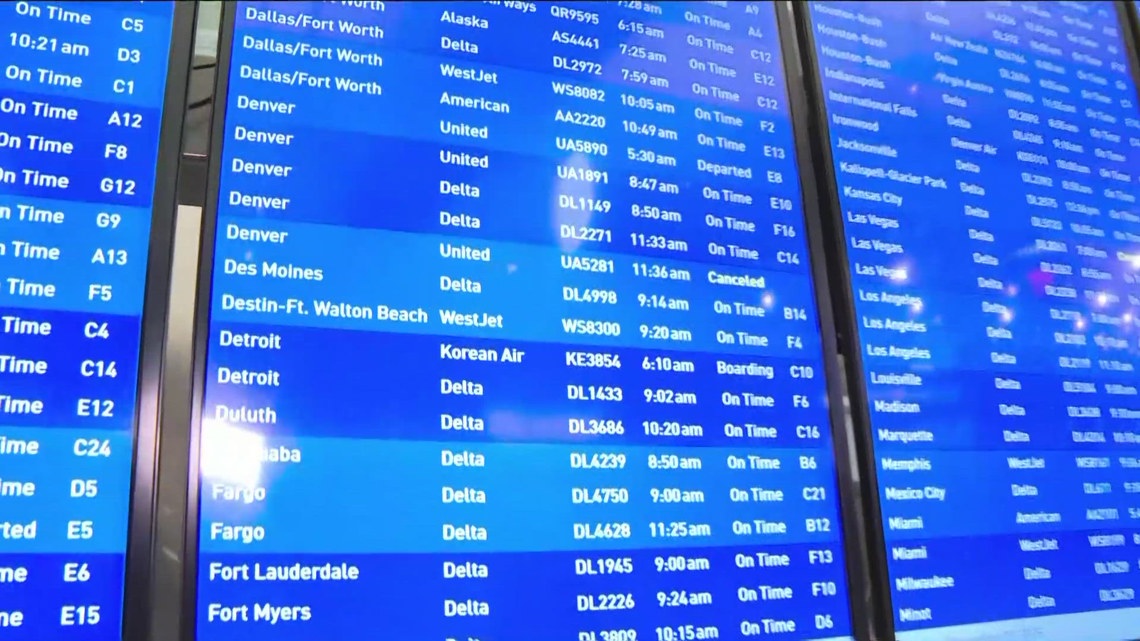
Nearly three dozen incoming and outgoing flights have been scratched as of 6 a.m. Friday due to an FAA mandate to take some pressure off air traffic controllers.
MINNEAPOLIS — Stress levels are higher than normal Friday at MSP Airport as an FAA mandate to reduce flight numbers kicks in.
At least 30 incoming and outgoing flights had already been scratched as of 6 a.m. Friday, with the potential of more throughout the day. Across the country, at least 1,000 flights were canceled, according to FlightAware.
As of 3:30 p.m., that number had jumped to at least 36 canceled incoming and outgoing flights.
The upheaval follows a federal directive issued on Friday to reduce flight numbers by 4% in order to take pressure off overburdened air traffic controllers, who have been working without pay since the government shutdown 38 days ago. That number is expected to grow to 10% by next Friday if a funding agreement cannot be reached by lawmakers.
Travelers at MSP said, despite the reduction, things are going smoothly.
“I was expecting it to be a little more packed,” said Dominic Jones.
Jones is flying home, but he said he’ll be traveling for the holidays.
“I’ll find a different way, a different route, if there’s an obstacle, you can always find a way around it, so driving wouldn’t be the worst aspect at that point,” Jones said.
The FAA maintains that the cutbacks are necessary to relieve pressure on air traffic controllers, many of whom have been pulling six-day work weeks with mandatory overtime. Increasing numbers have begun calling out sick as the financial strain and exhaustion mount.
“You can’t expect people to go into work when they’re not getting a paycheck,” said Kelly Matthews of Flat Rock, Michigan, a frequent business traveler who has canceled most of her upcoming trips.
“I mean it’s not a matter of them not wanting to do the job — but you can’t afford to pay for gas, your day care and everything else.”
Uncertainty over their flight status has travelers at MSP understandably anxious. Those KARE spoke with said they are calling and checking apps, hoping to get where they’re going without hitting a stumbling block.
Nancy Huot was up early, checking on her flight to Portland.
“Yes, I’ve been checking since about 8:00 this morning to see to see if there were any delays, but so far everything’s been good,” Huot said. “Everything is going great, everything is on time.”
She said MSP looked pretty normal on a mid-Friday afternoon. Even though she wasn’t worried flying out of MSP, she said she is worried about flying back.
“I am a little concerned because Portland has had quite a few flights canceled, so we’ll hope things will be better by then,” she said.
Among carriers, Delta, United and American all say international flights should be safe from cancellation. Domestic flights in and out of 40 major airports across the U.S. are not as certain. Travelers are advised to call their carrier directly and keep an eye on their phones to check on the status of their flight.
Delta Air Lines said it would scratch roughly 170 flights Friday, and American Airlines planned to cut 220 a day through Monday.
Editor of Thrifty Traveler, Kyle Potter, said people should expect and plan for disruptions.
“This is pretty unprecedented,” Potter said. “Be prepared for these curveballs because the likelihood that something is going to go wrong, big or small, is probably larger than ever.”
Potter said it’s hard to predict what air travel will look like in the coming days, but as of Friday afternoon, things weren’t looking too bad.
“I think things are looking pretty stable right now. We haven’t seen any airlines across the country kind of spiral into a meltdown as a result of being forced to make these kinds of reductions, so that’s really encouraging,” he said.
“We are seeing and we will continue to see probably some pretty extensive delays, especially flying in and out of some of the busiest airspace in the country around New York, in southern Florida, on the West Coast.”
Carriers are required to refund customers whose flights are canceled, but not to cover secondary costs such as food and hotel accommodations unless a delay or cancellation results from a contributing factor that is within the control of the airlines, according to the Department of Transportation.