
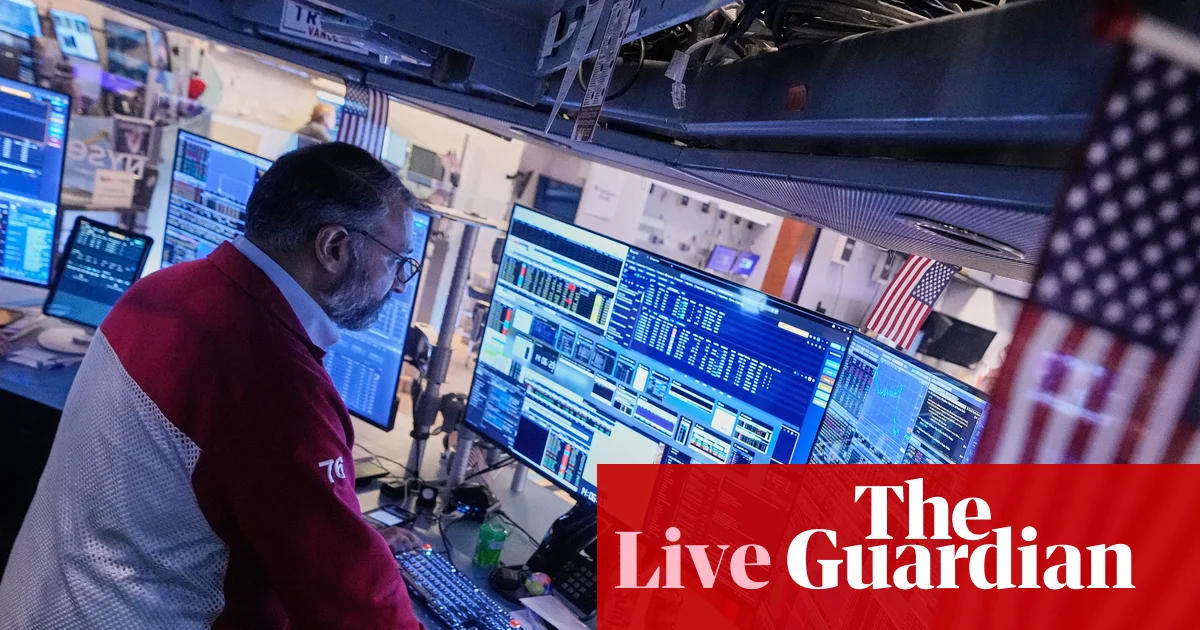
Wall Street falls as economic concerns and valuation worries hit stocks
Wall Street has opened in the red as jitters over the health of the US economy, and sky high tech valuations, continue to hit the markets.
The Dow Jones industrial average, of 30 large US companies, has dropped by 209 points, or 0.45%, in early trading to 46,703 points.
The broader S&P 500 index is down 0.6%, and the tech-focused Nasdaq has lost almost 1%.
Fawad Razaqzada, market analyst at City Index, says:
“Risk appetite continued to weaken Friday morning as European stocks and US futures resumed their slide after a brief bout of dip-buying faded – the sort of price action we have been accustomed to all week really.
Some analysts warn that this year’s artificial-intelligence-led rally has finally come to a halt, while others suggest markets needed to cool down anyway with indices racing to record highs without much pause and new stimulus.”
This has been a tricky week for the markets – the S&P 500 and the Dow are both set for their steepest weekly loss in four, while the Nasdaq is poised for its worst weekly performance since March, Reuters reports.
The selloff seems to be driven by anxiety over the ongoing US government shutdown, the resulting dearth of economic data, and warnings that an AI bubble might burst soon.
Stocks fell yesterday after a report that US company job cuts jumped in October.
European stocks remain in the red today too – the FTSE 100 is now down 95 points, or almost 1%, at 9640 points.
Key events
Show key events only
Please turn on JavaScript to use this feature
A late PS: The Nasdaq has registered its biggest weekly percentage drop since early April as investors worried about the sustainability of a rally in artificial intelligence shares.
Although the tech-focused Nasdaq recovered from its earlier lows, it still posted a fall of around 3% for this week.
ShareClosing post
Time for a recap.
Stock markets are ending the week in the red, as worries about the US economy and high technology valuations hit shares.
On Wall Street, the Nasdaq Composite has shed 2% today, adding to losses earlier this week.
According to the Financial Times, US tech groups closely tied to the artificial intelligence boom have lost more than $1tn in market value since last Friday.
The S&P 500 share index is down over 1%.
As well as fears of an AI bubble, the latest economic data is worrying investors. They learned today that US consumer confidence has dropped (see earlier post), a day after hearing that US job cuts jumped in October.
James Knightley, ING’s chief international economist for the US, explains:
The November reading of the University of Michigan sentiment index has deteriorated further, dropping to 50.3 from 53.6 relative to a consensus prediction of 53.0.
The expectations component dropped 1.3 points to 49, while the current conditions series fell 6.3 points to 52.3 – an all-time low for the monthly series – and this goes back to the 1970s! This is likely due to government shutdown concerns tied to SNAP food payments and ongoing non-payment of wages.
London’s FTSE 100 has ended the day at a two-week low, helping to pull European markets into their worst week since late August.
In other news…
ShareWorst week for European markets since August
European stock markets have posted their worst week since the end of August.
The pan-European Stoxx 600 index has closed down 0.6% tonight, taking its weekly losses to 1.3%.
That’s the biggest weekly fall since Friday 29th August, it appears.
ShareFTSE 100 closes at near two-week low
Back in London, the stock market has ended the day at its lowest closing level in almost two weeks.
The FTSE 100 share index has closed down 53 points, or 0.55%, at 9682 points.
Property portal Rightmove finished the day as the top faller, down 12.5%, after outlining plans to spend more on artificial intelligence.
Airline group IAG fell 11.5%, after it reported a slowdown in demand for flights to North America last summer.
Updated at 11.40 EST
Wall Street’s worst week in a month ends today, points out Joe Mazzola, head trading and derivatives strategist at Charles Schwab, adding:
Focus remains on the D.C. shutdown and concerns about AI valuations that sent the tech-heavy Nasdaq Composite down almost 2% yesterday for the third major sell-off in the last few weeks.
Stocks continued their retreat this morning as Magnificent Seven stocks stayed red, including a nearly 2% pre-market drop for Nvidia.”
That has turned into a 4.3% drop for Nvidia since the market actually opened….
US small company stocks are also sliding.
The Russell 2000 index has just hits a seven-week low, down around 1.2% today.
Wall Street’s fear gauge, the CBOE Volatility Index, has hit its highest level in more than two weeks.
ShareING: Situation starting to turn ugly on the US jobs outlook
James Knightley, chief international economist at ING, is concerned by the latest US consumer sentiment data released today (see earlier post).
He explains:
The real concern though is regarding the jobs market. 71% of households now expect unemployment to rise over the coming 12M while only 9% expect unemployment to fall. That gives a net reading of 62% predicting higher unemployment versus 52% last month. A huge increase which as the chart below shows, has historically been the prelude to an ugly outcome for jobs.
Tesla is joining in today’s selloff, with its shares dropping by 3.5% today.
Tesla’s stock doesn’t seem to be getting a lift from yesterday’s approval of Elon Musk’s new $1tn pay deal, which incentivises the company’s CEO to hit some stretching targets.
CCLA, the UK’s largest charity asset manager, isn’t impressed by the huge pay package.
Dr James Corah, head of sustainability at CCLA, says:
“Putting the cult of personality, ideology and politics to the side, the announcement of Elon Musk’s pay package raises questions of governance that we, as investors for the longer-term on behalf of church, charities and local authorities, consider a red flag.
The question is – would any other listed business give any other person this kind of ‘incentive plan’? At CCLA, we believe that good governance demands accountability: no individual, however talented, should be so disproportionately empowered, nor considered the sole engine of success. We expect executive pay to be fair, proportionate, and aligned with long-term value creation, and we continue to challenge companies that fail to meet these standards.”
ShareUS consumer sentiment retreats, unless you’re a big shareholder!
A closely-watched gauge of US consumer sentiment has fallen as anxiety over the government shutdown rises, although the wealthy aren’t sharing the gloom.
The University of Michigan’s consumer sentiment index has fallen by 6% this month, led by a 17% drop in current personal finances and a 11% decline in year-ahead expected business conditions.
Surveys of Consumers director Joanne Hsu cites fears that the shutdown is hurting growth, saying:
With the federal government shutdown dragging on for over a month, consumers are now expressing worries about potential negative consequences for the economy. This month’s decline in sentiment was widespread throughout the population, seen across age, income, and political affiliation.
There is one key exception, though, Americans with chunky shareholdings are in a jollier mood. Hsu says:
Consumers with the largest tercile of stock holdings posted a notable 11% increase in sentiment, supported by continued strength in stock markets.
AI chipmaker Nvidia is the biggest faller on the Dow Jones Industrial Average in early trading, down 2.2%.
It’s followed by construction equipment maker Caterpillar (-2.1%).