
German physicist Wilhelm Rontgen made a dramatic discovery for which he could not give a name on November 8, 1895.
Instead, he used a placeholder letter for the type of ray he had discovered – X-ray.
The X symbolises the unknown.
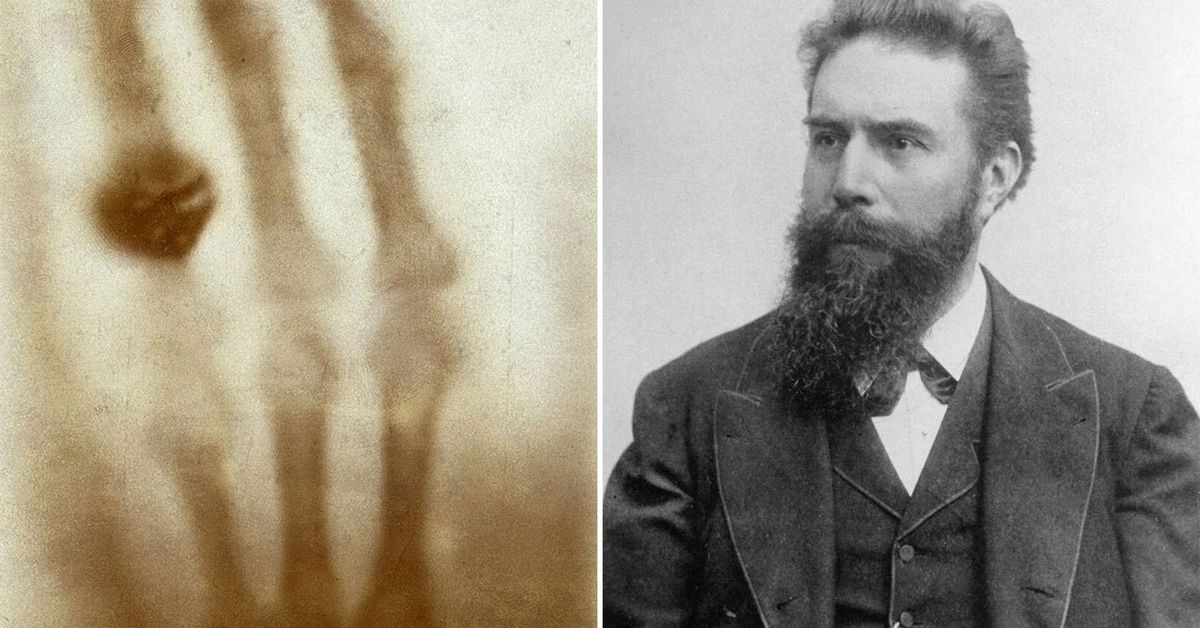
 Wilhelm Rontgen was given the first Nobel Prize in physics for discovering X-rays. (Public Domain)
Rontgen was investigating electron beams in a vacuum tube that day when he noticed a fluorescent screen on the other side of the room glowing.
He began placing objects in the apparent path of the invisible ray to see what would stop it.
But as he did so, he saw his own skeleton projected onto the screen.
Rontgen had accidentally discovered a way of seeing inside the human body without even breaking the skin.
Six weeks later, he took a photograph of his wife’s hand in the path of the X-ray.
When it showed the bones under her skin, she exclaimed in shock: “I have seen my death!”
 The first X-ray photograph ever taken, of Wilhelm Rontgen’s wife’s hand. (Public Domain)
But while his wife was terrified, doctors were ecstatic.
The discovery was a huge breakthrough in medical science.
Rontgen refused to take out any patents relating to X-rays, because he wanted everyone to benefit from his discovery.
When he was awarded the first Nobel Prize in Physics in 1901, he donated the prize money to the University of Wurzburg, where he worked.
He fell into bankruptcy thanks to the hyperinflation that struck Germany after World War I.
In accordance with the wishes in his will, all his personal and scientific notes were destroyed on his death in 1923.
X-rays still have Rontgen’s placeholder name in English.
But in German, they are known as Röntgenstrahlen, or Rontgen’s beams.