
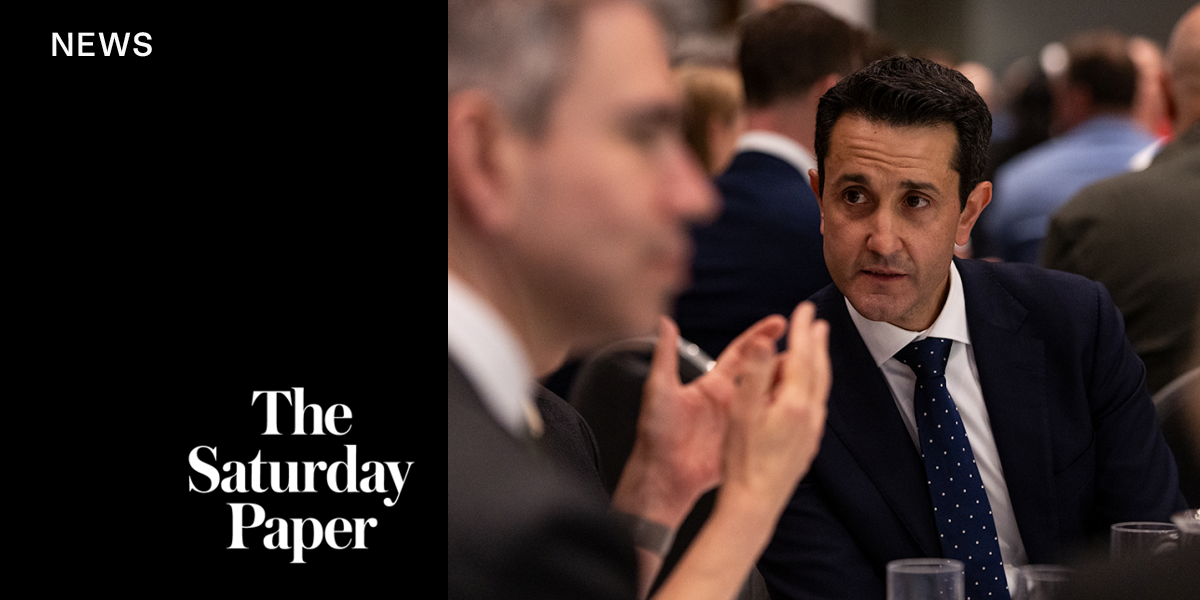
In his first 12 months, David Crisafulli has been a political oddity – a comparatively moderate Liberal National Party premier of Queensland.
Crisafulli’s leadership is shaped in part by his memory of Campbell Newman’s brief, chaotic government, which after a landslide victory lasted a single term and condemned the LNP to nine years in opposition.
Crisafulli was local government minister in that government and he and contemporary colleagues have learnt lessons from it.
“They’ve seen what happens when you unleash unbridled animal spirits,” said one witness to the period.
In last October’s election, Crisafulli won 52 of the 93 seats in Queensland’s single-chamber parliament. Labor won 35 and there are six crossbench MPs, including one from the Greens.
That would seem a guarantee of a second term for most. Even a Campbell Newman might be able to hold government.
Still, Crisafulli is taking no chances. Like his election campaigns, his first year has been slow and steady.
There have been some culture war skirmishes. His government has limited provision of puberty blockers to transgender children and banned community pill testing. His first act as premier was to close the state’s First Nations truth-telling inquiry and halt the progression of a Treaty.
The Crisafulli government has introduced laws to try some children as adult offenders, under the banner “Adult Crime. Adult Time”, although Labor supported the legislation, in part because it was a version of their own policy and was popular.
These laws, and a suite of other law and order changes, were condemned by the Human Rights Law Centre for violating the Queensland Human Rights Act.
“These policies do nothing to address the root causes of youth crime – intergenerational trauma, poverty, systemic racism and inadequate access to culturally safe support services,” the national director of Change the Record, Blake Cansdale, said at the time. “Instead, they reinforce damaging stereotypes and entrench cycles of disadvantage that harm First Nations children and families for generations.”
Shortly after the election, however, Crisafulli made clear that he didn’t want his government to be defined by culture wars. He told the LNP state council, “We don’t exist for culture wars.”
On election night itself he said that former Queensland senator Amanda Stoker, elected that night as a state MP, would not be in his cabinet.
Stoker, once a federal assistant minister, has a reputation as a hard-right campaigner on issues such as abortion. He has stuck to that exclusion through some murmurings of dissent.
Anti-abortion groups were further disappointed by his declaration he would not repeal laws decriminalising abortion, even though he had voted against them when in opposition.
The premier has indicated he will not be distracted from his principal policies on youth crime, health services, housing and lowering the cost of living.
Worthy as those objectives are, it seems certain there will be distractions from right-wing groups.
“Finding a way through those waves of right-wing demands is the greatest surfing challenge of an LNP leader,” one political operator told The Saturday Paper.
One such wave is the federal schism over renewable energy and net zero targets.
It’s close to home: federal Nationals leader David Littleproud and anti-renewables activist Senator Matt Canavan are Queenslanders who have led the party to dump net zero, which may yet lead to the dumping of Liberal leader Sussan Ley.
Further, Queensland produced 224 million tonnes of coal in the year to May and those producers are far from natural allies of renewables.
Midyear, Crisafulli said he supported net zero but not the intermediate targets. He has prolonged the emphasis on coal and gas power and cancelled or paused some renewable energy projects.
His policy objective is lowering the cost of living and his political objective seems to be avoiding the internal brawls that have racked the federal Coalition.
“Finding a way through those waves of right-wing demands is the greatest surfing challenge of an LNP leader.”
In addition, the premier has to tend to demands from voters in greater Brisbane – where Labor holds most of the seats – and provincial areas where coalmines are absent or unpopular or where solar and wind farming could become a substantial earner for landowners.
Crisafulli’s deputy, Jarrod Bleijie, is known as his spear carrier, and while the premier is underlining the “centre” in his “centre right” identifier, his No. 2 is occasionally highlighting the “right” bit.
Bleijie strongly supported Queensland becoming the first state to outlaw pill testing, a practice aimed at protecting drug takers from deadly concoctions.
Some observers suspected he had traces of “Trumpism”, but Crisafulli has rejected this, telling an ABC interviewer, “He is a strong, conviction politician who has delivered what he said he’s going to do.”
Donald Trump again entered state political chatter when the premier proposed Queensland host a coming Quad meeting of the leaders of Australia, India, Japan and the United States, which hypothetically could see the US president visit the Sunshine State.
Crisafulli sidestepped a question on whether he was a fan of the US president’s style by saying he was a fan of the US.
In another display of restraint, Crisafulli has not been a constant critic of the federal government, certainly not at a pace matching his conservative predecessors. He has questioned the amount of GST money Queensland gets from the Commonwealth Grants Commission, but most premiers argue they have been short-changed.
Local issues are bothering Crisafulli, such as demands for laws to regulate e-bike use, following the deaths of a teen and an eight-year-old on the Gold Coast. He has an inquiry report pending and most steps are looking at e-bike dangers.
Crisafulli’s grandest-sounding scheme is his $2 billion Residential Activation Fund, a big element of his Securing our Housing Foundations Plan.
The most recent state budget continued the list of snappy program names by launching assistance for first-home buyers called Boost to Buy. All up, the premier wants the state to get one million new homes built by 2046. That means about 50,000 a year. This would require well-stocked government finances, which Crisafulli doesn’t have. Instead, he wants scrap “a number of taxes”.
“I look at payroll tax and I see that as a disincentive for people to put people on,” he told an ABC interviewer.
“But it’s a big part of our budget and we have to make sure that we also run a responsible operation.”
Payroll tax is worth about $1.8 billion to government revenue.
Meanwhile, Crisafulli’s 2025/26 budget allocated an unprecedented $33 billion in health funding for new hospitals and to reduce excessive ambulance ramping and long surgery waiting times.
So, is it all working?
There is disparity among opinion polls, with some focused on the erosion of Liberal, National and LNP support by One Nation.
However, a recent poll by DemosAU found the Crisafulli government enjoying a two-party preferred rating of 54 to 46, much like its victory performance 12 months earlier. The poll recorded One Nation had 14 per cent of the primary vote, a six point improvement over the election tally.
One rendition of the One Nation result is that the LNP base is abandoning a premier advocating ideological restraint.
Still, on that polling result the premier might anticipate hosting the 2032 Brisbane Olympics.
Crisafulli has been praised by some observers for street smarts and pragmatism. One of those observers has likened him to another political leader of Italian extraction, Anthony Albanese.
The argument is that Albanese also has a low-key policy approach since winning office in 2022, because he endured the turmoil of the Rudd–Gillard–Rudd years. After that extraordinary performance, Labor was out of office for nine years.
Albanese is in no mind to return to that costly confusion by jamming the federal schedule with competing policy objectives.
Crisafulli, also shunned by voters for nine years, would appreciate the strategy.
This article was first published in the print edition of The Saturday Paper on
November 8, 2025 as “Crisafulli’s first year”.
For almost a decade, The Saturday Paper has published Australia’s leading writers and thinkers.
We have pursued stories that are ignored elsewhere, covering them with sensitivity and depth.
We have done this on refugee policy, on government integrity, on robo-debt, on aged care,
on climate change, on the pandemic.
All our journalism is fiercely independent. It relies on the support of readers.
By subscribing to The Saturday Paper, you are ensuring that we can continue to produce essential,
issue-defining coverage, to dig out stories that take time, to doggedly hold to account
politicians and the political class.
There are very few titles that have the freedom and the space to produce journalism like this.
In a country with a concentration of media ownership unlike anything else in the world,
it is vitally important. Your subscription helps make it possible.
Send this article to a friend for free.
Share this subscriber exclusive article with a friend or family member using share credits.

Used 1 of … credits
use share credits to share this article with friend or family.
You’ve shared all of your credits for this month. They will refresh on December 1. If you would like to share more, you can buy a gift subscription for a friend.
SHARE WITH A FRIEND
? CREDITS REMAIN
SHARE WITH A SUBSCRIBER
UNLIMITED
Loading…
News
‘A little more adventurous’: Inside Dutton’s youth crime strategy
Jason Koutsoukis
Peter Dutton is remaking the Coalition in the image of the Liberal National Party, wrongfooting a federal Labor government that has never before dealt with a Queensland opposition leader.