
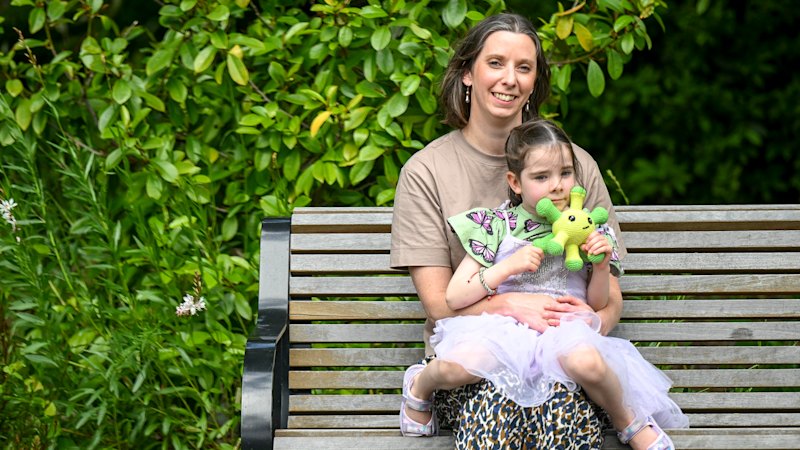
“We were right in the thick of that – we had to break curfew to go into the hospital and give birth,” she said.
Donley’s antenatal classes were cancelled, her husband was barred from their ultrasound appointments and at one stage, the 42-year-old worried her husband would not be allowed into the hospital for their daughter’s birth.
Lauren Donley and daughter Audrey.Credit: Eddie Jim
“It was just kind of unknown rules, constantly changing,” she said.
Donley does not believe the pandemic had any detrimental impacts on her child, but said that some of the parents in her mothers’ group were not so sure.
“I think maybe for kids that have high-level needs, I think it potentially would be more of an impact.”
Experts in speech and language development, including Charles Sturt University’s associate professor Sarah Verdon, believe it is too early to identify the pandemic’s impacts on young children.

A closed children’s playground on March 24, 2020 in London, United Kingdom.Credit: Getty
“I think it would be so important for our schools to be very vigilant about this cohort because we just don’t know,” she said.
She said she had seen issues emerge with children’s communication skills and social interaction and that more kids were getting flagged for autism after displaying social interaction problems.
“Sometimes kids who genuinely did have autism would go to the pediatrician, and the pediatrician would say, ‘oh, I think it’s just because they’re a COVID baby, don’t worry, they’ll catch up’,” she said.
“There’s a whole cohort of kids that are potentially getting dismissed because of COVID.”
Loading
Footscray City Primary School assistant principal Grace Speight said that post-pandemic, she had seen an increased need for preschool reports for children potentially requiring early intervention.
But new post-pandemic resources such as the school-wide positive behaviour programs, the Victorian Teaching and Learning model, mental health support and detailed kinder-to-school transition had helped.
“It’s all about practice makes progress and that practice builds comfort,” she said.
Starting school, she said, was a huge transition. She said parents should prepare for big emotions, new behaviours and challenges, and recommended lots of afternoon tea and early nights.
“It is the equivalent of starting a new job,” Speight said. “There will be a lot of tiredness, and preparing for that in term one will be really important.”
Cornish is developing a free digital tool called Thrive Early to help teachers note any concerning behaviours still unresolved by the end of term one, and look at early interventions.
She will discuss her research at a public forum at Victoria University on November 13.
“I don’t want our children growing up to be fearful,” she said. “I don’t want them growing up to not be able to look at uncertainty and feel they can get through it.”
Start the day with a summary of the day’s most important and interesting stories, analysis and insights. Sign up for our Morning Edition newsletter.