
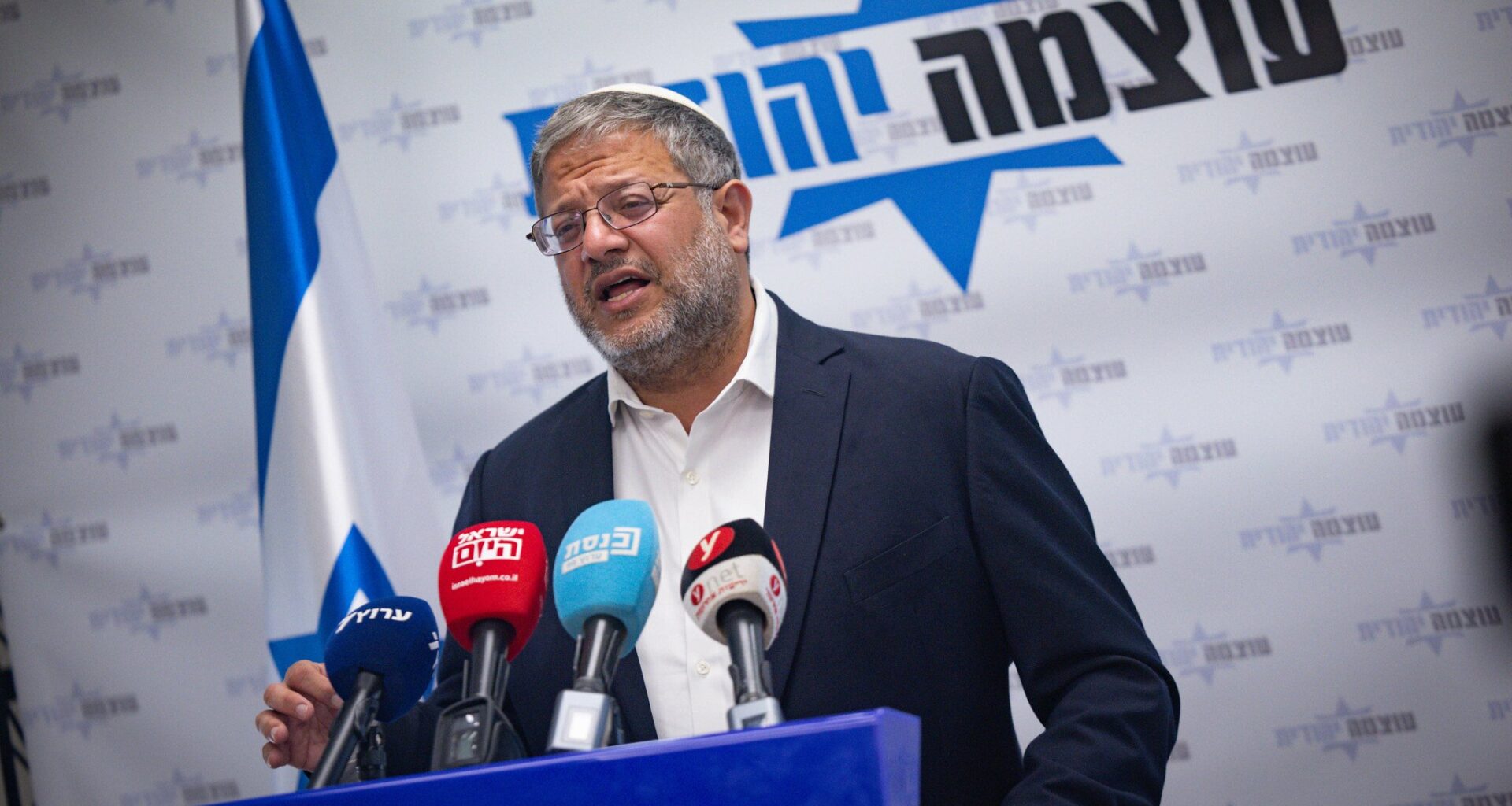
Prime Minister Benjamin Netanyahu’s decision to have the military enact daily “humanitarian pauses” in fighting and increase aid delivery to the Gaza Strip was made without the input of his far-right coalition partners, according to a report published Sunday.
The decision to increase aid supply, including through air drops made directly by the IDF and several other countries, as well as to pause fighting for 10 hours daily, was made during a Saturday meeting of a small number of senior cabinet ministers via a conference call, the Ynet news site reported.
Since the meeting was held on Saturday, it was not attended by the two far-right senior ministers, National Security Minister Itamar Ben Gvir and Finance Minster Bezalel Smotrich, who both observe Shabbat.
The report said Defense Minister Israel Katz, Foreign Minister Gideon Sa’ar, and senior defense officials were on the call with the prime minister.
According to Ynet, Ben Gvir, who is a staunch opponent of humanitarian aid deliveries to Gaza, was informed of the decision on Saturday evening by the Prime Minister’s Office, and is “furious.”
Get The Times of Israel’s Daily Edition
by email and never miss our top stories
By signing up, you agree to the terms
According to a statement put out by Ben Gvir’s office, the reason the PMO gave him for not including him in the meeting was that they “didn’t want him to desecrate Shabbat.”
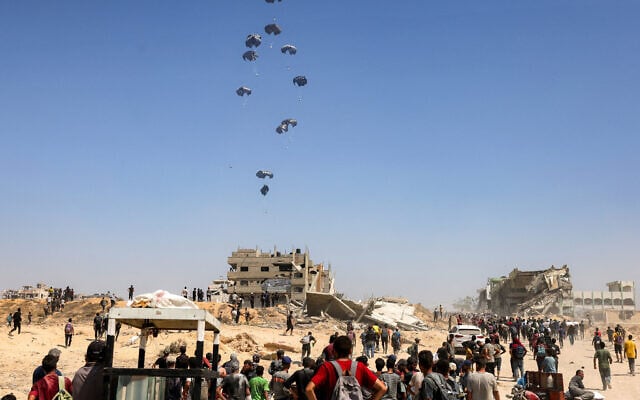
People gather as a C-130 Hercules military transport aircraft drops humanitarian aid on the northern Gaza Strip on July 27, 2025. (Bashar Taleb/AFP)
“I am available all Shabbat, 24/7, because I am the national security minister and receive updates all the time. These are just excuses,” he said.
Ben Gvir said that the decision was “a big mistake,” and that Netanyahu “didn’t include me in the conversation because you knew I was opposed. This is very serious.”
“This is a capitulation to Hamas’s deceitful campaign,” he said, repeating his call to choke off all aid to Gaza, conquer the entire territory and encourage its Palestinian population to leave. He stopped short of threatening to quit the government.
Smotrich, for his part, did not immediately comment on the decision to increase aid flow, or that it was made without his input.
Both ministers have consistently called to not allow any aid into Gaza, arguing that it helps Hamas and prevents the terror group’s surrender.
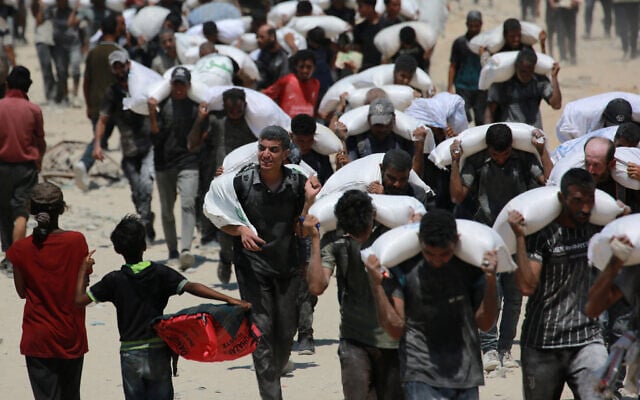
Palestinian walk carrying sacks of flour near Jabalia, in the northern Gaza Strip, on July 27, 2025, after trucks carrying humanitarian aid entered into northern Gaza from Israel. (BASHAR TALEB / AFP)
Saturday’s decision to dramatically increase aid into the Strip, facilitate pauses in fighting and begin air drops of aid packages came amid growing global outrage over reports that significant portions of Gaza’s population are severely malnourished and experiencing famine-like conditions.
Gaza’s Hamas-run health ministry said Friday that at least 56 people died of causes related to malnutrition in the previous three weeks, including 22 children. That was up from 10 children who died from such causes during the five previous months, according to the ministry. The figures cannot be verified.
Israeli authorities have denied claims of widespread famine in the enclave, but acknowledged issues with food access, blaming shortages on a “lack of cooperation” by the UN and other international organizations.
Nearly 60,000 Palestinians have been killed since the start of the war, according to the Hamas-run health ministry, which doesn’t differentiate between civilians and combatants.
Israel has said it seeks to minimize civilian fatalities and stresses that Hamas uses Gaza’s civilians as human shields, fighting from civilian areas including homes, hospitals, schools, and mosques.
Israel’s toll in the ground offensive against Hamas in Gaza and in military operations along the border with the Strip stands at 459.
The war began with the Hamas-led October 7, 2023, invasion massacre, in which terrorists killed some 1,200 people in southern Israel and took 251 hostages. Terror groups in the Gaza Strip are holding 50 hostages, at least 20 of whom are thought to be alive.
Is The Times of Israel important to you?
If so, we have a request.
Every day, even during war, our journalists keep you abreast of the most important developments that merit your attention. Millions of people rely on ToI for fast, fair and free coverage of Israel and the Jewish world.
We care about Israel – and we know you do too. So today, we have an ask: show your appreciation for our work by joining The Times of Israel Community, an exclusive group for readers like you who appreciate and financially support our work.
Already a member? Sign in to stop seeing this
You appreciate our journalism

You clearly find our careful reporting valuable, in a time when facts are often distorted and news coverage often lacks context.
Your support is essential to continue our work. We want to continue delivering the professional journalism you value, even as the demands on our newsroom have grown dramatically since October 7.
So today, please consider joining our reader support group, The Times of Israel Community. For as little as $6 a month you’ll become our partners while enjoying The Times of Israel AD-FREE, as well as accessing exclusive content available only to Times of Israel Community members.
Thank you,
David Horovitz, Founding Editor of The Times of Israel