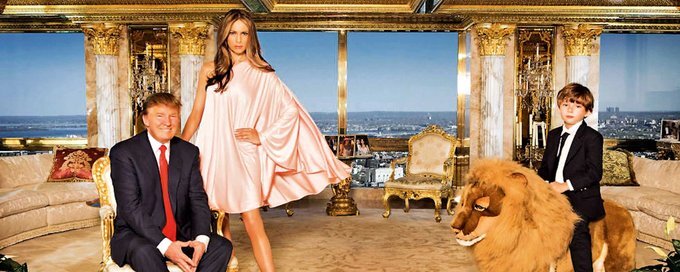
There’s something deeply strange about Donald Trump that goes beyond politics. Strip away the controversies, the policies, the partisan warfare—what remains is a human being who appears to have never experienced what most of us would call “normal life.”
Think about it.
No candid photos of him reading a novel. Not at a beach house. Not on a plane. Not ever. We’ve got paparazzi shots of virtually every celebrity doing mundane things, but Trump? Nothing.
No footage of him walking a dog. He’s never owned a pet. Not a dog, not a cat, not even a goldfish. He’s the first president in over a century to enter the White House without an animal companion. Every president since William McKinley had pets, except Trump.
No stories of him helping a neighbor move furniture. No anecdotes about him showing up to a friend’s barbecue with a six-pack. No tales of him fixing someone’s flat tire or lending a hand with yard work.
Never spotted alone in a grocery store. Think about that. The man is 79 years old and there’s no evidence he’s ever pushed a shopping cart, compared prices on cereal, or waited in a checkout line. In a 2020 speech, he appeared unfamiliar with how grocery stores work, suggesting you need ID to buy groceries.
Never photographed at a beach or swimming. Despite owning Mar-a-Lago, a literal beach resort, there are no images of him in swim trunks, building sandcastles, or wading in the ocean.
Never seen playing ball with a child—not his own kids when they were young, not his grandchildren now. No catch in the backyard. No teaching someone to ride a bike. Nothing.
What This Actually Means
This isn’t about politics. It’s about something more fundamental: relatability through shared human experience.
Most people, regardless of wealth or status, have done at least some of these things. Bill Gates has been photographed reading books. Warren Buffett famously shops at regular stores and eats at McDonald’s. Even Queen Elizabeth II was photographed walking her corgis countless times.
The absence isn’t just notable—it’s comprehensive. It suggests a life lived entirely in performance mode, where every moment has been staged, managed, or conducted with an audience in mind.
The Implications
It explains the disconnect. When Trump talks about “ordinary Americans,” he’s speaking about people whose lives he’s never actually lived. He can’t relate to grocery shopping because he’s never done it. He can’t connect over pet ownership because he’s never had that bond. He can’t share stories about quiet moments with a book because those moments apparently don’t exist.
It reveals the brand. Trump isn’t a person who became a brand—he’s a brand that happens to be a person. Every moment has been curated for maximum visibility and impact. Solitude, quiet hobbies, unglamorous tasks? They don’t serve the image, so they don’t happen (or at least aren’t documented).
It raises questions about authenticity. If someone has never been photographed doing any of the mundane things that make up most people’s lives, what does that say about who they really are? Or whether there’s a “real” person underneath the performance at all?
The Contrast
Compare this to almost any other public figure:
Barack Obama was regularly photographed playing basketball, reading to his daughters, and walking Bo and Sunny.
George W. Bush cleared brush on his ranch and was known for his love of mountain biking.
Bill Clinton jogged (and famously stopped at McDonald’s).
Even Richard Nixon walked his dog King Timahoe on the beach.
The pattern holds for celebrities, business leaders, and public figures across the spectrum. They have hobbies. They have pets. They have moments of documented normalcy.
Trump? Nothing.
Why It Matters
In an era of manufactured authenticity and carefully curated social media personas, Trump represents something different: a life so thoroughly performative that the ordinary has been completely eliminated.
It’s not that he’s hiding his normal life—it’s that there doesn’t appear to be one to hide.
That’s not a political statement. It’s an observation about a uniquely strange existence. And it might explain why, despite his populist rhetoric, there’s always been something fundamentally alien about the way he moves through the world.
He’s never lived like the people he claims to represent. Not even close.
And the photographic record—or rather, the absence of one—proves it.
Share this article on Bluesky, Facebook, and X/Twitter.