
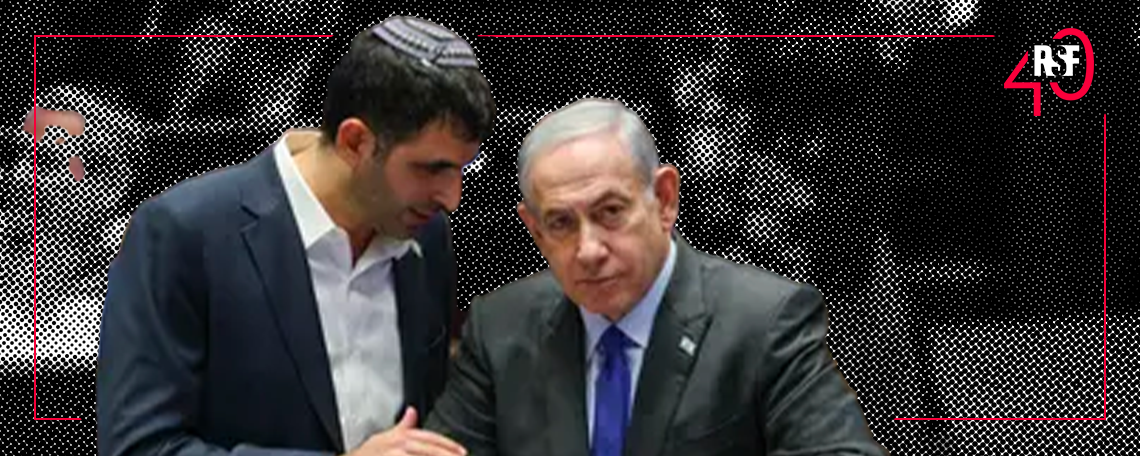
Although the rest of the legislative process is likely to be difficult, Israel’s Communications Minister Shlomo Karhi, a member of Prime Minister Benjamin Netanyahu’s Likud party, has managed to get a foot in the door. On the evening of 3 November, around midnight, his media broadcasting bill was adopted after its first reading, as part of a voting pact with ultra-Orthodox MPs.
The bill calls for the creation of a Broadcast Media Authority largely composed of members appointed by the Communications Minister himself. His ministry would also be entrusted with calculating television audiences, a measure approved by the Ministerial Committee for Legislation a year ago that was condemned by RSF.
Legal and legislative barriers are already being put in place in response to this attempt to strengthen the Israeli government’s control over the media landscape. Attorney General Gali Baharav-Miara, who is responsible for advising the government on legislative matters, is opposed to the bill, which has been deemed unconstitutional by the Knesset, Israel’s parliament. Two petitions against the bill have also been filed with the Supreme Court. One was submitted by the Union of Journalists in Israel, which represents around 3,000 media professionals. The other was instigated by the NGO Hatzlacha (meaning “success” in Hebrew), which promotes social justice.
Alongside this bill on broadcast media, a specific bill concerning the public broadcaster Kan, introduced by a Likud MP, is also making progress in parliament. This reform — which would give the Communications Minister direct decision-making power over the broadcaster’s budget — still needs to pass before the Ministerial Committee for Legislation before being put to a vote after its first reading.