
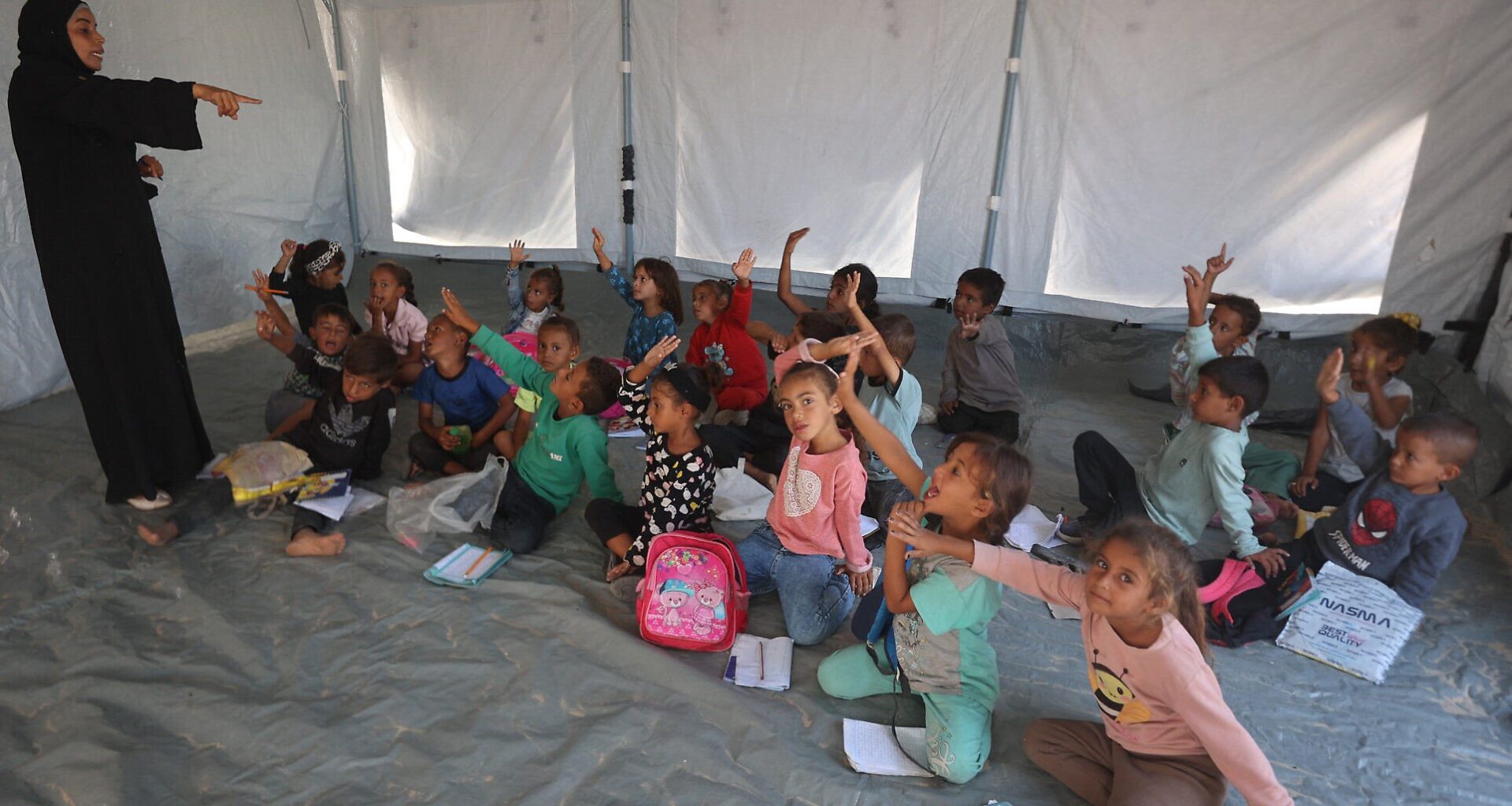
Gazan children have begun returning to school following two years of war in which education in the Strip was largely shut down, with tens of thousands back in classes managed by the same United Nations agency that critics say has for decades indoctrinated Palestinians to hate Israel.
Some 30,000 students have resumed in-person learning through schools run by the UN Relief and Works Agency, or UNRWA, according to Adnan Abu Hasna, the Gaza spokesperson for the Palestinian refugee agency.
Others are also attending schools run by various charities, and private schools that charge tuition have begun to crop up, though the Strip’s government-run public school system, which educated some 300,000 kids before the war, remains shuttered.
Those in UNRWA schools have not been able to return to classrooms with desks and chalkboards, due to extensive war damage and the transformation of most schools into shelters for the displaced.
Instead, footage coming out of the Strip shows students sitting on the floor in damaged buildings or tents.
Get The Times of Israel’s Daily Edition
by email and never miss our top stories
By signing up, you agree to the terms
A report submitted to the UN Human Rights Council last June found that over 90 percent of universities and schools in Gaza were damaged or completely destroyed by Israeli actions – through airstrikes, shelling, fires, and controlled demolitions.
???? Palestinian children are trying to continue their education under difficult conditions in a UNRWA building in Deir al-Balah, Gaza
???? Educational activities have been suspended in Gaza for nearly 2 years, as bombs have destroyed most schools, and the remaining buildings have… pic.twitter.com/GX5kgKhti2
— Anadolu English (@anadoluagency) November 5, 2025
Today, in the UNRWA schools still standing, displaced families continue to take shelter, preventing a full return to regular classes. UNRWA’s Gaza spokesperson, Adnan Abu Hasna, is well aware of this reality – but remains undeterred.
“We work with what we have,” Abu Hasna told The Times of Israel in an interview from Cairo, where he relocated from Gaza during the war.
“We started in 1949 in tents – and now, we start again in tents,” he said of the year the agency was founded.
Created to care for Palestinians displaced during the 1948 war for Israel’s independence, the agency continues to provide free education and healthcare services to millions in Gaza, the West Bank, Lebanon, Syria and Jordan descended from those original refugees.
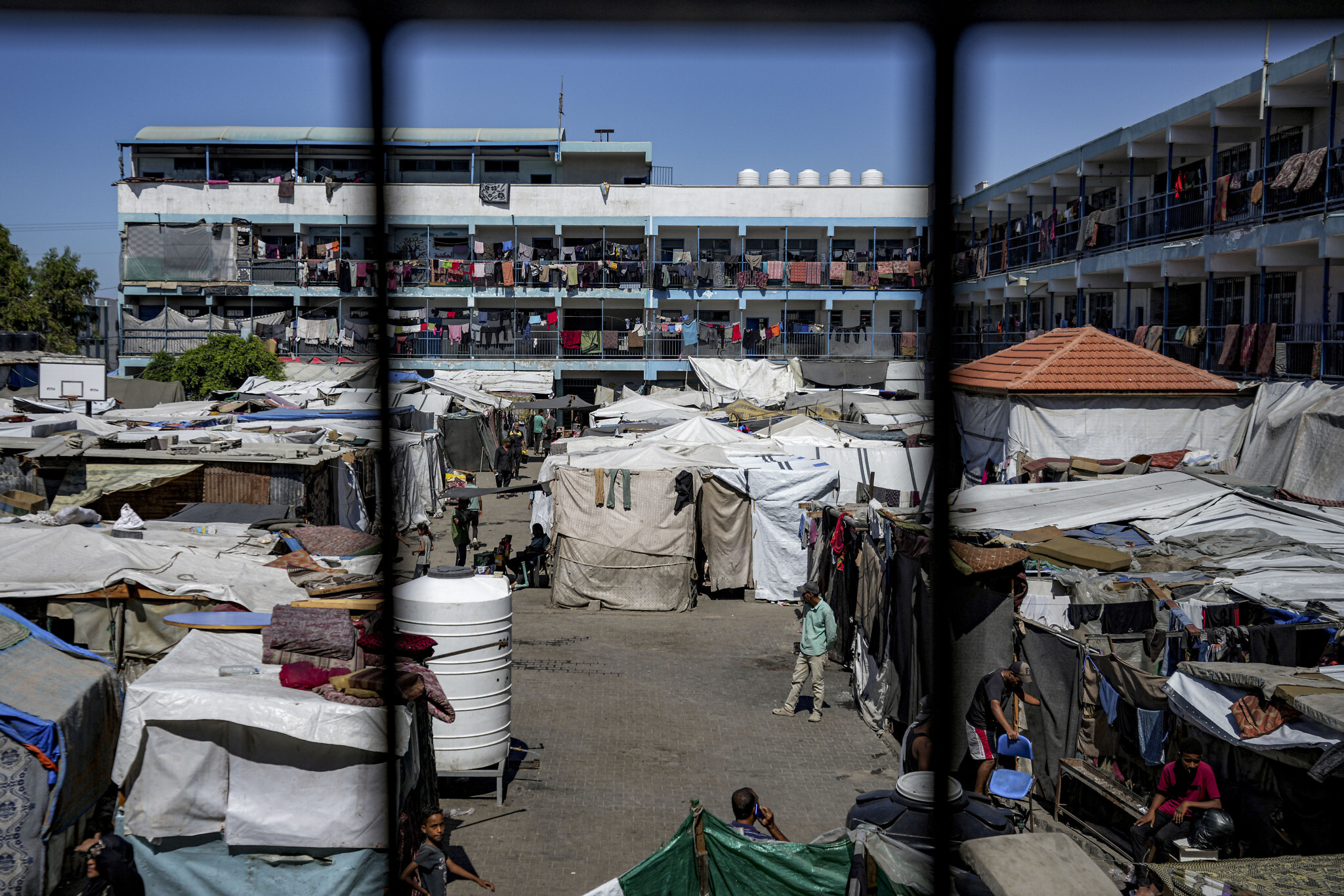
Palestinians take shelter from the Israeli bombardment at a school in Khan Younis, in the Gaza Strip, Wednesday, September 4, 2024. (AP Photo/Abdel Kareem Hana)
The Strip accounts for over half of the approximately 550,000 students UNRWA serves, with nearly 300 schools educating some 290,000 Gazan students as of 2022, out of approximately 600,000 who attended school in the Strip before the war. Only descendants of refugees are eligible to attend.
Most who did not attend UNRWA school instead went to government schools, which continued to follow the Palestinian Authority’s curriculum even after Hamas took control of Gaza.
For years, research has shown that some materials taught in both PA and UNRWA schools in Gaza and the West Bank included incitement to violence against Israel, delegitimization of the State of Israel and antisemitic or racist content.
The agency teaches in Gaza and the West Bank using textbooks provided by the Palestinian Authority. Those textbooks have been found to contain problematic content, such as the non-recognition of Israel and incitement to violence against Israelis.
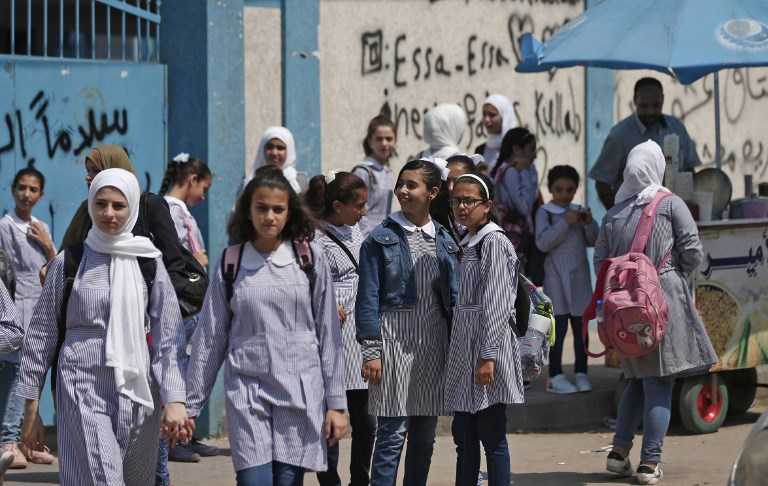
Illustrative: Pupils gather in front of a school run by the United Nations Agency for Palestinian Refugees (UNRWA) in Gaza City on August 29, 2018, on the first day of classes after the summer holidays. (AFP PHOTO / Mahmud Hams)
A study conducted prior to October 7, 2023, on supplementary materials written by UNRWA specifically for Gaza also found problematic content.
Marcus Sheff, the CEO of curriculum watchdog IMPACT-SE, told The Times of Israel that UNRWA was likely continuing to use problematic PA teaching materials in Gaza, despite promises to reform and remove offending content.
“These textbooks are antisemitic and incite to violence,” he told The Times of Israel. “As we have said many times, UNRWA abrogated its duty of care to the students it teaches and to the international community.”
Abu Hasna rejected these allegations. “We have a platform that shows our entire curriculum, and it is completely clean. It’s a curriculum free of incitement – one that speaks about equality, human rights, and gender issues.”
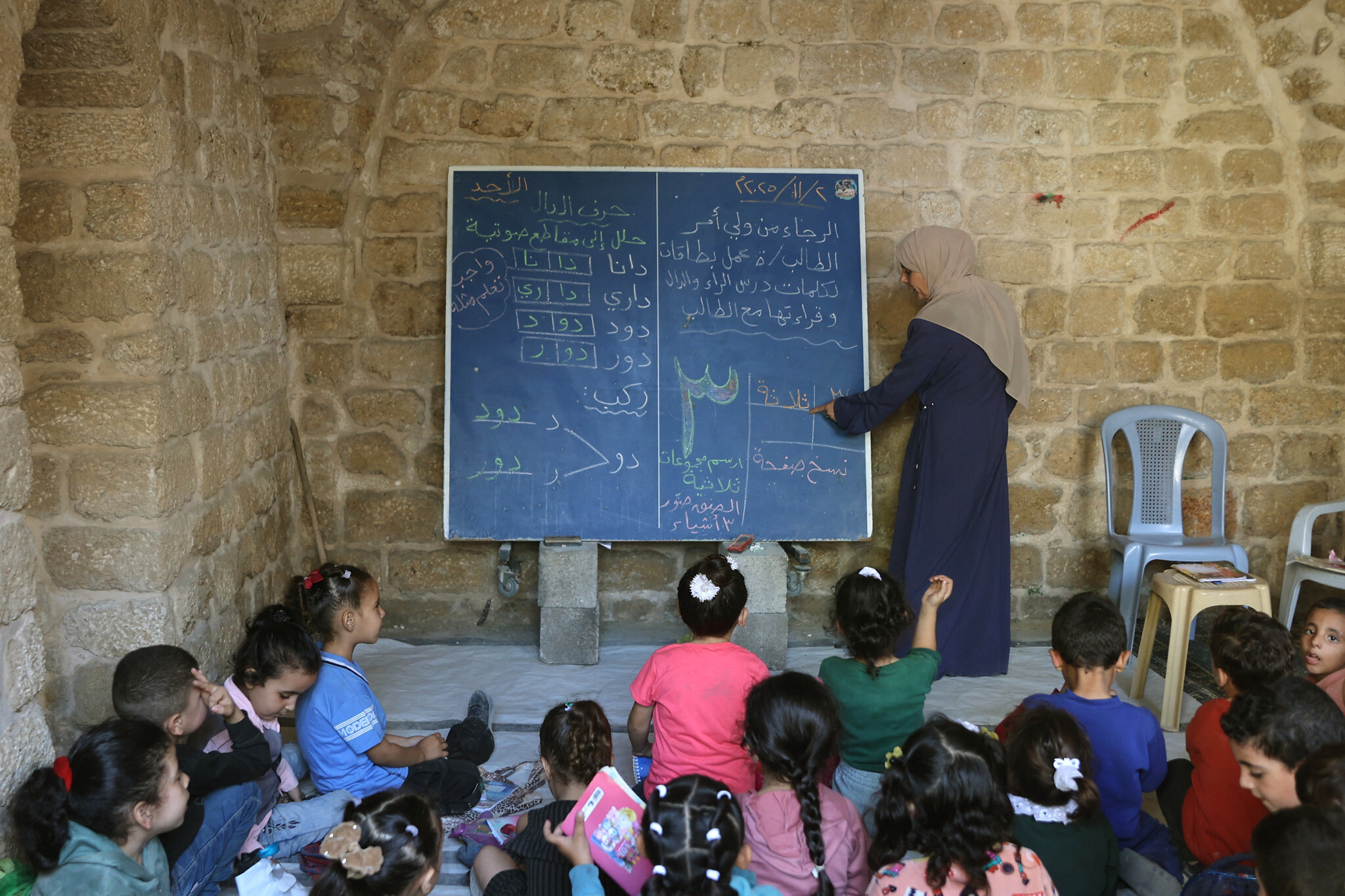
Palestinian children attend a class in school in Gaza City’s Old Town, in Gaza City on November 2, 2025. (Photo by Omar AL-QATTAA / AFP)
The UNRWA website includes only a partial account of the teaching materials it uses, and omits some subjects and textbooks.
Following the October 7, 2023, Hamas invasion and slaughter in southern Israel, and during the subsequent war in Gaza, Israel stepped up efforts to shut down UNRWA, accusing employees of collaborating with Hamas, and presenting evidence that some took part in the day’s atrocities and fighting against Israel.
In early 2025, Israel passed legislation prohibiting Israeli authorities and public officials from engaging with the organization and banning UNRWA operations within Israel — though the law does not apply to the West Bank or Gaza.
Last month, the International Court of Justice issued an advisory opinion stating that Israel is legally obligated to allow UNRWA to provide humanitarian aid in Gaza. The court found no evidence that UNRWA had violated the neutrality requirements under Article 59 of the Fourth Geneva Convention, which prohibits discrimination in the provision of humanitarian aid and services.
Government schools still closed
Aside from some schools that reopened during the two-month ceasefire in January and February of this year, schools in Gaza have essentially been shut since the war began with Hamas’s October 7 assault.
During the war, UNRWA emphasized that it continued to provide remote education, allowing students to download materials online via mobile phones. Hundreds of thousands of students in Gaza reportedly registered for this form of distance learning.
However, the agency also acknowledged that this option was extremely limited, available only to those who had access to mobile devices and electricity.
The PA also operated a remote learning program for students in Gaza. According to a study published on the program, some of the materials written specifically for Gaza’s students under wartime conditions contained anti-Israel and antisemitic content.
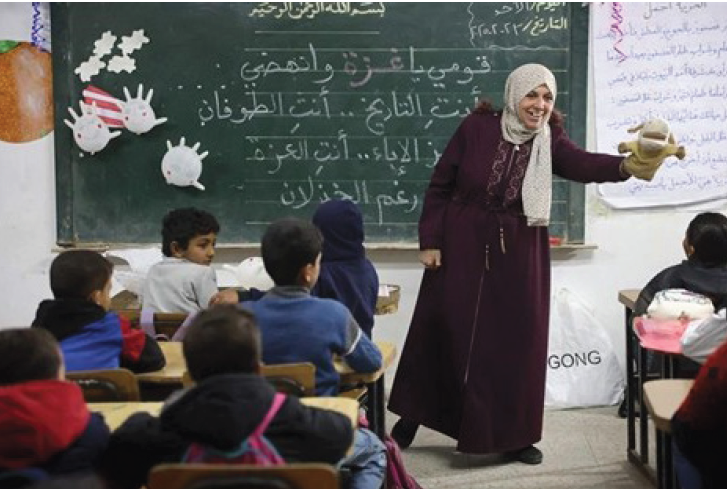
A teacher in Al-Nasr Elementary School in Gaza City stands next to a chalkboard with text that reads, “You are the Toufan” (the flood), a reference to the al-Aqsa Flood, Hamas’s name for the October 7, 2023, massacre in Israel, February 23, 2025. (Omar AL-QATTAA / AFP)
The return of students to physical classrooms in recent weeks marks the beginning of a gradual return to full in-person schooling, UNRWA officials say.
“We’ve opened 467 learning centers across the Strip, inside 67 displacement shelters,” Abu Hasna said. “There are 8,000 teachers, and classes are divided into two shifts – one in the morning and one in the afternoon.”
The agency is only operating schools in parts of Gaza where Israel’s military has pulled back from, including central Gaza, Khan Younis, and Gaza City.
“We can’t work in areas under military control or those that are unsafe, but most people are in western Gaza anyway. We work with what we have – even with the lack of books – but our activity continues,” he said.
In contrast, schools previously operated by Gaza’s Hamas-controlled government have not yet resumed.
There has been no official statement from Gaza’s governing authorities or from Hamas regarding the reopening of government schools, nor has there been any visual evidence of such an effort.
Izz al-Din Shehab, a resident of central Gaza, told The Times of Israel that some former government teachers were volunteering to provide education for elementary school children.
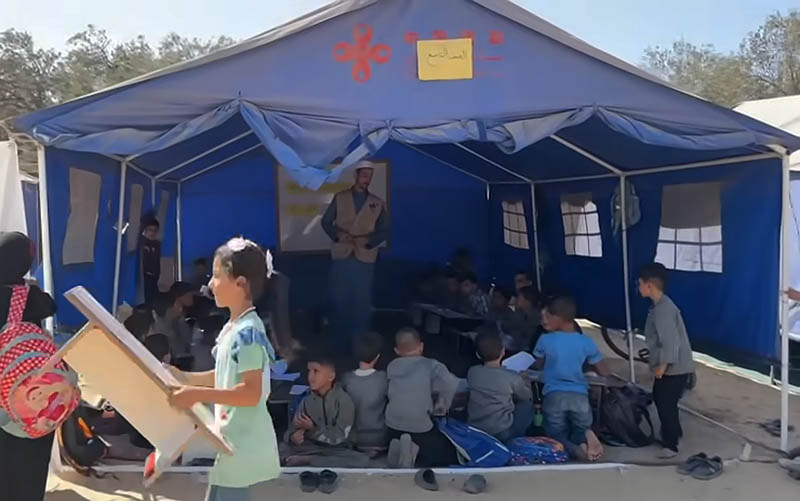
A school in Deir al-Balah operating in tents, run by the British Muslim charity Human Appeal. October 27, 2025. (screenshot: YouTube, 27a clause of the copyright law)
The White House’s postwar plan for Gaza does not explicitly state who will be responsible for education in Gaza, or whether UNRWA will continue in that role.
The scheme puts civilian affairs, which would likely include education, in the hands of the temporary administrative committee of Palestinian technocrats that will govern the Strip.
According to Arab media reports, the committee has yet to be formed due to internal disputes between Hamas and the Palestinian Authority, as well as disagreements between Palestinians and Israel over who will serve on it and who will lead it.
No oversight, yes tuition
Beyond UNRWA, numerous other organizations are now active in Gaza’s education sector. Some are humanitarian groups that were involved in education during the war and have since expanded their efforts. Others have only recently begun operating in education, with the halt in fighting facilitating more in-person learning.
Footage aired by Al Jazeera on October 27 showed a school in Deir al-Balah operating in tents, run by the British Muslim charity Human Appeal. On October 30, Fayez Abu Shamala, the former mayor of Khan Younis, filmed himself visiting a school in the city run by the American aid organization LIFE.
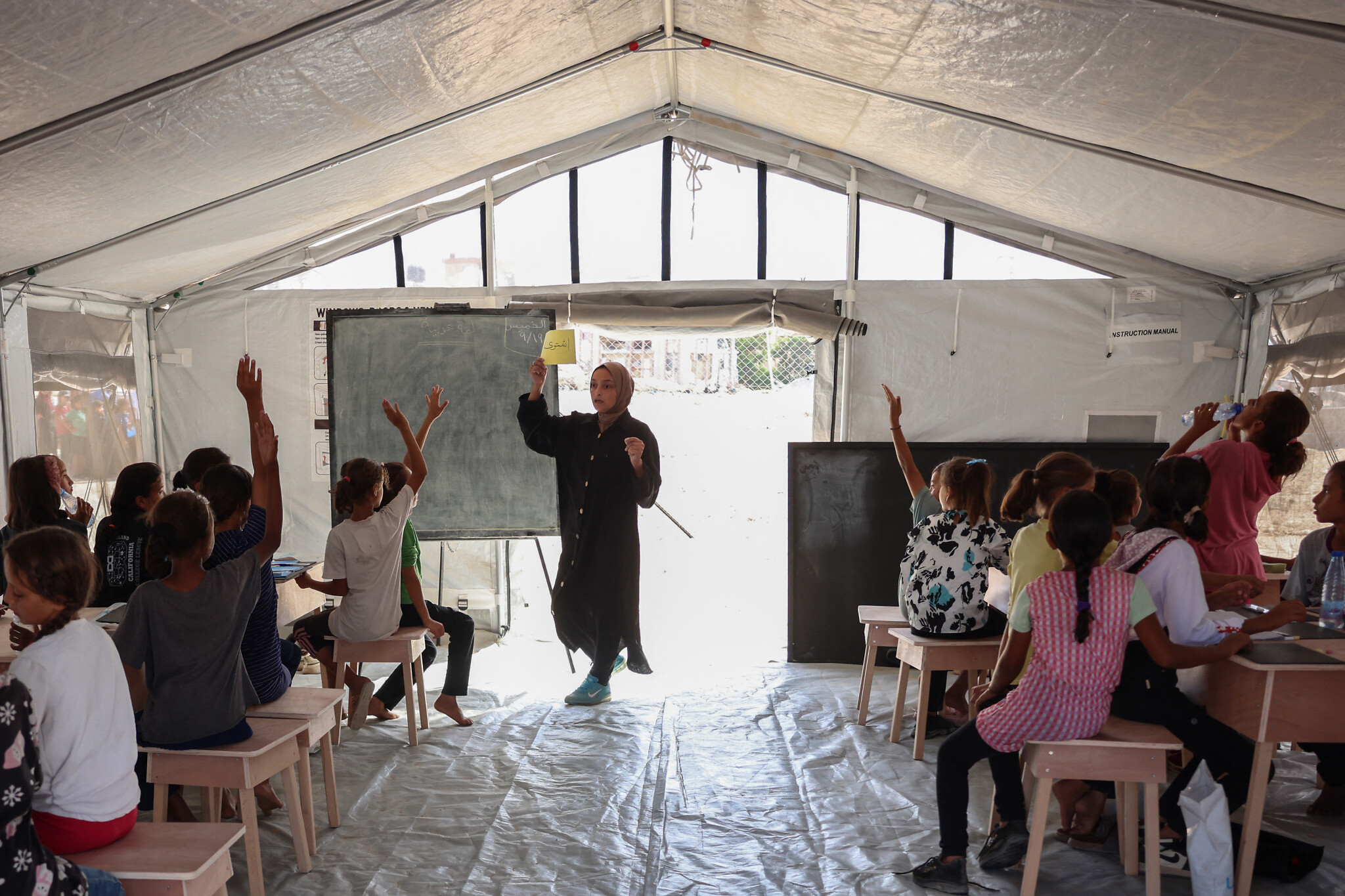
Palestinian school children attend a lesson at a temporary educational center under the supervision and funding of UNICEF in Khan Younis in the southern Gaza Strip, on September 19, 2024, amid the ongoing war between Israel and Hamas. (Bashar TALEB / AFP)
Other footage has shown schools without it being clear who is running them, including a newly opened school seen in a November 2 Al Jazeera report from the Zeitoun neighborhood of Gaza City. According to the report, about 300 students study there.
It remains unclear which curriculum is being used in these schools — whether run by aid groups or other local actors. None of the organizations has published details about their educational materials on their websites or in official statements, and no authority currently oversees or monitors what is being taught.
While most of Gaza’s two million residents are in the western part of the Strip under ostensible Hamas control, there are also tens of thousands of civilians in parts of the enclave under IDF control or within four zones held by Israel-backed militias, according to Israeli defense assessments.
The oldest of these militias, led by Yasser Abu Shabab, has reportedly been running a school for several months with a few hundred students.
Footage published in August showed students there learning about tolerance and peace. According to members of the militia, they rely on equipment provided by Israel.
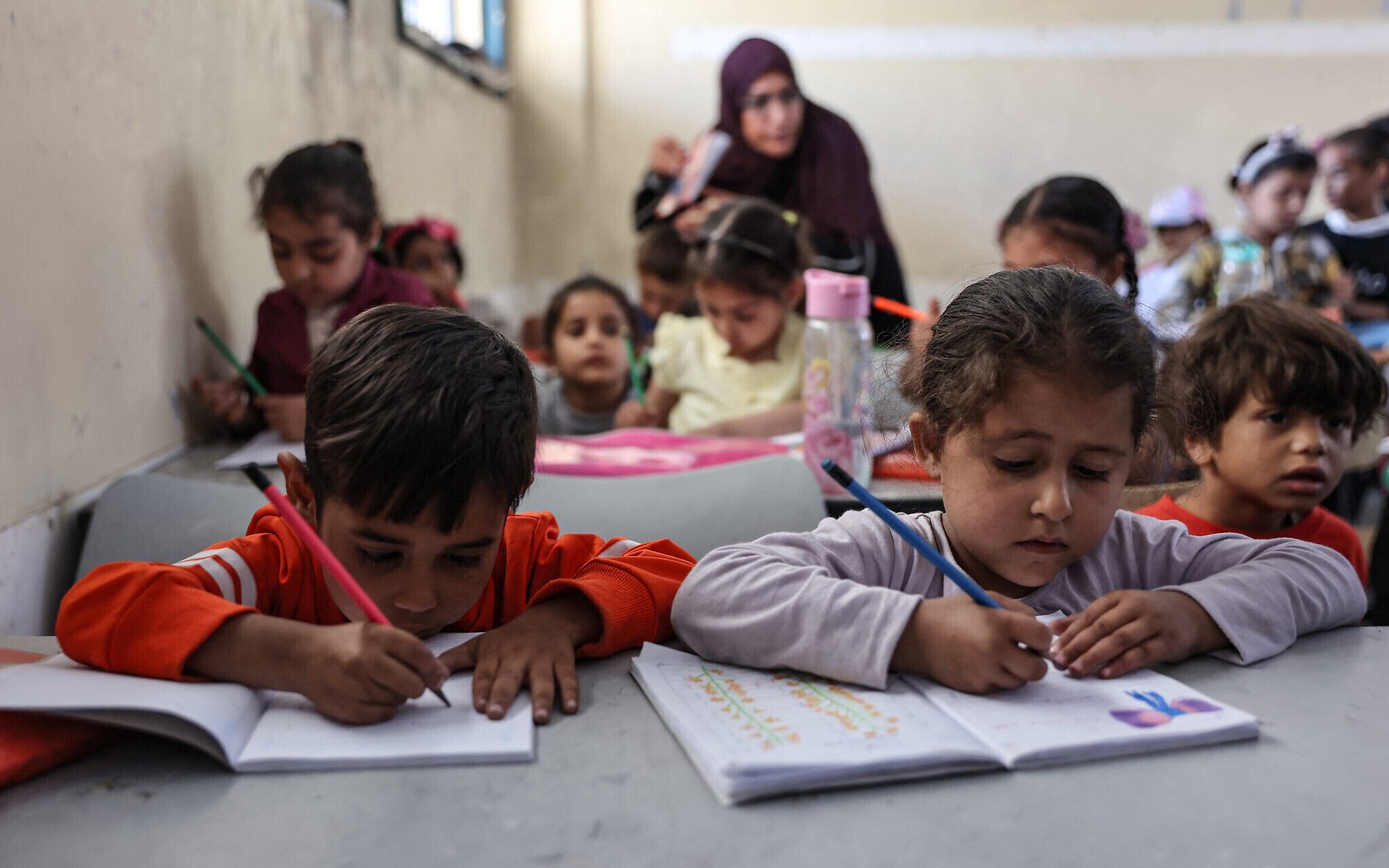
Displaced Palestinian children attend a class recently opened in a school used as a temporary shelter, in Beit Lahya in the northern Gaza Strip on May 4, 2024. (AFP)
Gaza residents say private schools and kindergartens that charge tuition fees are also being opened across the Strip.
Before the war, a small percentage of private educational institutions in Gaza charged monthly tuition, while those run by UNRWA or the government were free aside from nominal fees.
Before the war, private schools in Gaza operated only after obtaining licenses from the government. Today, the schools operate without oversight, and many appear to be for-profit ventures run by local businesspeople. Yet with government schools shuttered and limited space in free schools run by charities, many Gazan parents have little choice but to pay up for their kids’ schooling.
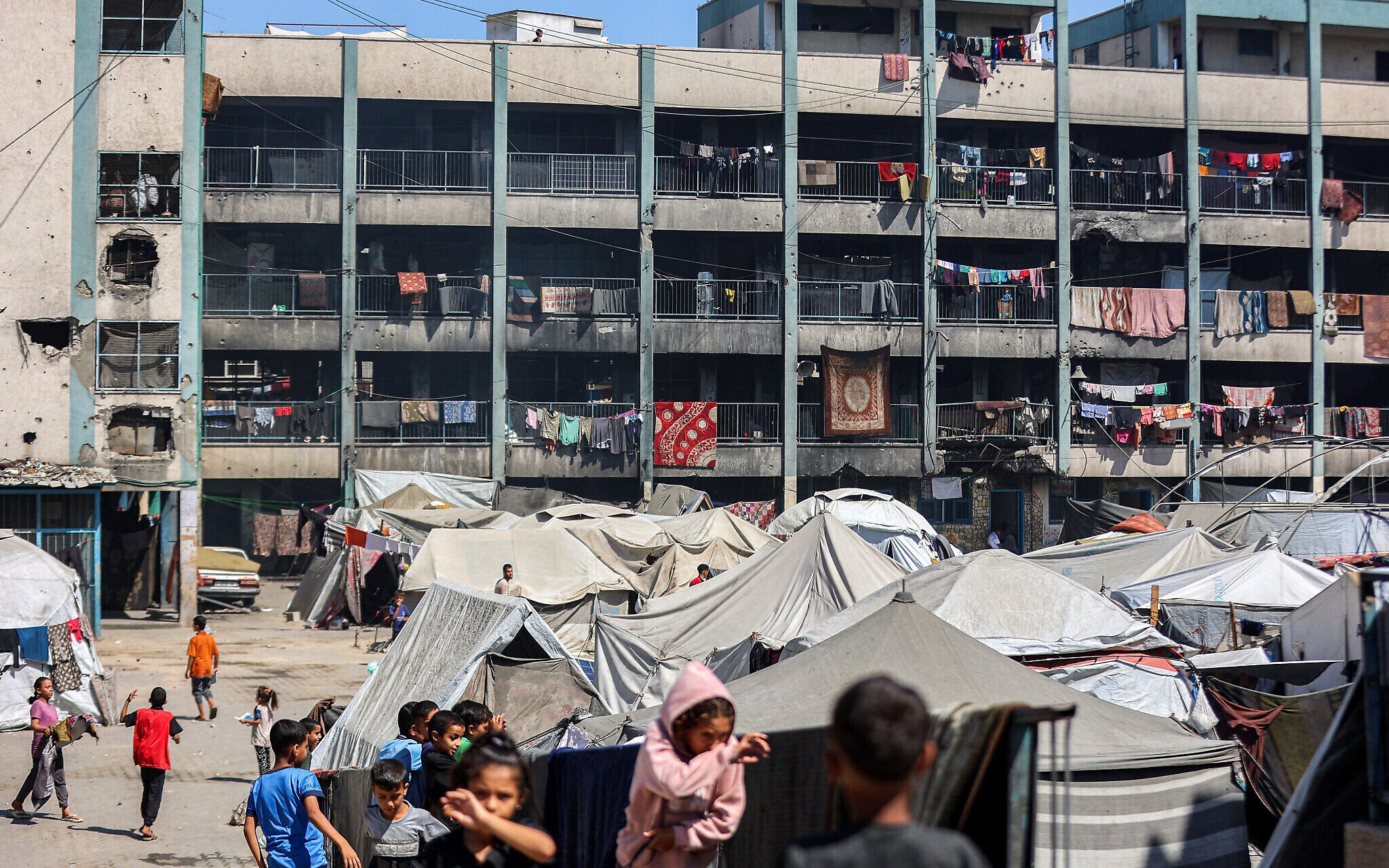
Tents sheltering people displaced in the yard of a school run by the UNRWA in Khan Younis in the southern Gaza Strip on September 30, 2025. (Omar Al-Qattaa / AFP)
“I don’t know if I’ll be able to keep up with the payments,” said Anas Arafat, a Gaza City father of three who recently enrolled his 6-year-old in a private school. “The lack of income makes it hard.”
His younger son, aged five, keeps asking when he’ll be able to go to kindergarten. But with schools charging NIS 800 ($245) per month, plus an NIS 500 ($150) enrollment fee, the out-of-work lawyer says the math does not work for him.
“He keeps asking me when I’ll register him, but prices are very high given that we have no income,” Arafat said.
Moein Hilu, another Gaza City resident, noted that despite the fees, some of the private kindergartens and schools were operating in tents due to the extent of destruction in the Strip.
Schools are just one part of Gaza’s daily life that will take time to recover from the war, he noted.
“Government schools haven’t reopened yet because people are living in them. Most of Gaza doesn’t even have running water,” Hilu said. “Gaza is destroyed in every sense.”