
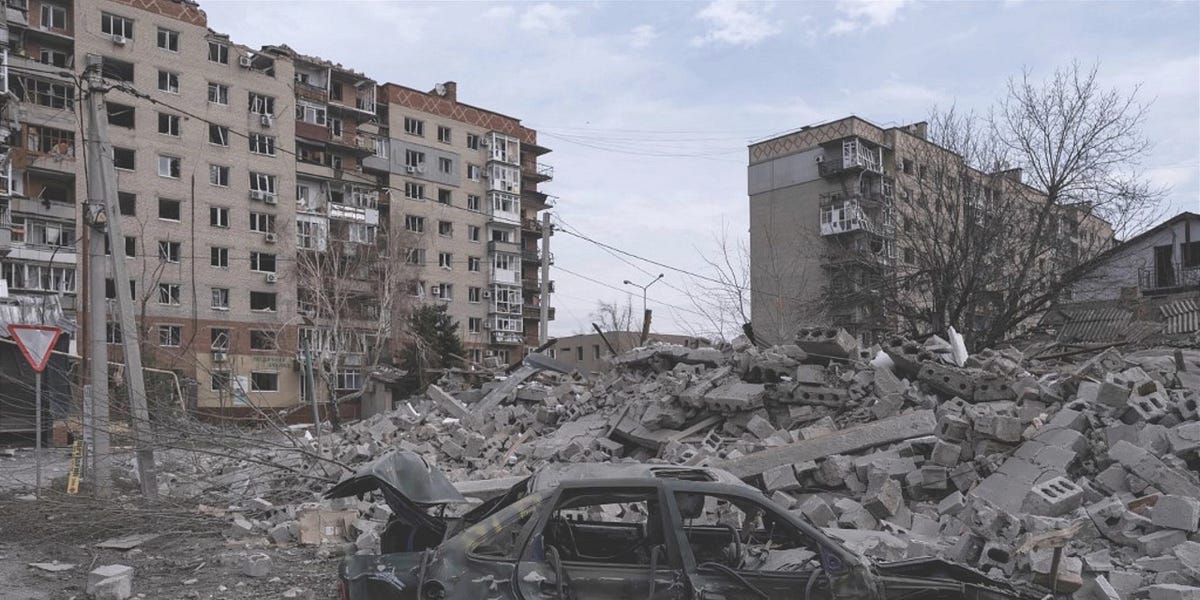
 Pokrovsk. Image: Kyiv Post
For the foreseeable future, Russia will remain a destabilizing force in Europe and the world. And Russia is not alone in its efforts to undermine the global rules. As you know it is working with China, with North Korea, with Iran and others. They are increasing their defence industrial collaboration to unprecedented levels. They are preparing for long term confrontation. We cannot be naive. We must be prepared. NATO Secretary General Mark Rutte, 6 November.
As is normally the case these days, it has been another big week in international affairs, and the war in Ukraine.
The Ukrainians conducted an insertion of special force troops to hold open the route into the Pokrovsk salient, although this smacks of desperation rather than good tactics. Ukraine and Russia are pounding away at each other’s power generation and distribution system as another northern hemisphere winter approaches. Citizens in both nations face a cold, bleak winter with rolling blackouts in many areas.
In the Pacific, China commissioned its third aircraft carrier, the Fujian, in the presence of President Xi. This is a significant technological achievement as the carrier is the first indigenously designed and produced carrier for the PLA Navy. China also continued its incursions into Taiwanese airspace, although at a slightly reduced tempo.
And, in other news, my brain is finally back to normal operations after a few days of reduced capacity due to jet lag!
Welcome to my weekly update on modern war and strategic competition.
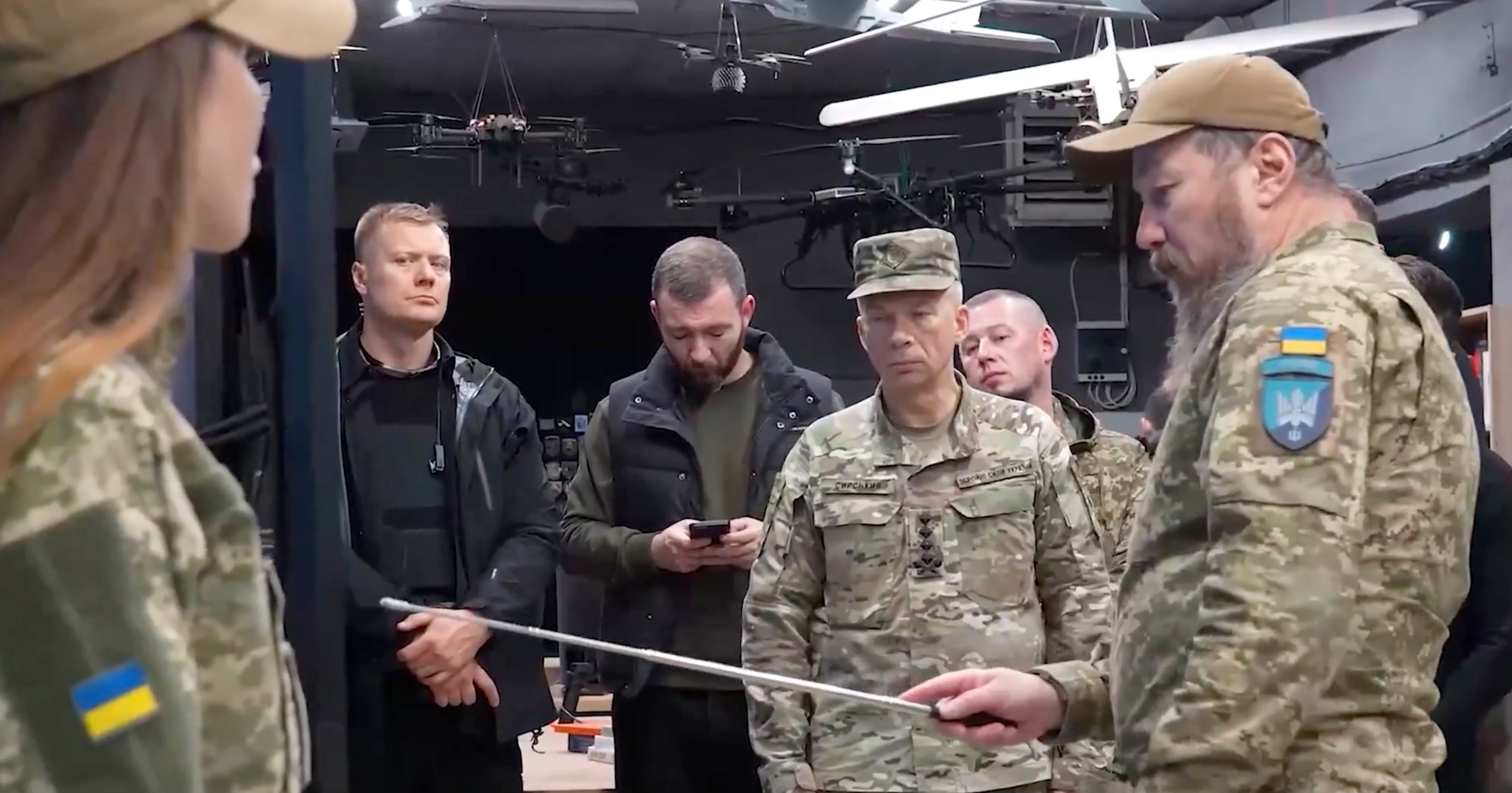 Image: @ZelenskyyUa
In Europe, the Drones Keep Coming. European authorities reported this week that more unidentified drone incursions occured in NATO airspace. The Swedish Civil Aviation Administration reported at least one unidentified drone flying over the Gothenburg Landvetter Airport on 6 November, which forced the diversion or cancelation of flights. On the same day, Belgium temporarily closed the Brussels Airport after an air traffic controller observed an unidentified drone. Belgian police confirmed on November 6 that unidentified drones flew near the Belgian Nuclear Research Center.
German General Warns of Future Russian Aggression. While presenting Operation Plan Germany this week – a new national defence plan aligned with NATO’s regional strategy – Lt. Gen. Alexander Sollfrank, head of the armed forces’ Operational Command, warned about future Russian aggression and stated that:
Russia is already today capable of carrying out a regionally limited attack on NATO territory…After the end of Russia’s war against Ukraine, and if its rearmament continues unchecked, a large-scale attack on NATO could become possible — and soon. That means we have to deal with the possibility of an attack against us, whether we like it or not. And beyond that, we have no time to lose.
Operation Plan Germany is part of Germany’s strategy of deterring Russian aggression by organising for up to 800,000 allied troops to move through Germany within 180 days to reinforce NATO’s eastern flank.
Ukraine’s Unmanned Air Defence Forces. This week, President Zelenskyy appointed Yurii Cherevashenko to command this organisation, and has tasked him with integrating unmanned systems – in particular, interceptor drones – and strengthening our air defense capabilities with advanced armaments.
Russia’s Casualties on the Uptick. As expected, and forecast in previous weekly updates, Russian average weekly casualties have shown an increase as the calendar year draws to a close. This increase has been observed now in all four autumn-winter periods of this war. The increase coincides with the desire of the Russian government to achieve significant Russian strategic objectives.
In 2022, it was the escalation in Russian operations around Bakhmut. Last year, it was Putin’s desire to capture as much territory as possible to shape the views of Presidential contender Trump. This year, Putin seeks the capture of Pokrovsk to again shape the narrative it rolls out to the Trump administration and it to put itself in a favourable position for subsequent operations in Donetsk.
We should expect the average casualties to rise over the next two months at least. Despite this, the only assessment that can be made with these figures is that Ukraine is killing enough Russians to ensure that Russia cannot win this war, but is not killing enough to change Putin’s calculus. Unless there is a drastic increase in the overall number of Russians killed (which the Commander of the USF has discussed) and the kill ratio between Ukraine and Russia improves, it is hard to see any drastic changes in the trajectory of this war.
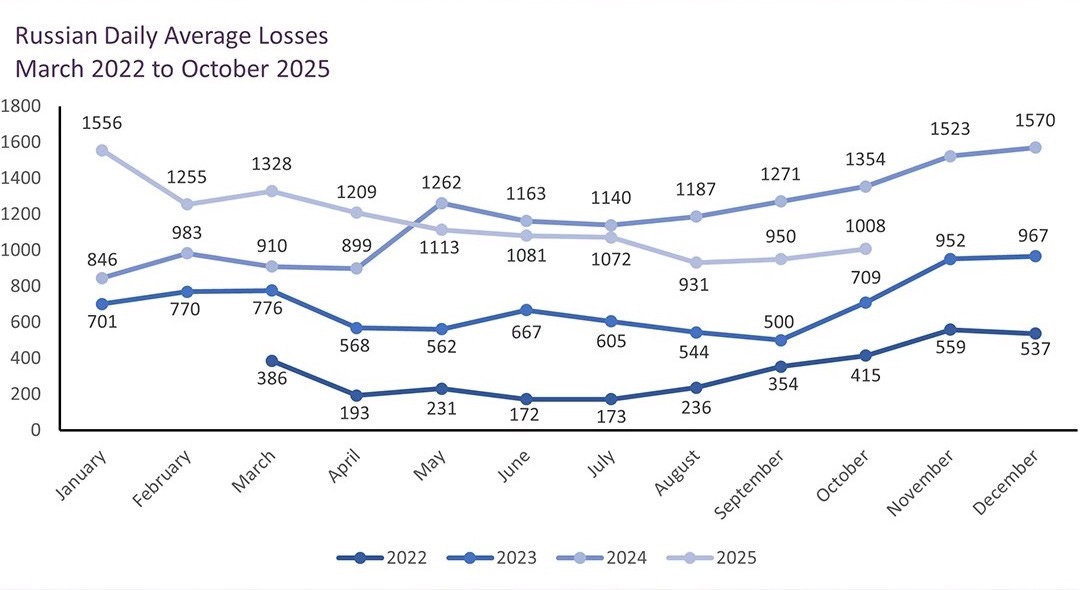 Image: @DefenceHQ
USF Update. The Unmanned Systems Forces released their monthly update for October on 7 November. Key statistics included in this month’s report include the following:
26,067 unique enemy targets were struck, including 8,060 enemy personnel, of whom 4,729 were killed.
The share of the Unmanned Systems Forces in the total volume of targets struck/destroyed by the Armed Forces of Ukraine is 33.5%.
Over 25% of the enemy’s oil-refining capacity has been put out of action thanks to precise strikes by the Unmanned Systems Forces.
Average cost to eliminate one russian serviceman — $784.
Average cost to destroy one unit of military equipment — $949.
You can view the full update at this link.
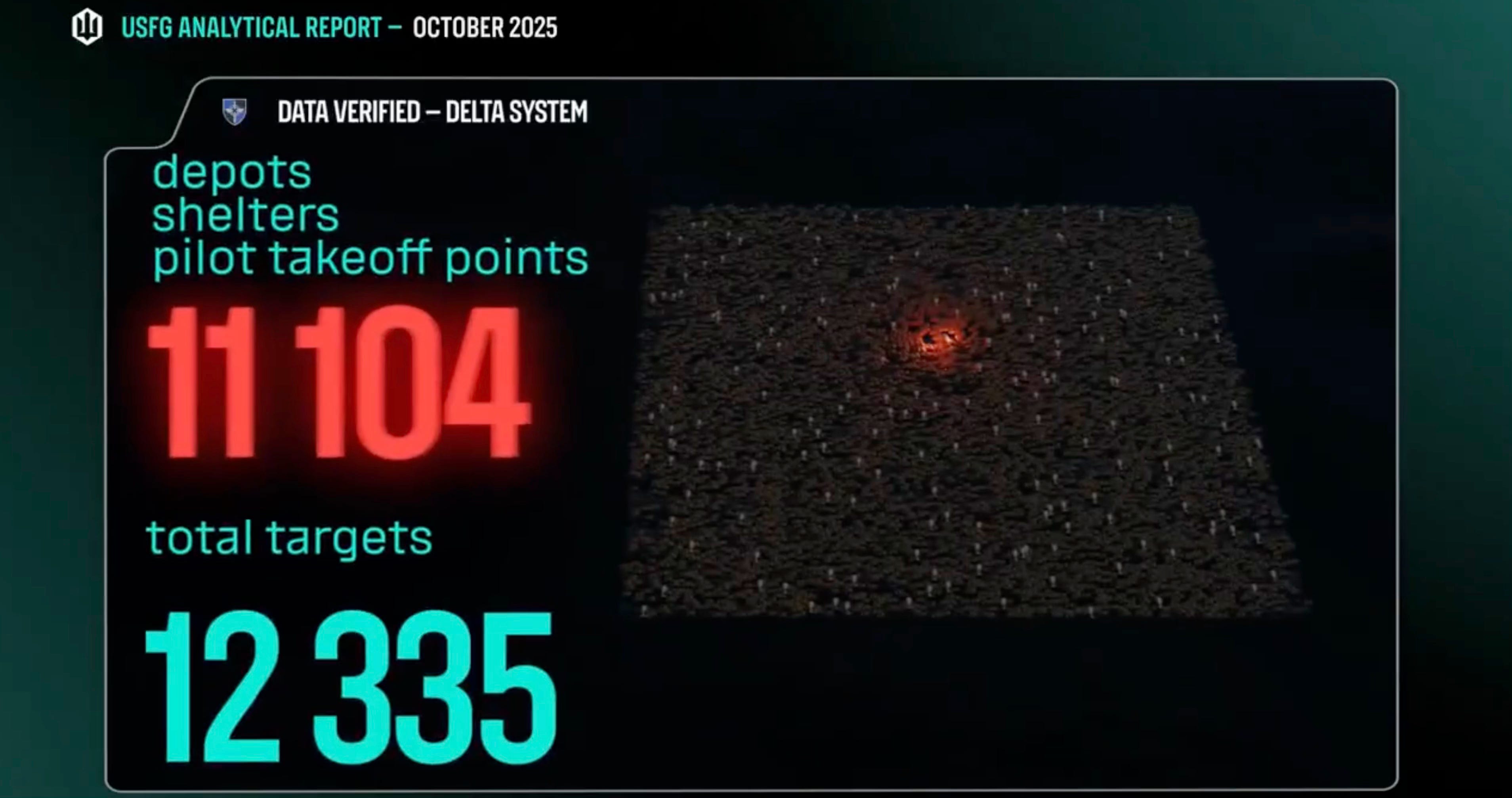
The Battle for Pokrovsk. While Ukraine continues to fight to retain ground in the Pokrovsk salient, it appears that the Battle of Pokrovsk may be approaching its culmination. The insertion this week of special operations soldiers to hold open the route out of Pokrovsk for Ukrainian defenders was courageous but may only delay what appears to be the inevitable fall of Pokrovsk.
The Battle for Pokrvosk began in earnest in July 2024, and since then, the Russians have maintained the Pokrovsk axis of advance as their ground operations main effort. Even when Ukraine executed its incursion into Kursk in 2024, Russia sustained its efforts on the Pokrovsk axis of advance. As I wrote at the time:
For the foreseeable future therefore, both Ukraine and Russia must commit to conducting two major ground campaigns concurrently. While Russia is probably better placed to resource two such campaigns, neither Ukraine nor Russia is likely to be able to do so into 2025…Unfortunately, as stunning and clever as the Ukrainian offensive in Kursk has been, it may not change Putin’s overall war goals. Previous setbacks, including the Russian Army’s defeat in its 2022 Kyiv offensive, its defeats in Kharkiv and Kherson as well as the international sanctions regime, have not modified Putin’s overall goal of subjugating Ukraine and destroying its capacity to exist as a sovereign, prosperous democracy.
And so this campaign has played out. The Ukrainian Kursk campaign is largely over. Russia, freed from its need to clear the Ukrainians from Russia soil, has continued to throw troops at the Battle for Pokrovsk and to prepare for subsequent advances.
Progression of Russia’s double envelopment of Pokrovsk since May 2025. Images: ISW
What will be the political and military impacts of a possible fall of Pokrovsk?
Political Impacts. The biggest impact of a fall of Pokrovsk will be to reinforce Russian strategic messaging about inevitable victory in this war. Of course, this proposition has no evidence given that in four years, Russia has lost over one million troops, taken less than 20% of Ukraine and is suffering massive damage to its economy from Ukrainian aerial assaults. But that won’t stop Putin, Lavrov and others from seeking to influence the Trump administration to pressure Ukraine to ‘stop the killing.’
The fall of Pokrovsk probably won’t do wonders for Zelenskyy’s popularity but he retains broad popularity and support of two thirds of the population. It is unlikely that Pokrovsk’s loss to Russia will have a major impact on Zelenskyy’s government given that he can demonstrate that the military has done everything possible to defend it. And, given the need to preserve the army is more important that retaining what is essentially now a dead city with no value as a logistics hub, the smart political move soon will be to withdraw Ukrainian troops while they can do so in good order.
Military Impacts. In many respects, the fall of Pokrovsk will simplify things for senior Ukrainian commanders in Eastern Ukraine. They will have straightened the defensive line, potentially allowing them to form some operational reserves to deny the Russians further advances if they take Pokrovsk.
Clearly this would also give the Russians a boost, and they will have an opportunity to potentially have an operational pause while they prepare for subsequent operations in the east. The seizure of the rest of Donetsk is a key political and military objective for Putin. Russian ground operations after Pokrovsk will be designed to achieve this goal.
The most likely campaign design to achieve this would be an operational level double envelopment of the Fortress Belt of cities in Eastern Ukraine. I have sketched out what this might look like on the map below.
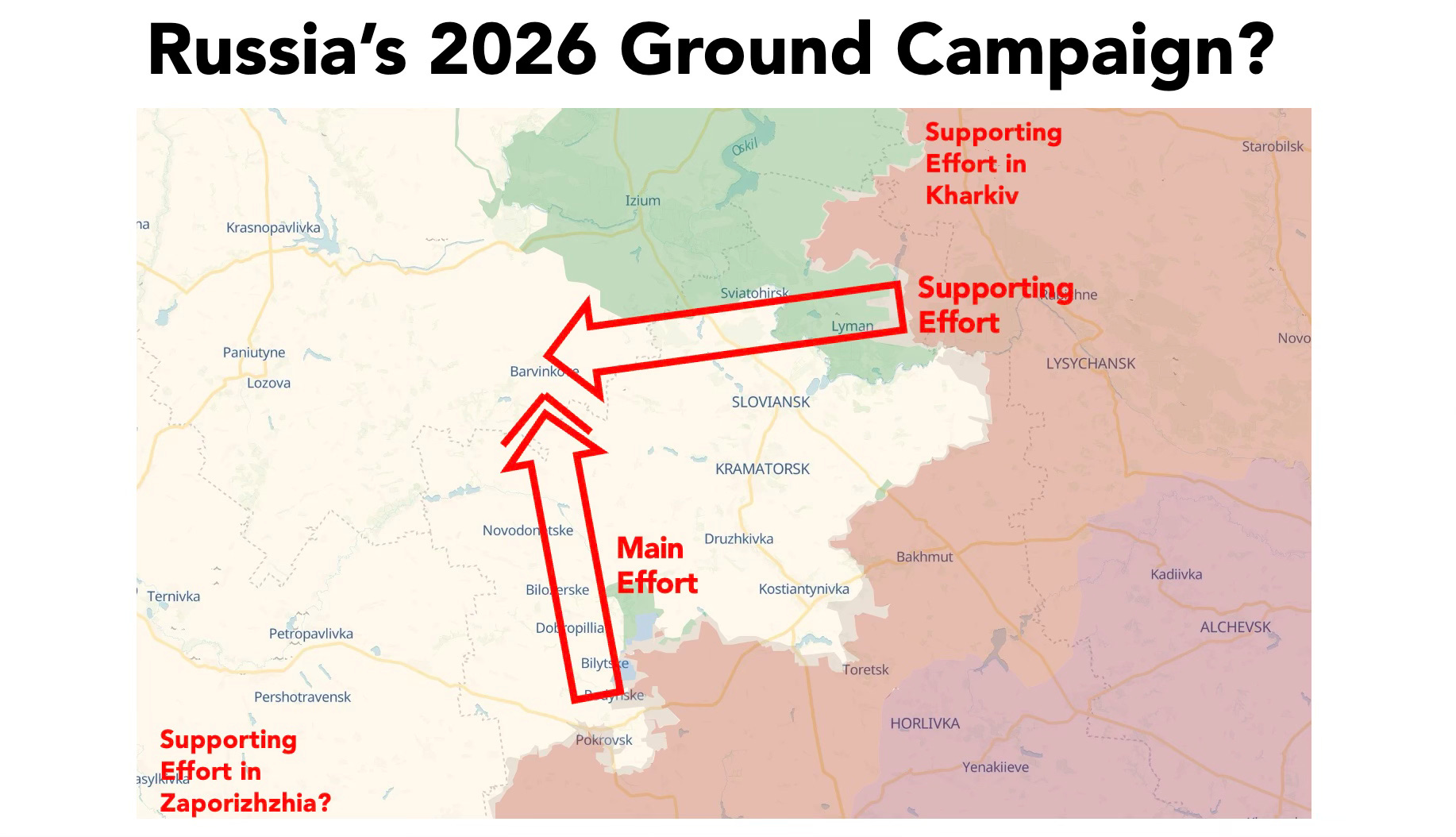 Background map from DeepState Live.
Ukraine’s Long-Range Strike Campaign. Frequent readers here will know that I have covered the development of Ukraine’s deep strike capability over the past three and a half years. It has been a very impressive achievement for a nation that just four years ago had almost no capability to conduct long-range strike operations. In the intervening time, Ukraine has built a hybrid strategic strike force that is a mix of western and indigenous weapons, and mix of foreign and Ukrainian sourced target intelligence, and balance of technological and human capabilities to enhance the precision of their strikes.
You can read some of my recent assessments of Ukraine’s deep strike campaign, and the various components of Ukraine’s long-range strike force here, here and here.
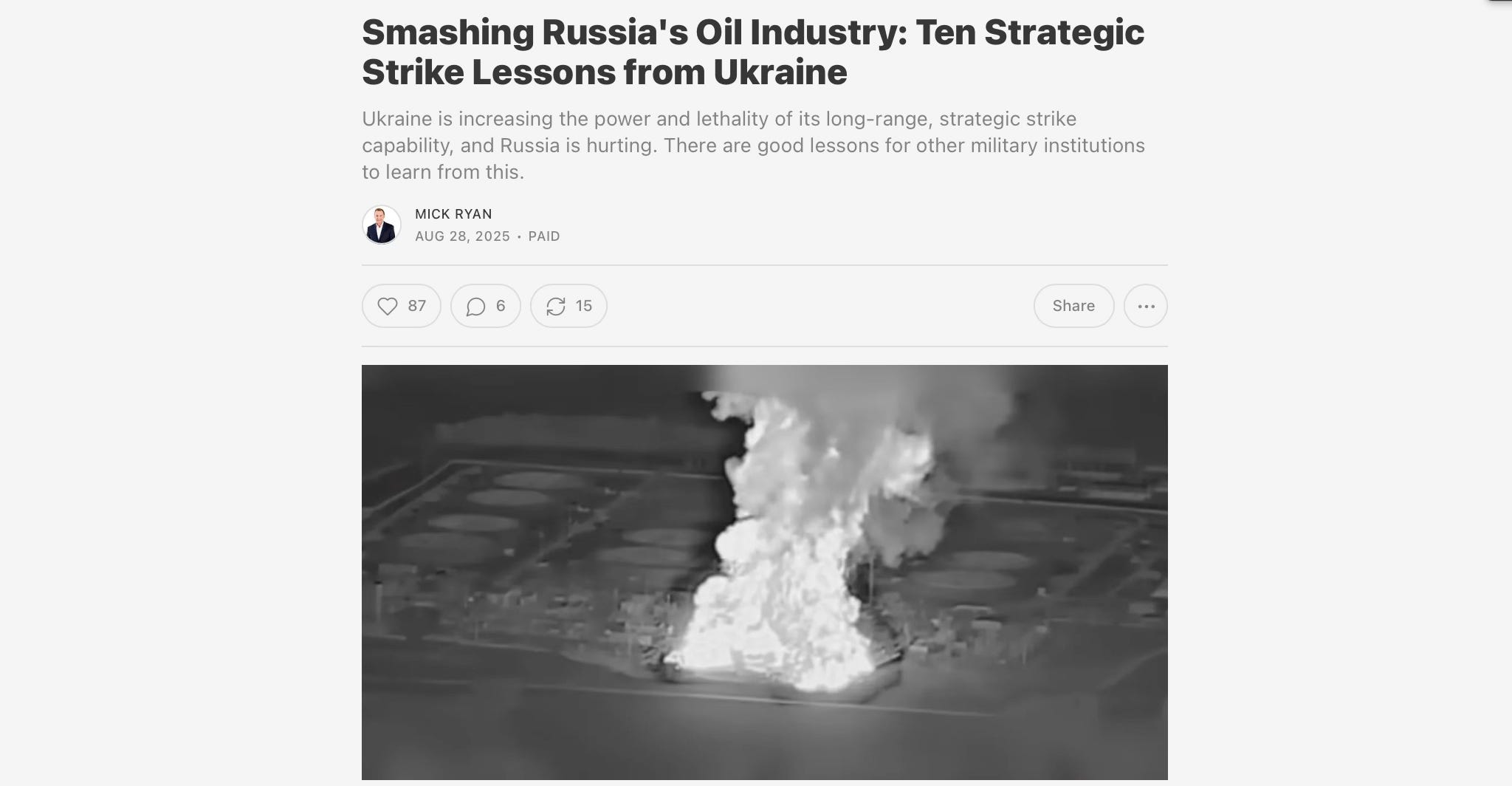 A recent article of mine about what we can learn from Ukraine’s long-range strike campaign, which can be read at this link.
For some time, the main effort of Ukraine’s deep strike campaign has been Russian energy infrastructure, primarily oil refineries and storage facilities. The supporting effort has been striking defence manufacturing sites (including this recent one which destroyed many Shahed drones) as well as munitions storage locations.
It now appears that Ukraine has shifted its targeting slightly to encompass the Russian power generation and distribution system. The Russian power plants struck in the past week (according to a list compiled by Stefan Korshak) include:
Orel gas power plant, two explosions, fuel storage and main generator buildings hit and on fire.
Vladimirskaya Power substation station, two hits.
Zheleznegorsk power transmission station, Kursk region.
Alechevsk city, Luhansk, power transmission station.
Orel, city heating plant.
Usman power transmission station, Lipets region.
Vladimirskaya substation.
Oryel heating plant.
Yaroslavl region, two oil transfer stations hit.
Volgorechensk, Kostroma thermal plant, supports Moscow.
As Korshak describes in his article for the Kyiv Post:
Since Oct. 13, according to Kyiv Post counts, Ukrainian strike planners have launched at least 29 separate strikes directly targeting power grid infrastructure inside Russia or occupied Ukrainian territories, with attacks almost always seemingly intended to hit flammable sections of a transformer station to set it afire. Over the same 3-week period Kyiv has launched a total 76 strikes, with the majority of attacks aiming at Russian capacity to process oil and gas products, or export them.
Prior to October, Ukraine targeted multiple Russian power generation and distribution facilities. The September strikes on Russian power infrastructure has been mapped by Shahed Tracker, and can be seen below.
So, there has been a shift in targeting by Ukraine. What are we to make of this?
First, it is clear that Ukraine is now producing sufficient long-range weapons to target a wider variety of Russian targets concurrently. This helps to overwhelm the Russian air defence system. While the Russians have demonstrated the ability to learn, adapt and improve their air defences, even they cannot defend every potential target at the same time. If the Ukrainians throw enough weapons at enough targets dispersed over a wide area, some will get through.
Second, it is unlikely the shift to targeting Russian power supplies is designed to bring Putin to the table. If over one million casualties can’t do this, a few power blackouts (which will not affect Putin or his senior leadership) is not going to achieve this. It could however be designed to foster a negotiation over halting the targeting of power plants by both sides.
Third, the means of conducting long-range strike has evolved since the beginning of this war. In 2021, the key methods for executing a long-range strike against an adversary were missiles launched from aircraft (particularly long-range bombers) as well as missiles fired from submarines and ships. Now, with the development of multiple classes of long-range drones which are produced in large numbers – and the introduction into service of ground-launched weapons such as PRSM and the Typhon system – western military organisations have a wider array of options to chose from in developing their deep strike capabilities. And, the flip side is, they have a wider range of threats that they must now defend against.
Finally, despite the huge expense and the mass use of aerial assault weapons so far in this war, they have proved again that this strategy is not a silver bullet in war. It can certainly cause significant damage, and pain to civilians and a nation’s war effort. But long-range strike operations by themselves are insufficient national tools by themselves for winning a war. As the evidence so far shows us in Ukraine, the deep strike campaigns of both sides has yet to force a negotiated resolution to the war.
Meanwhile, on the evening of 8 November, Russia launched a large, combined strike on critical infrastructure facilities in Ukraine using strike UAVs, air-, ground-, and sea-based missiles. As described by the Ukrainian Air Force, the air defence forces detected and tracked 503 air attack weapons – 45 missiles (including 32 ballistic) and 458 UAVs of various types (about 300 Shaheds). The main directions of the strike were the Kyiv, Dnipropetrovsk, and Poltava regions. Around 406 of their drones and missiles were brought down by Ukrainian air defence units, according to reporting in the Kyiv Independent.
China’s New Carrier. This week, the PLA Navy officially commissioned its third aircraft carrier, the Fujian (Hull No. 18), at the Yulin/Longpo Naval Base in the presence of President Xi. The first indigenously designed aircraft carrier for the Chinese navy, the new carrier is equipped with an electromagnetic catapult and recovery capability.
The carrier was launched in 2022 and has conducted nine series of sea trials. It is designed to carry up to 40 fixed wing aircraft plus helicopters. On display on the Fujian’s deck during the commissioning ceremony were the four types of aircraft most likely to form its initial airing: the fifth-generation Shenyang J-35 naval fighter; the Shenyang J-15T fourth-generation fighter; the KJ-600 airborne early warning aircraft; and, the Hongdu Z-20J medium multirole naval helicopter.
The PLAN now has three aircraft carriers in service. Theoretically, this means they should be able to keep one deployed at all times.
The China Power site at the Center for Strategic and International Studies has a primer on the new aircraft carrier, which you can peruse at this link.
BrahMos in the Philippines. The BrahMos missile system is now operational with the Philippine Marine Corps. The Corps unveiled its first BrahMos missile battery during a 75th anniversary ceremony on 7 November. The battery is deployed in Zambales. From there, the BrahMos missiles can reach locations such as Scarborough Shoal.
Designed and built in India, the Brahmos is a ramjet-powered, long-range supersonic cruise missile which is capable of being launched from a variety of platforms including ground, air and naval platforms. In Indian service, the missile has a range of up to 900km, but the export version is limited to a range of 290km.
UAV Battalions for Taiwan’s Operational Theatres. Taiwan has announced that each of the Operational Theatres in its military command structure will be allocated an integrated UAV battalion by 2026. The Taiwanese Theater Command boundaries are shown in the graphic below.
Taking effect from 1 January 2022, the Taiwanese reorganised their three army corps and two defence commands into five main “theatres of operation”.
In a related development, the Taiwanese Ministry of National Defense has announced the reorganisation of drone development and employment into three key roles: joint operations, tactical, and combat
At the joint operations level, Taiwan’s uncrewed aerial vehicles conduct long-range reconnaissance, surveillance, and strike missions in the air and sea domains.
At the tactical level, drones will execute reconnaissance and target identification, draw enemy air defences to waste missiles, and support joint anti-landing and coastal defence missions by Taiwan’s Theater Commands.
In combat, drones will be employed to extend the range of other weapons, speed up target acquisition, and to conduct sustainment activities during prolonged operations.
North Korean missile test. This week, North Korea fired a single short-range ballistic missile. The missile landed in waters outside Japan’s exclusive economic zone.
Ghost Sharks in Production. This week, Anduril Australia opened its new Ghost Shark manufacturing facility in Sydney. The factory will produce these large, uncrewed underwater vessels for the Royal Australian Navy. The opening coincided with the rollout of the very first series-produced Ghost Shark extra-large autonomous underwater vehicle ahead of its scheduled delivery date.
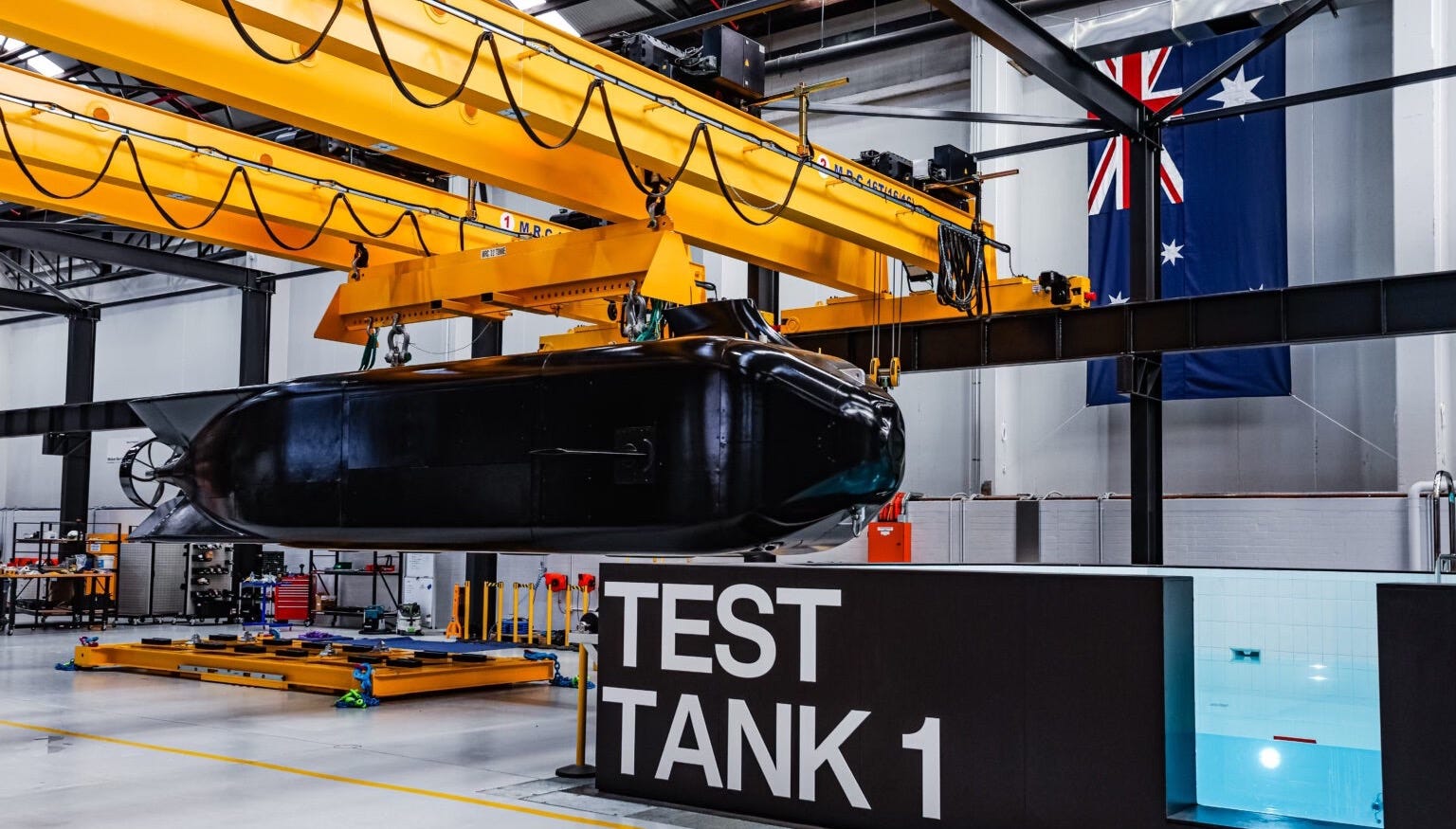 Image: Asian Military Review
*******
This week I published a couple of articles. I began the week publishing an article that summarised by recent visit to Ukraine, Poland, Germany and Canada. In this piece, I included the transcript of a speech I gave in Canada, called Confronting Complacency. You can read the article at this link.

I also published an article that summarised some of my insights from Ukraine about drone operations, which I briefed an Australian federal parliament committee about early in the week. You can read that piece here.
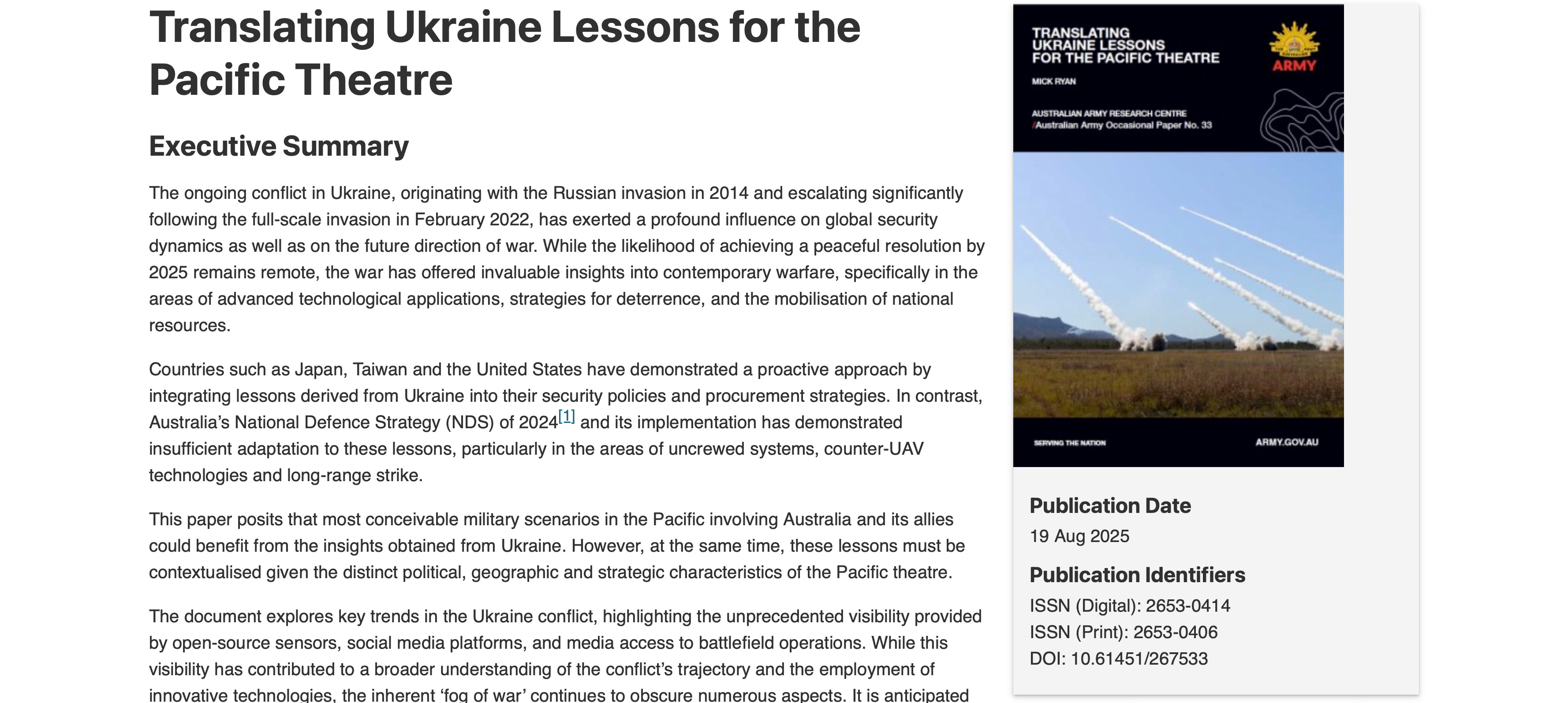
Finally, if you haven’t already read my recent report, Translating Ukraine Lessons for the Pacific, you can do so here at the Australian Army Research Centre website where you can also download a pdf version of the full report.
*******
It’s time to explore this week’s recommended readings.
I have included a new report that explores how the United States of America might compete against Russia and China in space from the Center for Strategic and Budgetary Assessments, as well as an article from War on the Rocks about the future of the military profession. There are two useful articles on drone developments, including the Shahed interceptors developed by the Wild Hornets, as well as a good piece on the global battle of narratives.
As always, if you only have the time available to read one of my recommendations, the first is my pick of the week.
Happy reading!

In this report from the Center for Strategic and Budgetary Assessments, the author argues that the United States cannot treat space threats from China and Russia in isolation; instead, American must be prepared to deter or counter both simultaneously. To compete and deter in this environment, the author contends that the U.S. Space Force must adopt a more proactive approach and match efforts at deterrence by denial and resilience with investments in counter-space capabilities. Read the full report here.

In this article, the author examines alternate models for the profession of arms as the world and its political systems evolve in the 21st century. As the author writes, “if liberalism weakens, the profession of arms will inevitably adapt to whatever civic order replaces it. Because the military has always drawn its legitimacy from its regime, officers ought to be prepared to redefine professionalism in post-liberal contexts rather than assume present norms will endure.” The full article can be read at this link.
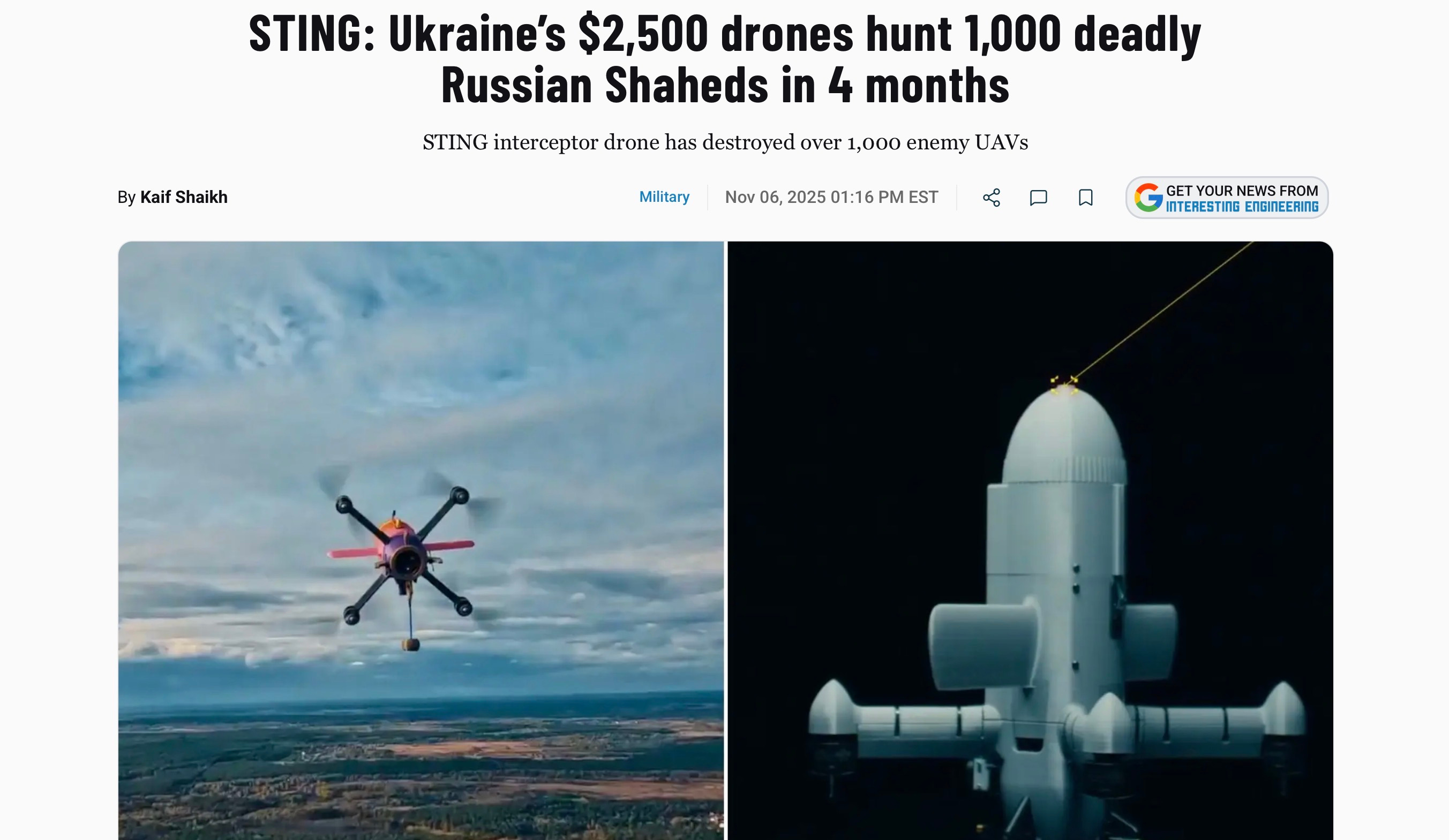
In this article from Interesting Engineering, the development and employment of low-cost, Shahed interceptor drones is examined. Developed by the Wild Hornets, this new, low-cost vehicle is designed to lower the cost of intercepting Shades, and provide an affordable solution to Russia’s attempts to overwhelm Ukraine’s air defences with large numbers of Shahed drones. You can read the full article at this link.

In this article published by Foreign Affairs, the author argues that “one way to think about the current state of the world is to imagine it occupying the intersection of story and war. The story has gained ascendancy as a vehicle for understanding the world while the ability to interpret narrative has atrophied.” The key argument is that the consumers of extant narratives must be better at interpreting the kinds of strategic messages and narratives propagated by governments and other institutions, and make their own judgements about what the truth really is. The article can be read here.
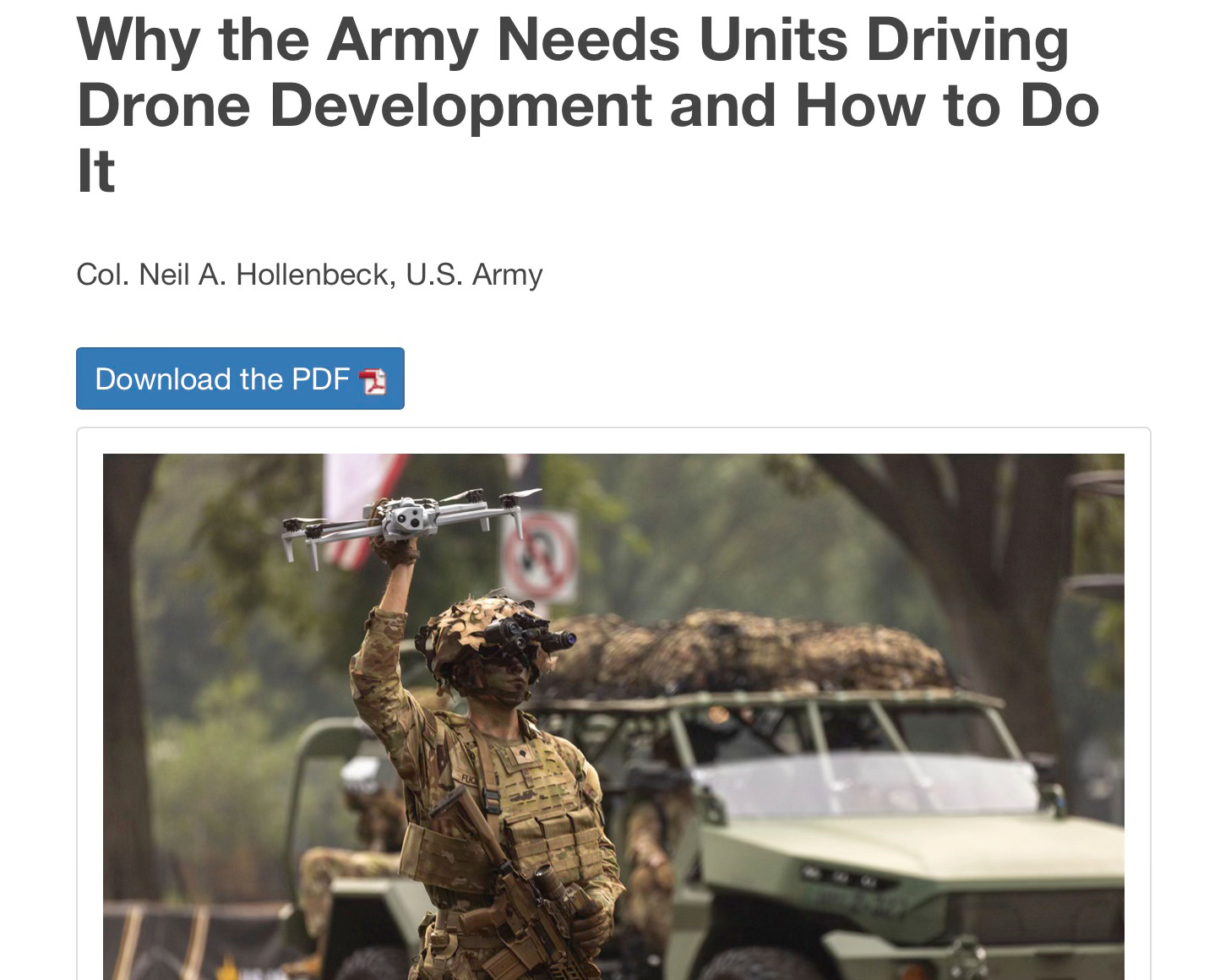
In this article published by the U.S. Army’s Military Review, the author proposes a leading role for army units in driving the development of drones, and their accompanying tactics and organisational changes. As the author notes, “the Army should lead the world in developing capabilities for small-drone warfare. It does not because the Army’s process, while designed to take input from operational units, still holds them at too far a distance. If the Army wants maximum speed and agility, units must do more than inform the process—they must drive it.” The full article is available at this link.