
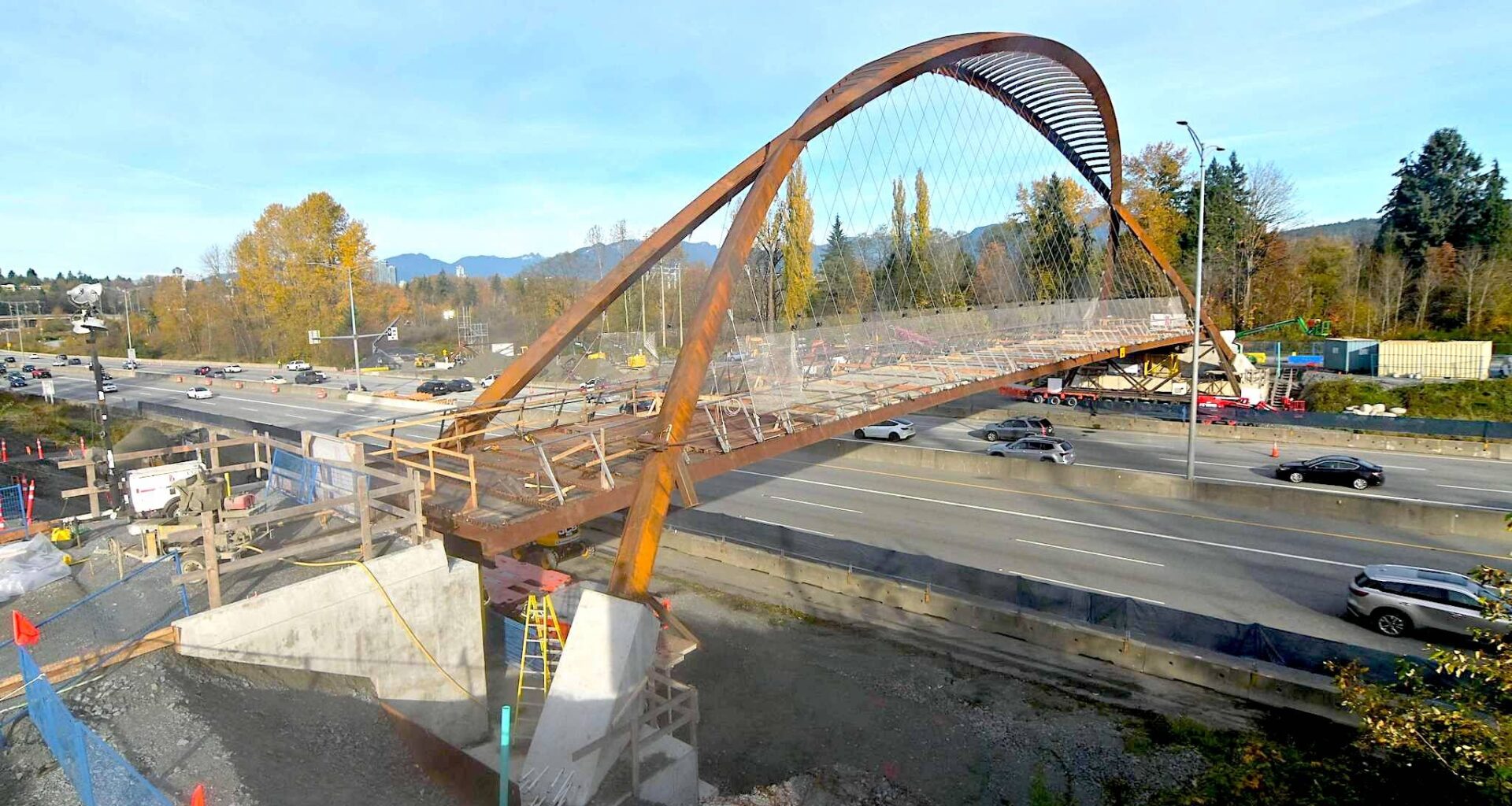
Following an overnight construction operation — carefully planned and executed between late Saturday night and early Sunday morning — the stretch of Highway 1 between Burnaby Lake and Deer Lake has a striking new look.
Construction crews completely shut down a 10-km-long segment of Highway 1 within Burnaby for hours to raise and install a pre-built, 400-tonne pedestrian and cycling overpass bridge structure into place, with the main work of lifting the structure into place occurring early Sunday morning.
The final lift saw two computer-controlled platforms rotate the massive overpass 90 degrees into place — a carefully choreographed move that marked the culmination of years of planning.
Time-lapse video from the City of Burnaby documenting last night’s feat of engineering of lifting the new pedestrian & cycling overpass bridge into place above Highway 1.
All accomplished within a few hours. #vanpoli #vanrehttps://t.co/5BGeMlTBhu pic.twitter.com/JbHo6gsJqZ
— Kenneth Chan (@iamkennethchan) November 9, 2025
This new bridge serves to seamlessly connect the trails of Burnaby Lake to the north and Deer Lake to the south, and ultimately form a new north-south active transportation route in the city.
Crews worked through the night to prepare the site, removing the highway’s concrete median before laying protective ground sheets and spreading a thick layer of gravel across the road surface.
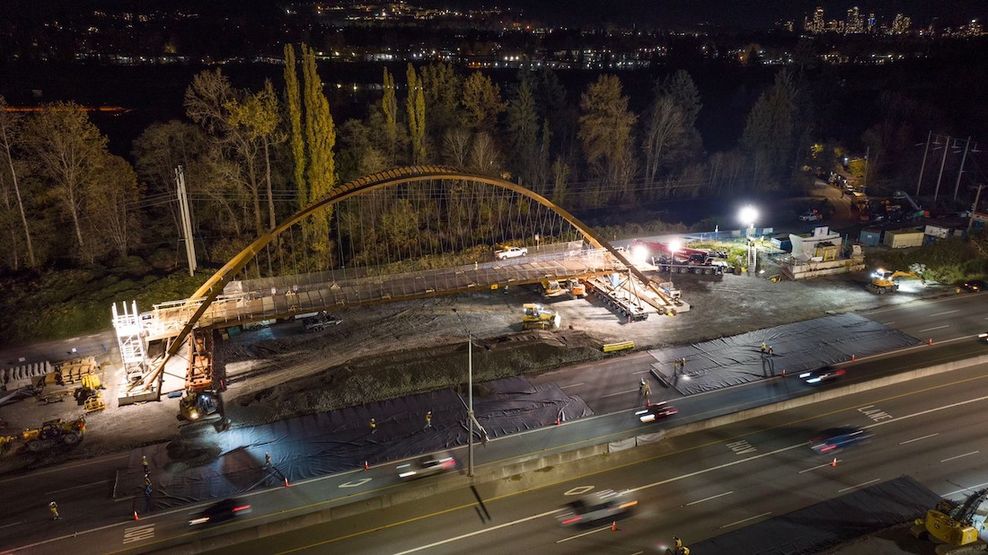
Lifting and installation of the new Highway 1 pedestrian and cyclist overpass bridge between Burnaby Lake and Deer Lake on November 9, 2025. (City of Burnaby)
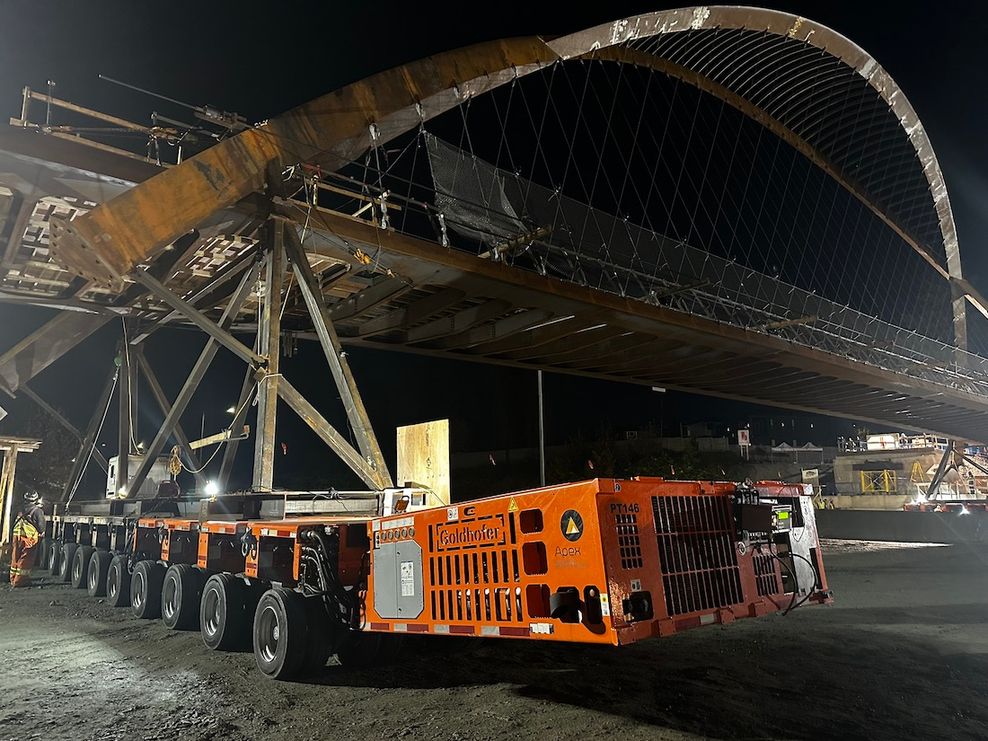
Lifting and installation of the new Highway 1 pedestrian and cyclist overpass bridge between Burnaby Lake and Deer Lake on November 9, 2025. (City of Burnaby)
The bridge deck stretches 5.7 metres above the highway’s roadway, rising higher than the nearby Kensington Avenue crossing, which is a busy intersection with multiple merging lanes and highway ramps — considered challenging and unsafe for pedestrians and cyclists to use.
Planning for the project began in 2019, when four potential designs with varying locations were considered. The City ultimately selected the first option for its cost efficiency, geotechnical stability, and minimal environmental impact, with this selected option — the easternmost of the four location options — situated at the foot of Claude Avenue.
The bridge deck has been built wide enough to accommodate both pedestrians and cyclists, with seamless ramp access allowing for smooth and easy passage. It is built from Canadian weathered steel, a corrosion-resistant material often used in outdoor infrastructure for its durability and long lifespan.
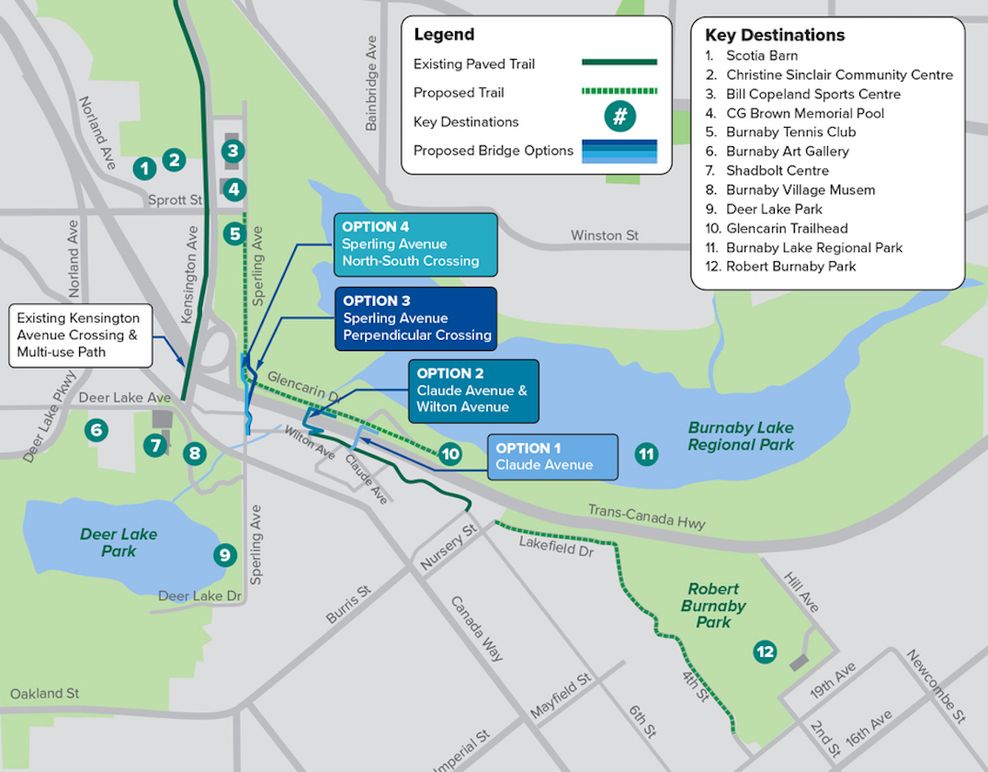
Map showing the four location options for the Highway 1 pedestrian and cyclist overpass between Burnaby Lake and Deer Lake. (City of Burnaby)
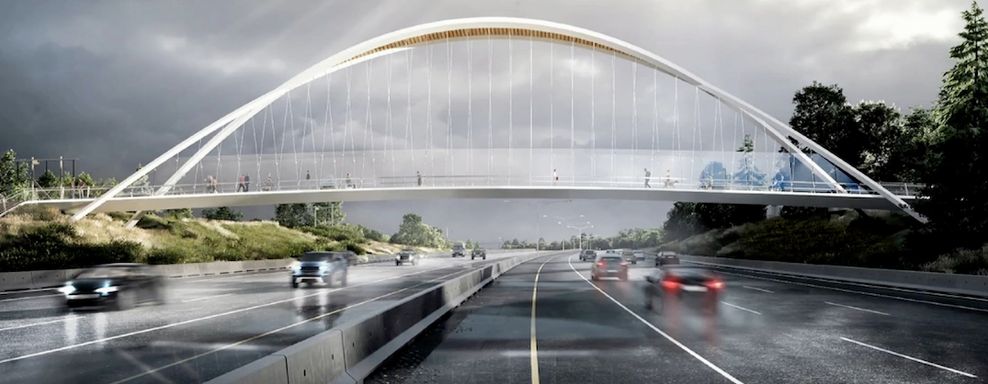
Option 1: Artistic rendering of the pedestrian and cyclist overpass design across Highway 1 between Burnaby Lake and Deer Lake. (City of Burnaby)
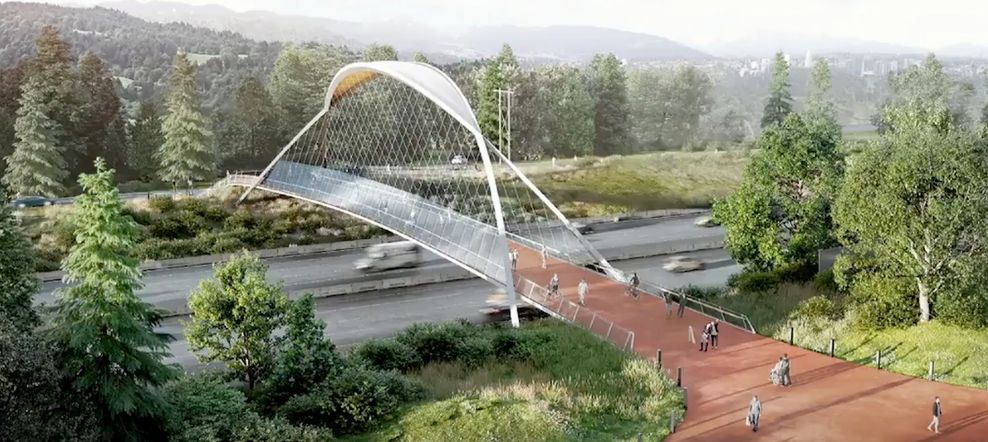
Option 1: Artistic rendering of the pedestrian and cyclist overpass design across Highway 1 between Burnaby Lake and Deer Lake. (City of Burnaby)
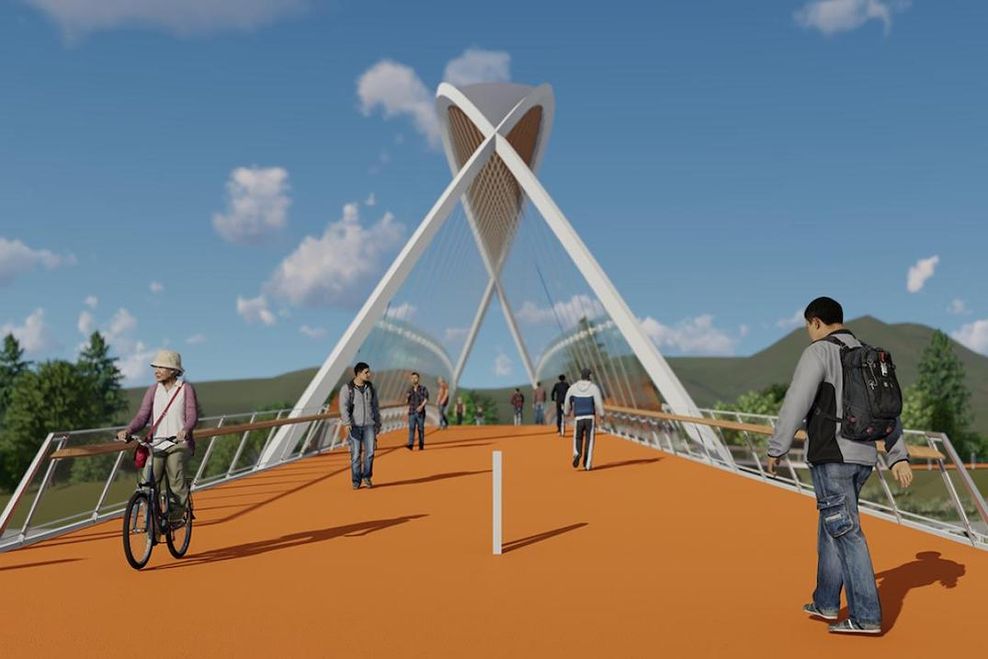
Artistic rendering of the pedestrian and cyclist overpass design across Highway 1 between Burnaby Lake and Deer Lake. (City of Burnaby)
The structure is also visually distinguished by its impressive arch design, and during nighttime it will be illuminated.
The project carries a total cost of $25 million, with the municipal, provincial, and federal governments and TransLink sharing the cost. Jacob Brothers is the project’s contractor.
The City states the overpass in on target to open in early 2026. Construction at the site first began in early 2024.