
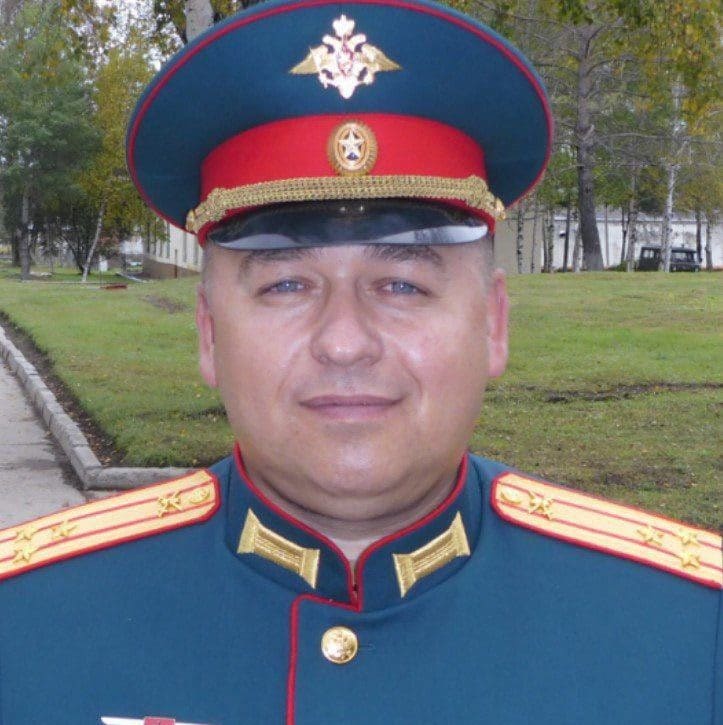
His name is not often spoken among the Ukrainian troops defending the shattered city of Kupiansk, but it is well known.
Lt Gen Sergei Storozhenko, the commander of Russia’s 6th Combined Arms Army, is probably the highest-ranking Ukrainian defector waging war against his homeland.
He grew up in a village a two-hour drive west of the city upon which he is now laying siege.
His mission is to recapture the vital stronghold on the north-eastern fringe of Ukraine’s front line, which has been under attack for two years. Occupied in the first months of the war and liberated in September 2022, Ukraine is desperate to prevent it falling for a second time.
If captured, it will act as Russia’s gateway into the wider region, threatening key supply lines and allowing Vladimir Putin’s forces to advance towards the bigger prize of Kharkiv, Ukraine’s second-largest city.
So many Russian men have been killed in the pursuit that Ukrainian war bloggers have joked that the 50-year-old traitor is either on their side, or might as well be.
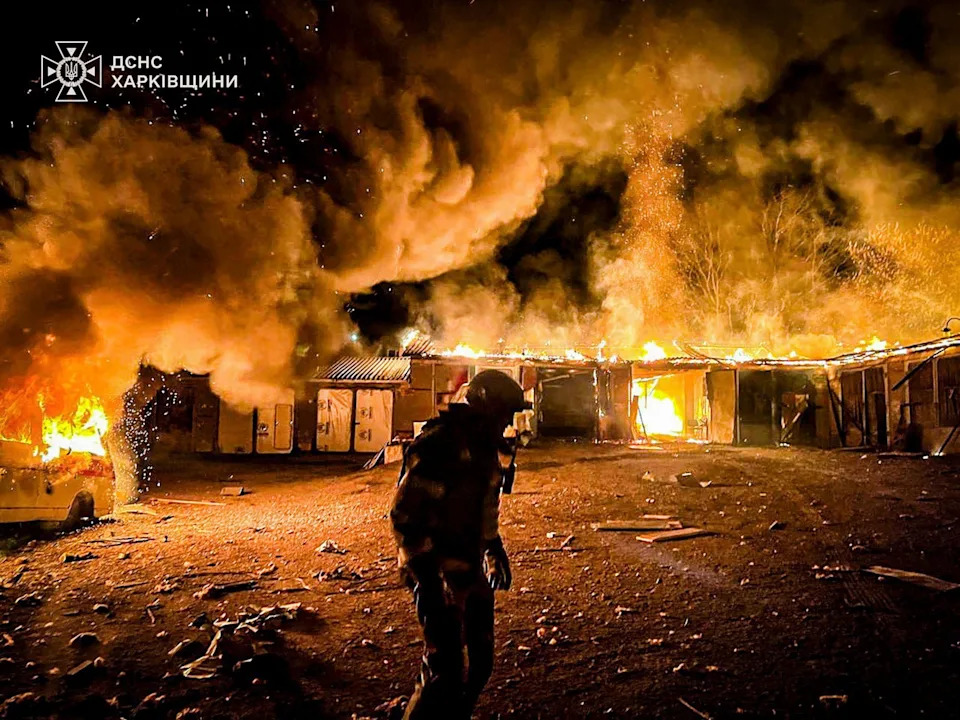
Ukrainian rescuers at the site of the glide bomb attacks in Kupiansk, the vital stronghold on the north-eastern fringe of Ukraine’s front line – STATE EMERGENCY SERVICE/HANDOUT/EPA-EFE/Shutterstock
Once a decorated Ukrainian officer, he defected during Russia’s annexation of Crimea in 2014.
Lt Gen Storozhenko’s task has become even harder, since he is racing to catch up with the Kremlin’s version of the truth. Either unconcerned with facts or misinformed by reports from the general, Putin last week declared that thousands of Kyiv’s troops are encircled within the city.
Even Russian propagandists baulked at the claim.
Major Victor Tregubov, the spokesman for Ukraine’s Joint Forces Group, laughed off what he called the Russian leader’s “alternative reality”.
He told The Telegraph: “The city is far from encircled… Ukrainian defences are holding and the situation is difficult – both statements can be true at the same time.”
b’
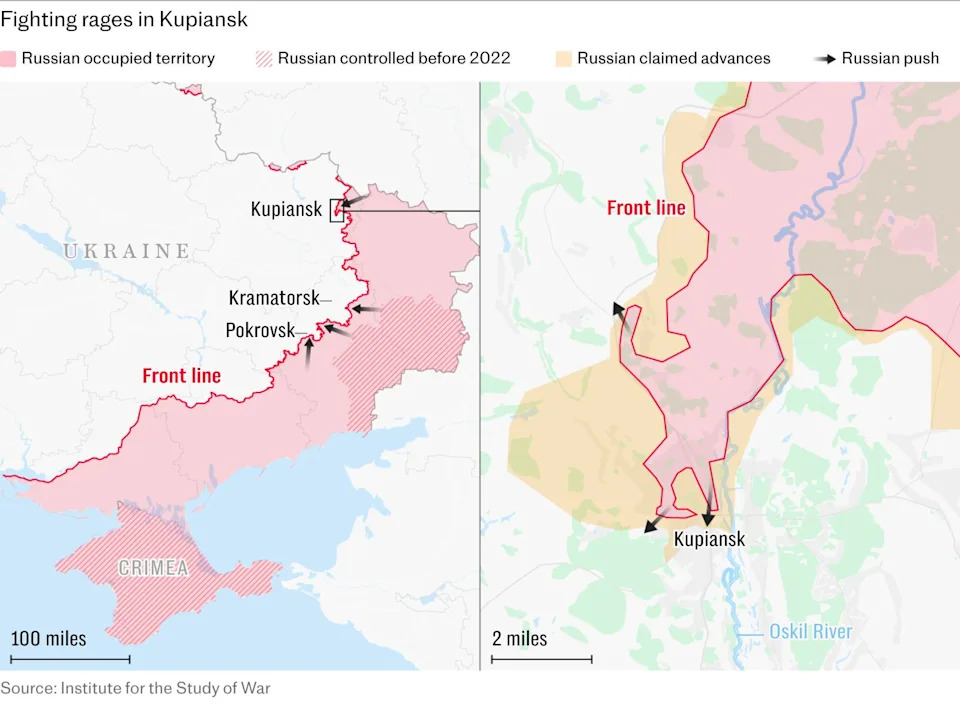
0911 Russia\’s siege in Kupiansk
‘
Analysts say that as many as 13,000 Russian troops have been killed trying to take the city, yet there has been no major breakthrough.
The north-eastern front draws less attention than battles in the Donbas, but the charred rubble of Kupiansk serves as a cautionary tale of what Moscow is willing to do to the Ukrainian front-line cities that refuse to fall.
Currently, Russian forces occupy the northern districts of the city, while Ukraine still maintains control of the east and south, according to Deep State, the open-source intelligence map. An unknown number of Russian soldiers are in the centre of the city itself.
Both sides are pinned down by the ever-present threat of drones buzzing overhead, instead engaging in house-to-house battles.
Major Tregubov said: “Russia is trying to take the city centimetre by centimetre, building by building.”
It is part of a broader plan to exhaust and destabilise Ukrainian defences over time.
“The tactic works but only if you have an unlimited number of infantry and you do not care for their lives,” he added.
To get around Ukraine’s defences and circling drones, Russia has adopted tactics it has used elsewhere, including Pokrovsk, sending small sabotage and reconnaissance groups, as little as two or three men, to slip past Ukraine’s undermanned lines.
The infiltrators – often dressed as civilians and sometimes in Ukrainian military uniforms, both considered war crimes under international law – try to sow havoc behind enemy lines, targeting drone operators and threatening logistics. Most are killed before reinforcements arrive.
Credit: Facebook/10ArmyCorps
Andrii “Mazhor”, an artillery commander from the 15th Operational Brigade, said that despite suffering high casualties, Russians kept attempting to enter the city through a heavily-guarded narrow corridor.
He told the Kyiv Independent last week: “Compared to other sectors [of the front], I haven’t seen soldiers of the Russian Federation die as pointlessly as here. I haven’t seen a single wounded soldier getting evacuated.”
In early September, Russian forces used an underground pipeline network beneath the Oskil river, a natural defensive barrier that guards the city, to bypass Ukrainian positions in the city’s northern outskirts.
Crawling through the metre-wide tunnels for several miles, it was the third time that Russia had attempted a pipeline ambush, following success in Avdiivka and a high-casualty operation in Kursk.
Ukrainian forces later said they blew them up and captured dozens of troops, but acknowledged that an unknown number had slipped through to the city. Other Russian troops tried crossing the river on rafts and boats, which were easy targets for Ukraine to sink.
Credit: X / @NOELreports
It would not be a stretch to suggest that Lt Gen Storozhenko is responsible for the disconnect between Putin’s grand claims and the reality on the ground.
His reports land on the desk of Gen Valery Gerasimov, Russia’s top general, who directly informs Putin on the battlefield progress. Gen Gerasimov has, since August, trumpeted claims of Russia’s success in Kupiansk.
Lt Gen Storozhenko, or the “Watchman” as his officers called him, previously commanded the largest Ukrainian unit in Crimea. He defected to Russia after its invasion of the peninsula, reportedly encouraging hundreds under his command to do the same.
Awarded a medal “For the Return of Crimea”, he took command of Russia’s newly formed 126th Coastal Defence Brigade in Crimea, steadily rising through the ranks.
According to a BBC Ukraine investigation, he was directly involved in the planning and organisation of the full-scale invasion. He led the 35th Army in Kharkiv – where his relatives still live, and presided over a major defeat in the city of Izium in 2022.
In 2023, he was promoted by Putin to lieutenant general, and took over leadership of the 6th Army and its assault on Kupiansk.
‘All traitors will be brought to justice’
Major Tregubov shrugged off the mention of his name. He said Lt Gen Storozhenko was not a figure who inspired fear among the defending troops, noting the “many disasters” that have taken place under his command.
“Everyone in Kupiansk knows who they are fighting, what was a shock 10 years ago is old news now. All traitors will be brought to justice,” he said.
About 500 civilians are believed to remain inside the ruins of Kupiansk, which had a pre-war population of 27,000, as Russia attempts to pummel the city into submission.
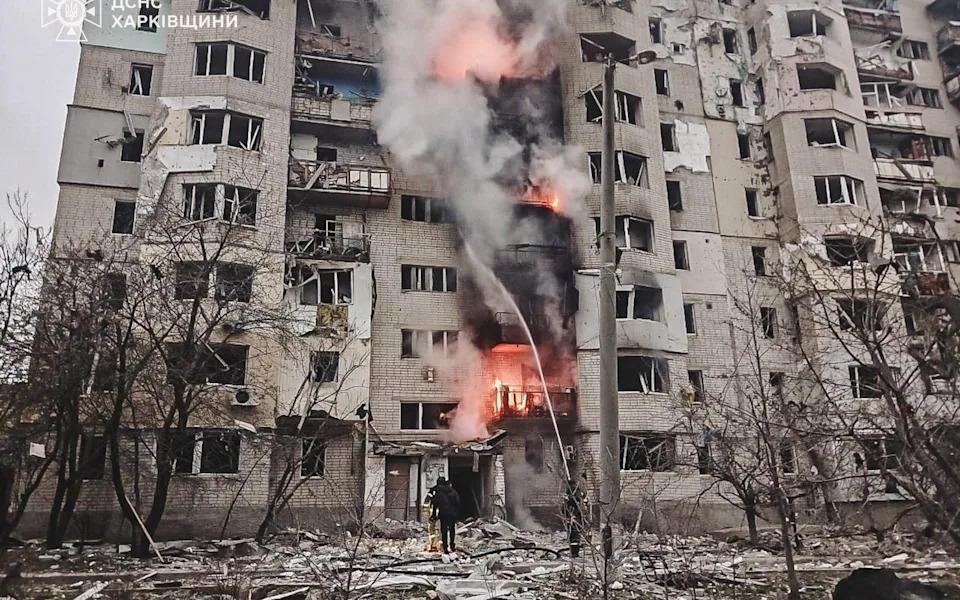
Russia is slowly trying to take Kupiansk – a front-line city that refuses to fall – Anadolu/Ukraine State Emergency Service
Yevhen Kolyada, the head of the Relief Coordination Centre (RCC), which helps civilians in Kharkiv, said: “It is not possible to survive in the city, let alone live.
“There is no water, no electricity, no gas and the shelling, rocket attacks and strikes are constant.”
Winter is settling in, food stocks are running low and it is too dangerous for civilians to leave their home with firefights in the streets and “more FPV drones in the sky than birds”.
The Russian drones “are hunting the civilians too” and it is now near-impossible to evacuate them, Mr Kolyada said.
Valentina Makarova, who managed to get out of the city last month, said life was unbearable inside.
Credit: Telegram/@karadag15brop
She told The Telegraph: “Explosions could be heard constantly… We never knew where the next bomb would fall. People hardly went outside – only to find some food or help their neighbours. The scariest time was at night, when the sky rumbled and it seemed that everything around was burning.”
The constant whirring sounds of drones overhead still haunts her, she said, explaining that just leaving to collect water could be a death sentence.
Ivan Ostapchuk, speaking from a displacement centre in Kharkiv managed by the RCC, said the Russian soldiers who entered the city in the north prowled the streets with weapons, checking houses. “Some were young, looked as scared as we were.”
All the residents were scared of being shot at or killed by a drone. “You start to tell yourself, ‘maybe not today’. Fear becomes like another neighbour – always around, even when it’s quiet,” he said.
“Kupiansk has changed beyond recognition. Many streets I used to walk are gone, houses flattened, trees burned. The school where my grandchildren studied [is] just ruins now. But life is stubborn, you know. Flowers still bloom between the broken bricks, and people come back, fixing windows, planting gardens. We’ve lost a lot, but not our will to live.”
With Russia’s growing desperation to capture the city, reports of its troops committing war crimes against the remaining residents are increasing.

Ukrainian troops fire at Russian targets in Kupiansk where about 500 civilians are believed to remain inside the ruins of the city – Kostiantyn Liberov/Libkos/Getty
On Oct 3, Ukrainian intelligence intercepted a Russian commander’s call discussing how one of his men “opened fire all over the building” and hit three civilians.
In another intercepted call from Oct 19, a Russian officer can be heard issuing the orders: “When the civilian in the blue panama hat walks past, shoot him and take away the body.”
In response to the second recording, Ukraine’s northern command wrote on Telegram: “This is not an accident – this is their strategy of terror. They do not come to ‘liberate’ – they come to kill, torture and intimidate. Their war is not a war with the army, but with the civilian population.”
On Monday, Volodymyr Zelensky said that “a clearance operation is under way” to remove up to 60 Russian soldiers inside the city. Without providing any evidence, Russia’s defence minister refuted this, arguing that Ukrainian units were trapped in what it called “cauldrons”, with no option other than surrender.
Credit: X/@Bielitzling
The truth is lost somewhere in the fog of war. Only a small number of people in the Ukrainian military are permitted to speak about the current situation.
Unlike the besieged eastern city of Pokrovsk further south – Russia’s current focus in the Donbas – Kupiansk does not look poised to fall imminently.
Russian forces are penetrating weak points, but have not succeeded in destabilising Ukrainian defences to the same degree as in Pokrovsk, according to the Institute for the Study of War, a US-based think tank.
In part, this is because of Kupiansk’s open terrain, which makes movement perilous, but mainly because Russia has not committed the same level of manpower and resources to taking the city.
And yet, the fate of the two pulverised front-line cities, 125 miles apart, appears to be tied.
However, Ivan Stupak, a Ukrainian military analyst and former officer in Ukraine’s security service, said: “Compared to Pokrovsk, the situation in Kupiansk appears good.”
The city is likely to hold until at least December or January “but a lot depends on how well both sides can bring in supplies and reinforcements”. If Pokrovsk falls and Russia redeploys some of those forces north, “then the situation becomes much more difficult”.
He hopes winter will be on Ukraine’s side. With less foliage, Russians have fewer places to hide and attacks become more dangerous.
“Kupiansk is not the main story for now,” he said. It could be soon.