
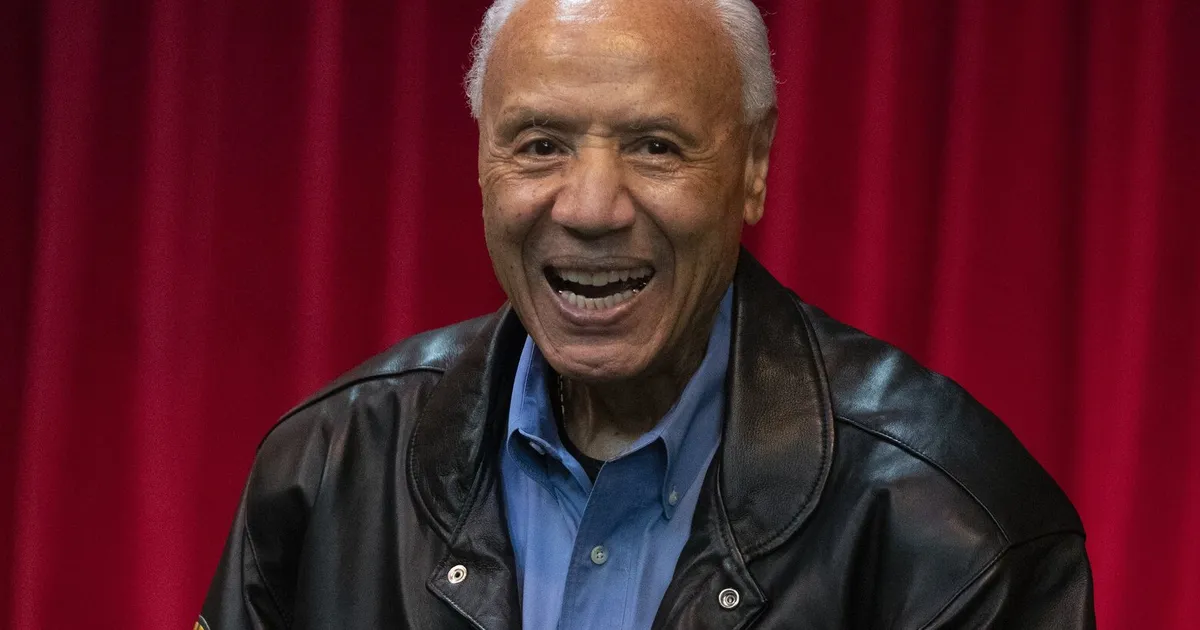
Lenny Wilkens, one of five people inducted into the Basketball Hall of Fame as a player and coach, and an ambassador of Seattle basketball for more than 50 years, died at his home Sunday.
The 88-year-old Wilkens grew up in Brooklyn, played in St. Louis, Cleveland and Portland as part of his career on the court, and coached six different franchises during 32 seasons on the sidelines.
But Seattle was his home. As a player. As a coach. As a local leader away from the gym and the arenas through years of charitable work that benefited the Seattle community.
Wilkens was not a born-and-raised representative of Seattle and Seattle basketball. But he became one of its biggest proponents through seven decades of connection with the city he made his home.
read more
lenny wilkens’ death
More
“Even more impressive than Lenny’s basketball accomplishments, which included two Olympic gold medals and an NBA championship, was his commitment to service — especially in his beloved community of Seattle where a statue stands in his honor,” NBA Commissioner Adam Silver said in a statement. “He influenced the lives of countless young people as well as generations of players and coaches who considered Lenny not only a great teammate or coach but an extraordinary mentor who led with integrity and true class.”
Wilkens was inducted into the Hall of Fame as a player in 1989 to acknowledge a career that included nine All-Star Game appearances, a second-place finish in MVP voting in 1968 and recognition on the NBA’s 75th anniversary team.
He added induction as a coach nine years later while still manning the sidelines. Wilkens eventually retired after he was let go by the New York Knicks midway through the 2004-05 season. His career ended with a .536 win percentage and 1,332 wins in the regular season, and 20 playoff appearances in 32 seasons as a head coach.
His only two appearances in the NBA Finals and his only championship came with the SuperSonics, forever making him basketball royalty in Seattle.
Related
More
“It lets people know Seattle has rich history,” Wilkens told The Times in 2022 on what was proclaimed “Lenny Wilkens Day.”
“I’m so happy to be a part of that history. This is basketball country. We should have never lost our team and I hope that this helps in some way get another team back. Everywhere I go, people talk about the Sonics and about that time when we won a championship. I don’t think that team gets the credit that it deserves. Gus (Williams), Fred (Brown), Jack (Sikma) and all of those guys became a part of this community and most of them still live here. It was a wonderful time.”
Wilkens first arrived in the Pacific Northwest in 1968 as a point guard for the SuperSonics in their second season of existence. He was 31 with eight seasons of experience and five All-Star Game appearances.
He became the first superstar for the fledgling franchise. Little did anyone know at the time how inextricably connected Wilkens would become with the Sonics and with Seattle.
Wilkens became a player-coach for the SuperSonics a year after his arrival. He was an All-Star in three of the four seasons he played for Seattle before finishing his playing career with two seasons in Cleveland and one final year in Portland.
Wilkens concluded the playing portion of his career as a nine-time All-Star who averaged 16.5 points and 6.7 assists, and finished second in MVP voting in the 1967-68 season behind Wilt Chamberlain.
His playing career was beyond worthy of Hall of Fame induction. It proved to be a supporting role in the story of Wilkens’ basketball life.
Wilkens was a great player. He was a better coach.
“It’s something I never dreamed of. I mean how could you dream of being in the Hall of Fame as a player and as a coach, even though when I talk with young people all the time I dare them to accept challenges to be great and to dream dreams of greatness. But this is a dream for me that has come true,” Wilkens said upon his Hall of Fame induction as a coach in 1998.
Beginning as a player-coach in the final stages of his playing career, Wilkens moved to the bench permanently early in the 1977-78 season. He was in charge of player personnel for the SuperSonics, but a 5-17 start under Bob Hopkins led to a change and Wilkens took over.
The Sonics went 42-18 the rest of the regular season and rolled through the Western Conference playoffs before losing to Washington in the NBA Finals in seven games.
A season later, Wilkens and the Sonics were back in the NBA Finals again against Washington. But instead of a painful defeat, Wilkens and the Sonics celebrated the only championship in franchise history.
Wilkens ended his tenure with the Sonics following the 1984-85 season. He led Seattle to playoff berths in six of those eight seasons he was charge.
But that wasn’t the end of his coaching career or his affiliation with Seattle.
After a season away, Wilkens took over in Cleveland beginning in 1986, the start of seven seasons with the Cavs. He reached the playoffs five times, but had the misfortune of coaching in the Eastern Conference during the height of the “Bad Boys” Pistons and the rise of one Michael Jordan with the Bulls.
From Cleveland, it was Atlanta as the next stop on Wilkens’ career path. It was with the Hawks that Wilkens became at the time the NBA’s all-time leader in coaching wins on Jan. 6, 1995 when he passed Red Auerbach with his 939th victory. Six playoff appearances in those seven seasons was followed by three years in Toronto and eventually his coaching epilogue in New York.
Despite last standing on the sidelines in 2005, Wilkens remains third in all-time coaching victories, trailing only Gregg Popovich and Don Nelson. Doc Rivers is the only active coaching within 200 victories of Wilkens and his mark of 2,487 regular season games as a head coach may never be reached.
Not to be forgotten in his exploits as a player, coach and player-coach, was the off-the-court philanthropy Wilkens showed for decades — primarily with the Odessa Brown Children’s Clinic in Seattle’s Rainier Valley. Wilkens’ foundation has benefited the community since the early 1970s, including its famous golf tournament and auction that was held for the last time in 2019.
“I said, ‘That’s going to be my charity,’ because they were providing health care to families regardless of their ability to pay,” Wilkens said in 2021. “I’ve always said a sick kid who goes to school puts their head down on the desk, and they don’t learn anything. But if we give them the health care that they need, we let them know that they’re important to us, and then they’ll want to strive for more.”
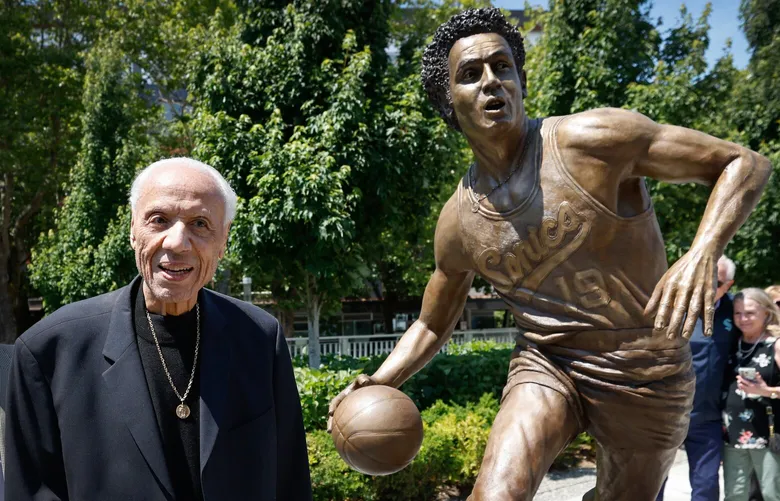
Wilkens received another recognition of his contributions to the basketball and local community when a statue was unveiled on the plaza outside of Climate Pledge Arena this past summer. Wilkens was feted by local leaders, former players and anyone who at some point bled green and gold.
It came just before his 63rd anniversary with his wife Marilyn, which led to a family of three children and seven grandchildren. His legacy as an inspiration for the community and for basketball was permanent long before the statue was unveiled.
“I’m just overwhelmed,” Wilkens said in an interview with The Times last summer. “It’s not something I ever thought much about or anything like that. This has been a great community. I got to know people here.
“When I first got here, I thought about going back East, but we liked it out here my wife and I … and decided it would be a wonderful place to make a home.”
Tim Booth: Tim Booth is a sports reporter at The Seattle Times, where he covers the Kraken and the ongoing story surrounding possible NBA expansion and helps with coverage of the Seahawks and Mariners.