
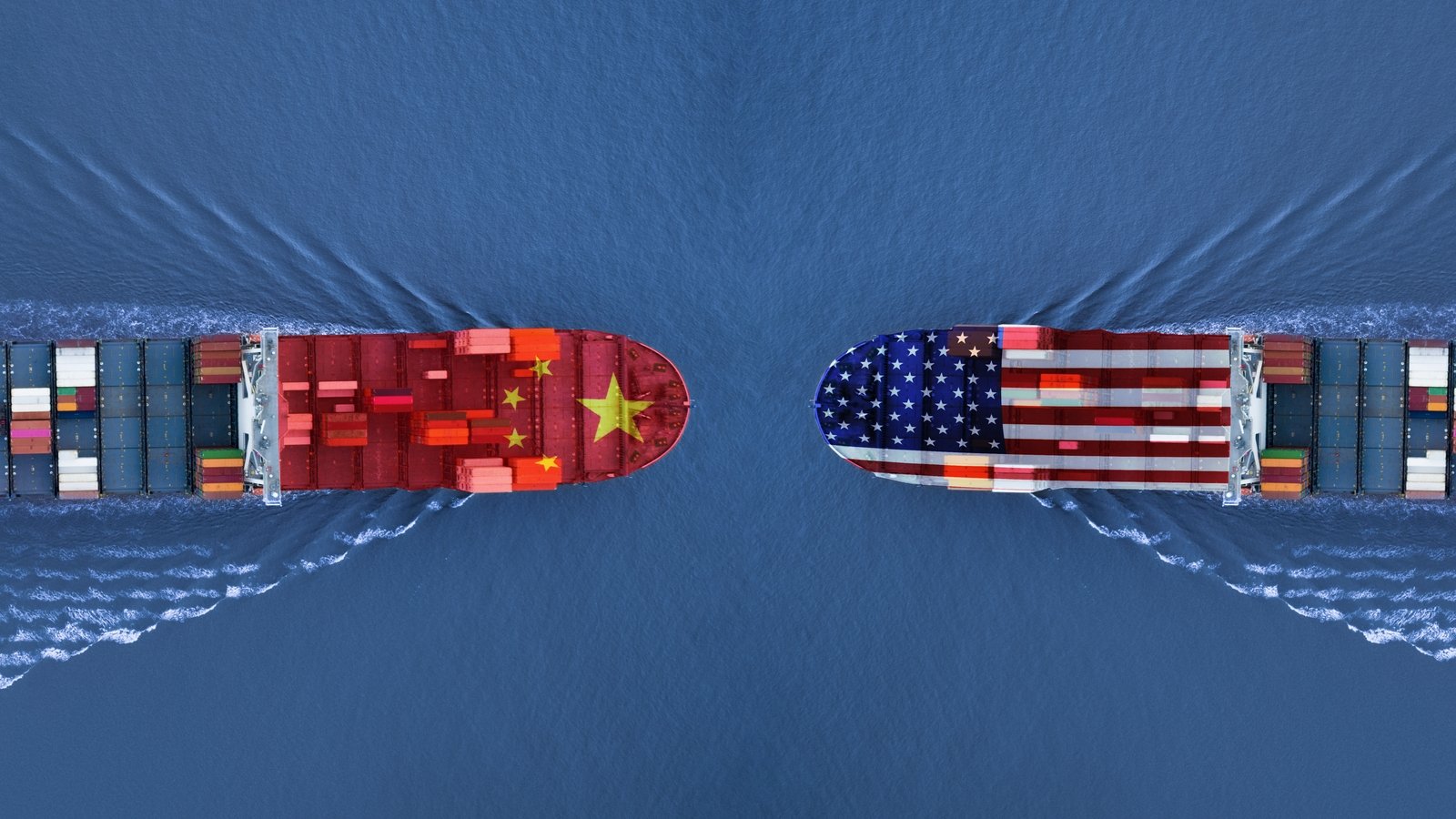
CEO of Ibec Danny McCoy has described the deal reached by the European Union and the United States on trade tariffs as a capitulation by Europe.
The deal was announced following a meeting between European Commission President Ursula von der Leyen and US President Donald Trump.
Speaking on RTÉ’s Morning Ireland, Mr McCoy said: “The good news, if there is good news on this, is that uncertainty may be dissipating and that’s going to be important for people in business to make decisions.”
However, he said the deal was “fairly punishing” for the EU and added “Europe has capitulated”.
“It’s quite tragic that we are in this situation. If Europe had equal strength, it could have confronted the United States,” he said.
Mr McCoy said that while the EU is a “strong economic zone”, its weakness is that “we cannot defend the European Union”.
Under the deal, the EU pledged to buy US military equipment and European companies are to invest $600 billion in the US over President Trump’s second term.
Read more:
Tariffs aren’t good news but it could have been much worse
Orbán says Trump ‘ate’ EU chief ‘for breakfast’ in trade talks
“US businesses are now favoured coming into Europe without tariffs and our European businesses are facing 15%.
“In time, this will lead to a lot of changes in terms of businesses having to look at different markets than the United States or suffer significant losses trading with the United States,” Mr McCoy said.
He also raised concerns for Ireland that goods from the UK entering the US will have a smaller tariff rate of 10%.
The US and UK agreed to a trade deal in early May, which included a baseline 10% tariff on most goods exported to the US, with certain exemptions.
The agreement includes goods being exported from Northern Ireland.
EU-US tariffs deal gives clarity, says minister
Minister for Enterprise Peter Burke said that the deal brings clarity and avoids a trade war that could have resulted in 30% tariffs on EU goods.
Speaking on the same programme, he said: “It gives certainty which is key, but there’s three key areas I think we have to focus on.
“We are about four days away, which would have been a 30% tariff for the US and that would have been very significant for all our companies right across the country.
“Secondly, I think it avoids a direct trade war because we’re very much aware that there was about €100 billion of countermeasures that were ready to be deployed, which would have a very significant effect on Ireland and as well on the north-south economy.”
Mr Burke added that “the devil is in the detail and we do need to see those key areas, those carve-outs that have been specifically called out by the President of the Commission yesterday”.
He said that the Irish Government “is very, very clear and has been that tariffs are bad” and said 15% is a “very significant tariff”.
In relation to pharmaceuticals, Mr Burke said that the understanding is that the 15% tariff “will be a ceiling” subsequent to the US investigation.
“Pharmaceuticals are very complex, a lot of the product that is exported over to the US is not a complete product. Almost 70% of it is components of the final product that will come together.
“And that’s why we do need to ensure that we have a very keen rate to ensure we incentivise innovation in that sector because that’s so important for the global economy.
“We’ve about 100,000 employees in Ireland, 130 billion exports in the life science sector and the Government will be bringing forward a separate life science strategy later on this year, which will be key in continuing the investment and offering a very competitive proposition from Ireland’s perspective,” Mr Burke added.