

Watch video: Speech delivered by Andrew Hauser, Deputy Governor, UBS Australasia Conference, Sydney
Introduction
Its great to be here with you today, to speak with, and hear from, investors from Australia and around the world.
The timing of this conference is auspicious. Thats true from a global perspective, of course, as we
navigate an extraordinary inflexion point in world economic affairs. But its true locally, too,
because its just a week after Australias most famous horse race – the Melbourne Cup.
For decades the RBA has made its November interest rate decision on Melbourne Cup Day. Not to spoil the
mood – but simply because, long ago, both the Reserve Bank and the Victoria Racing Club laid claim
to the first Tuesday in November – and neither has yielded since.
For a time in the 2000s, the tendency to raise interest rates on the day – and even close to the
time – of the race gave newspaper editors a field day: rates gallop ahead as Cup Day
looms, the double gamble, or a cartoon of the entire Reserve Bank Board of many years
ago precariously perched on a single horse, one member cracking the whip while another pulls on the
economic reins.
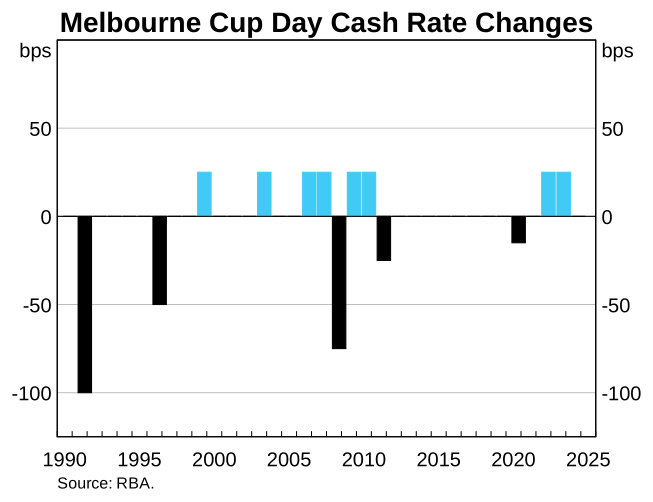
Over the longer sweep of history, however, increases have proved few and far between (Graph 1).
Melbourne Cup Day has much more often seen rate holds or rate cuts – and some big ones at that (in
1991, 1996 and 2008). The RBAs Monetary Policy Board added another hold to that tally last week.
Graph 1
In my remarks today I want to put that decision in context, looking back at the economic events of the
past year, before turning to the outlook.
Monetary policy in Australia faces an unusual challenge – the recovery in GDP growth began last year
with a higher level of capacity utilisation than at the start of any other recovery in over
40 years. Thats a real achievement, when it comes to making full use of the economys
available resources. But it also poses a big, and pressing, question. Could Australia find itself trapped
on the economic rail like one of the riders in last weeks Cup – boxed in by its own capacity
constraints? Or will it find ways to break free, through higher productivity and more investment in new
capacity? If it does, we could be off to the races.
Looking back: The year in review
A year ago, GDP growth had bottomed out at just 0.1 per cent in the June quarter. With most
other advanced economy central banks having already cut their policy rates several times earlier in the
year, some felt we were behind the curve, anticipating that we would be forced into a sharp easing to
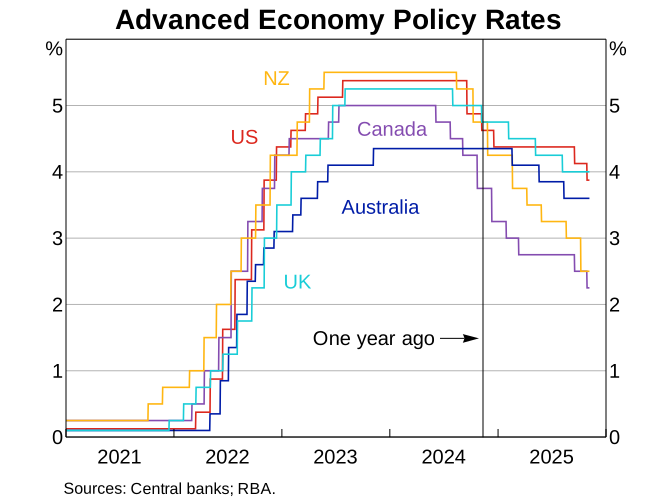
make up lost ground. From the Boards perspective, that view underweighted three key points. First,
we had explicitly adopted a different monetary policy strategy to others, in which, having not tightened
as much as others, there was also less imperative to cut aggressively (Graph 2). Second, underlying
inflation remained well above the 2–3 per cent range, something the
Board judged required it to maintain a clearly restrictive stance until it could be confident that
inflation would settle sustainably at target. And, third, activity was already expected to pick up in
the near term, supported by public demand and a gradual strengthening in household consumption, as real
incomes were boosted by lower inflation and the Stage 3 tax cuts.
As 2024 turned towards 2025, another pessimistic lens for the Australian economic outlook emerged, in the
form of a new US administration seemingly determined to use tariffs and other policy levers to reshape
global trade relationships, particularly with China – Australias biggest trading partner. Some felt this
added to the need for a sharp, perhaps even pre-emptive, easing in our policy settings.
Graph 2
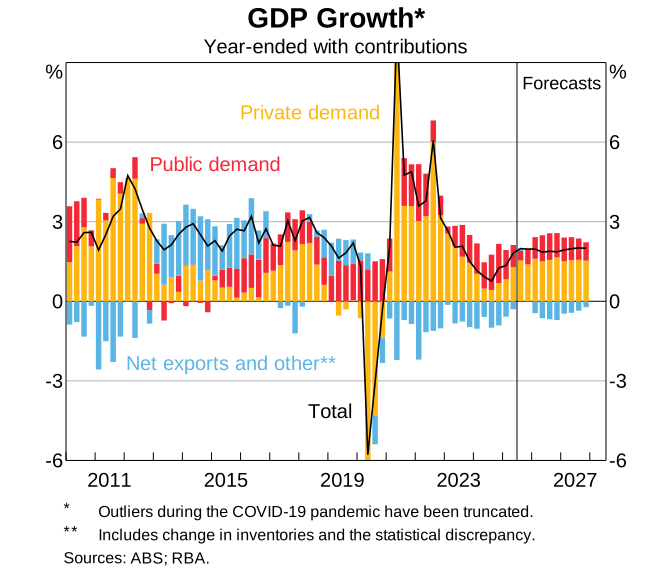
A year on, few of those worst fears have come to pass. GDP growth did pick up from the September 2024 quarter,
driven by the predicted recovery in private domestic demand (Graph 3). US tariffs have so far proved
smaller and narrower in scope than feared in the wake of the liberation day announcements;
and the limited retaliation, widespread trade rerouting and targeted policy stimulus, including in China,
have dampened, or in some cases even offset, the drag on global growth from tariffs. Commodity prices and
financial markets have generally held up. And the feared impact of global policy uncertainty on
Australian consumer and business confidence has so far failed to materialise.
Graph 3
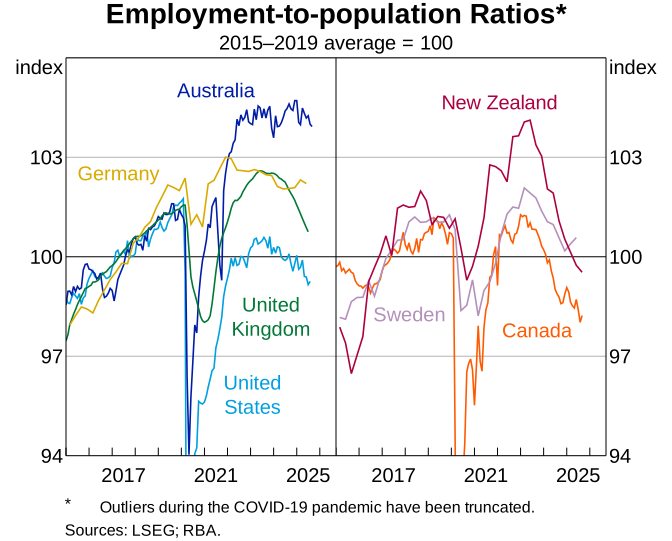
Employment continued to grow strongly, supported by public demand in the market and non-market sectors.
Indeed, normalised by population size, employment in Australia has remained higher and more stable than
in any of the other advanced economies shown in Graph 4, compared to pre-pandemic levels.
Graph 4
Alongside these developments, the further decline in inflation through the end of 2024 and into 2025 gave
us greater confidence that it would return sustainably to target over the medium term. That allowed us to
begin reducing the degree of policy restrictiveness, cutting the cash rate target by 75 basis points
between February and August 2025.
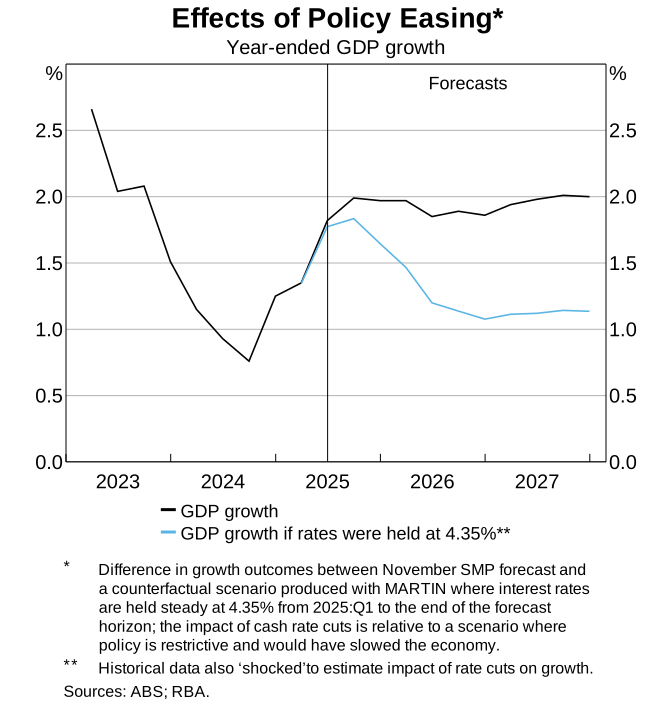
The normal lags in monetary transmission mean those cuts wont have had much impact on activity
during the first half of 2025. But they will play an important role in supporting growth from late 2025
as the impulse from public demand and last years tax cuts wanes. To bring that to life,
Graph 5 shows an estimate of the counterfactual path of future GDP growth if the cash rate target
had been held at 4.35 per cent.
Graph 5
Looking ahead
So macroeconomic outcomes over the past year were less severe than some feared. But monetary policy must
be set not through the rearview mirror but in anticipation of where the economy is going in the future.
For inflation, that depends on the balance of demand and supply – and here we find ourselves in an
unusual place.
To see that, consider Graph 6. It shows that most recoveries in GDP growth over the past
40 years typically start with some margin of spare capacity – a negative output
gap – as the preceding slowdown pushes the level of aggregate demand below estimates of the
potential output of the economy. As the economy recovers, that buffer typically provides room for a
period of above-trend growth in activity and employment, as demand rises back towards potential output,
without generating excessive inflationary pressures.
Graph 6
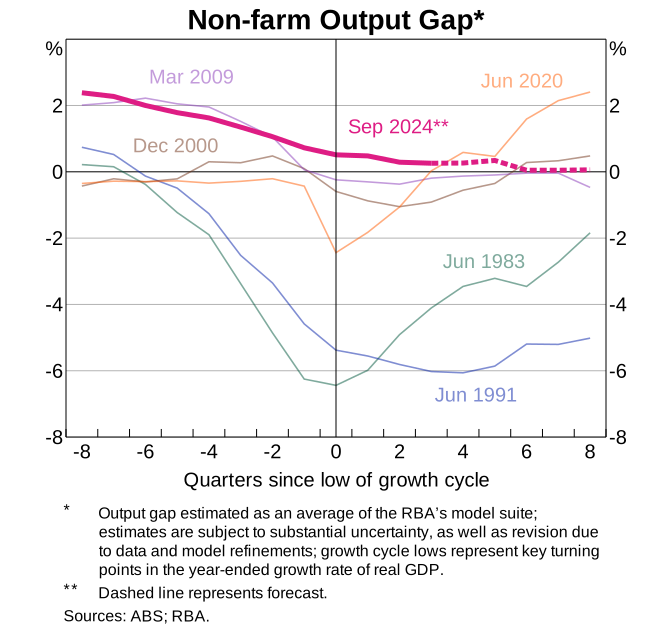
But this time looks different. Our central estimate suggests that demand was slightly above potential
output at the time GDP growth started to pick up last year – the tightest economic backdrop to a
recovery since at least the early 1980s. As the November Statement on Monetary Policy sets
out, that can still be consistent with bringing inflation back to target over the medium term. But achieving
that goal will require policy to be restrictive enough to keep shrinking the gap over that period. The
path implied by those forecasts is shown in the dotted line on Graph 6.
The historical comparisons in the Graph are based on model-based estimates. So, although we try to control
for model uncertainty by averaging across a range of alternative approaches, and also adjust for known
disturbances to supply including the COVID-19 pandemic, the bands of
uncertainty remain large. Nevertheless, the ranking of this cycle relative to
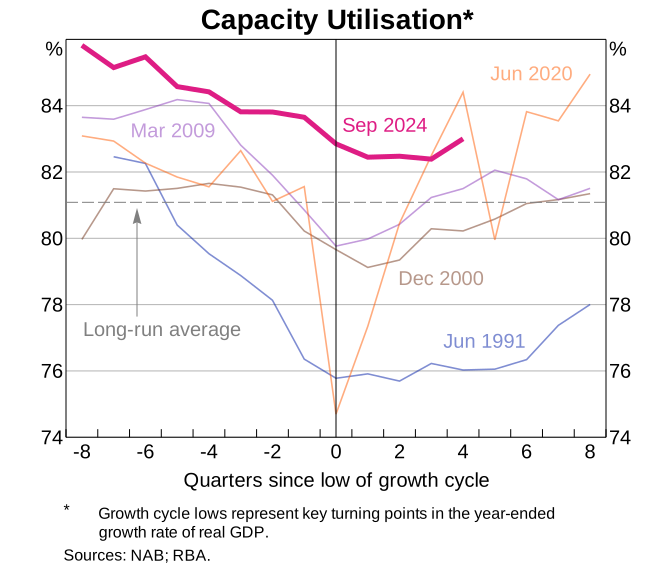
others does seem robust. To see that, Graph 7 repeats the same exercise using the NAB business
survey, which asks companies directly about their capacity utilisation. No models, no equations –
but the same result: capacity utilisation was higher at the start of the current recovery than in any
similar situation in recent decades, and materially above the whole-period average.
Graph 7
How did this come about? Its not because demand growth in the past year or so has been particularly
strong – far from it. Instead, its the cumulative effect of rapid demand growth in 2021–2022, the deliberately cautious monetary policy strategy of more
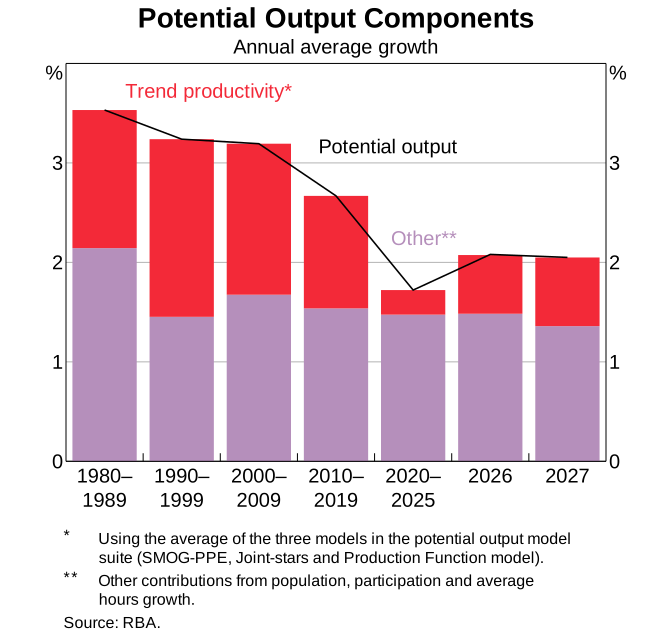
recent years, and – importantly – weak growth in supply. To make that last point explicit,
our estimate for potential output growth fell from 2½ per cent a year in the decade before the
pandemic to 1½ per cent in 2020–2025; and we expect it to
pick up only a little to around 2 per cent in each of the next two years (Graph 8). That
reflects the downward revision we made in August to our near-term assumption for annual trend
productivity growth, from 1 per cent per year to 0.7 per cent.
Graph 8
The absence of spare capacity is good news: it means busier companies and more jobs. Achieving sustainable
full employment is a key part of the Monetary Policy Boards mandate. But it does pose challenges for
policy setting. Those challenges were highlighted by the latest data, which showed underlying inflation
rising to 3 per cent in the year to September – ½ percentage point higher than
expected in our August forecasts – at the same time as unemployment also rose to
4.5 per cent in September.
How will this play out? In the spirit of the Melbourne Cup, let me sketch three different tracks the race
could take.
Track A: Still ground to make up?
On one view, the pictures in Graphs 6 and 7 overstate the degree of inflationary pressure in the
economy. Maybe theres more capacity today than the estimates suggest; maybe the outlook for demand is
weaker (opening up a larger future margin of spare capacity); or maybe capacity pressures have only a
weak effect on inflation. On this view, the Australian economy still has ground
to make up – and further policy easing may be necessary at some horizon.
Someone taking this position might note that the pick-up in CPI inflation in the September quarter could
prove entirely temporary, a function of volatile and one-off price increases with no persistent
implications for inflation. The labour market may turn out to have greater capacity than currently
thought, and hence may weaken further on current interest rate settings. Overall employment growth has
fallen as slower growth in non-market sector jobs has outpaced the pick-up in the market sector; the
unemployment rate has ticked up, and growth in the Wage Price Index has eased relative to last year.
Activity may slow: consumer confidence, for example, remains substantially below historical averages. And
global conditions could yet prove deflationary if tariffs and labour restrictions weigh on US demand,
Chinese exporters offer bigger discounts, or stretched valuations in financial markets prove
unsustainable (perhaps in a disorderly way).
Track B: Boxed in on the rail?
A second view gives more credence to the picture in Graphs 6 and 7, fearing that the economy may find
itself boxed in by its own capacity constraints, like a racehorse trapped against the course fence,
unable to surge forward. On that view, there may be little scope for demand growth to rise further
without adding to inflationary pressures, and hence there may be little room for further policy easing.
Observations consistent with that view might include the fact that the pick-up in inflation in the
September quarter was broadly based across expenditure categories. Financial conditions may no longer be
restrictive: credit spreads and equity risk premia are at or close to all-time lows; banks are competing
to lend to businesses and households; and the cash rate is sitting below some estimates of neutral that
place most weight on world long-term market interest rates. Private domestic demand growth has picked up
a little more rapidly than previously forecast, and household income and wealth are increasingly
supportive of stronger consumption. In the labour market, firms continue to report recruitment
difficulties, unit labour costs are growing strongly and a range of models suggest the market may be
tighter – not looser – than our central case. And finally, the world economy may yet confound
everyone: with investment in AI and other technologies beating the tariff effect on the US economy,
supported by accommodative policy settings; the commodity and product markets most relevant to Australia,
including in China, remaining strong; and financial markets surging on, at least for now.
Track C: Off to the races?
If we do find ourselves boxed in on the rail in this way, the only escape route is to grow
the capacity of the economy.
To be clear – the RBAs projections already assume some pro-cyclical pick-up in labour
productivity, as firms make fuller use of existing staff and mothballed capital, and paused investment
projects are brought back online. But this is still assumed to cap non-inflationary
growth at around 2 per cent over the next two years (Graph 3) – a far from
spectacular performance by historical standards.
Expanding productive capacity further will require time and investment – and here there is work to
do. Real business investment has been flat over the past 18 months, and capital expenditure
intentions suggest little or no growth over the 2025/26 financial year. And
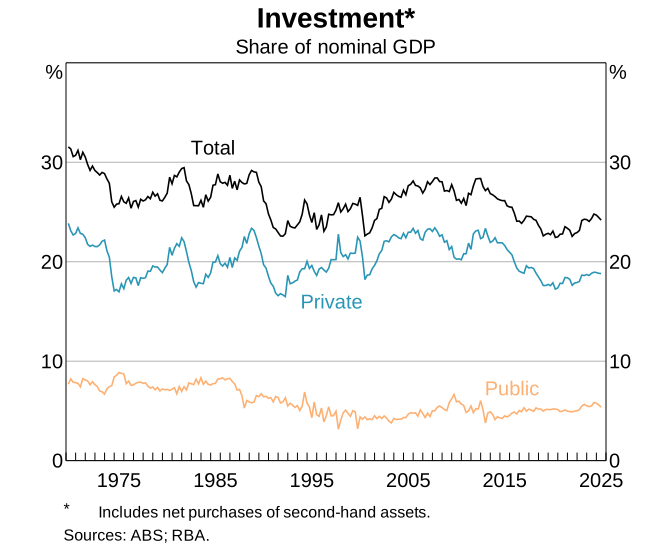
private investment, which also includes housing investment, remains well below its peak of the mining
boom as a share of GDP (Graph 9).
Graph 9
So here is the opportunity for this audience today. An economy already operating near full capacity. With
extraordinary minerals resources, old and new. World-leading universities and human capital. A plumb
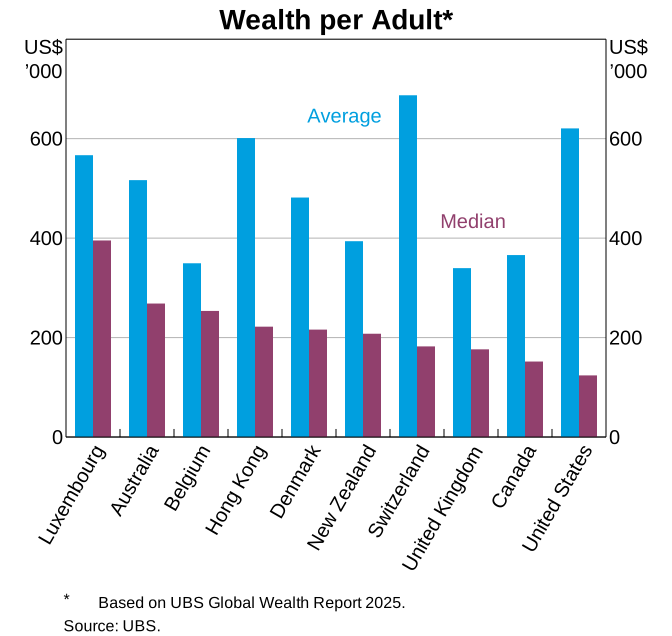
geographical position in the Asia Pacific. A huge domestic savings pool – the second largest median
wealth per capita in the world according to UBS (Graph 10), and the fourth (in due course, second)
largest pension system globally. One of the lowest public debt burdens in the G20. A strong banking
system, proven political and economic institutions, and a long track record of welcoming foreign capital
and labour.
Graph 10
If that doesnt scream investment potential, I dont know what does. Seize that
opportunity, and we really could be off to the races!
Conclusion
Let me conclude.
The Australian economy is in a unique situation. One of the sharpest disinflations in decades has been
achieved without a decline in GDP, and with the employment share at an all-time high. That is a great
outcome – but it also means that the recovery in GDP growth began last year with the highest level
of capacity utilisation in any recovery over the past 40 years.
As Ive set out today, there is room to debate what that means for the precise stance of monetary
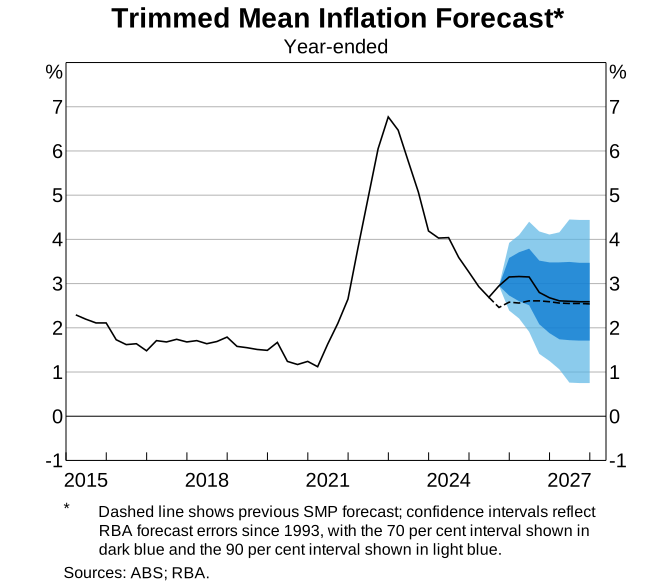
policy in the near term. Our latest projections show inflation settling very slightly above the midpoint
of the 2–3 per cent target range if the cash rate follows a
market-derived path of one more 25 basis point cut (Graph 11).
Graph 11
But the bigger picture challenge for the economy over the medium term, if we are to return to the sort of
growth rates we have been used to, is how to create more supply capacity. If we fail to do so, we may
find ourselves boxed in on the rail. If we succeed, we could be off to the races.
You may be aware that there is a racehorse in Australia called Reserve Bank. Its so far had five
wins and one place off nine starts. Its four years old, and Im told that racehorses typically
peak at ages three to five, so theres still hope for a Melbourne Cup win – for the horse, and
for the Australian economy!
I look forward to answering your questions today.