
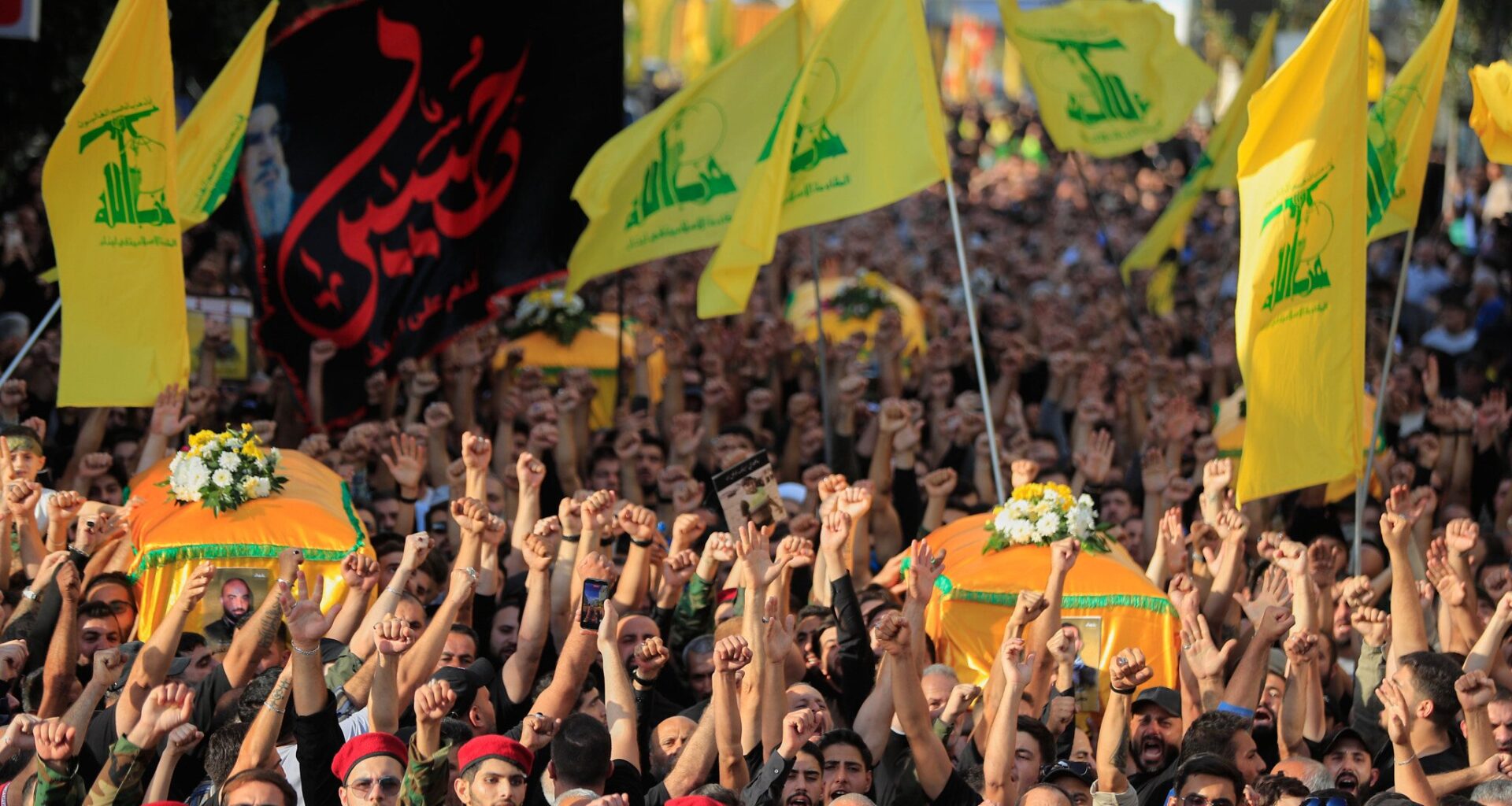
A year after Israel halted its invasion of Lebanon with a highly favorable ceasefire, another IDF operation against Hezbollah looks increasingly inevitable.
Under the year-old deal, brokered by the US and France, the Iran-backed terror group was to be relieved of its arms and prevented from rebuilding its fighting forces.
Instead, as Prime Minister Benjamin Netanyahu warned in public comments during last week’s cabinet meeting, Hezbollah has continued trying to rearm. Israel would do whatever is necessary to prevent that from happening, he threatened.
The IDF has stepped up its airstrikes against Hezbollah in recent weeks, carrying out dozens of attacks and sometimes launching wide sorties. On Monday, it deployed another wave of strikes, targeting southern Lebanon and the Beqaa Valley, deep inside the country.
A senior IDF official told Channel 12 news last week that the strikes were “just a preview” of what would come if Hezbollah is not disarmed.
Get The Times of Israel’s Daily Edition
by email and never miss our top stories
By signing up, you agree to the terms
“If the Lebanese army does not disarm Hezbollah and fails to meet the demands of the ceasefire,” said the IDF officer, “Israel, with US backing, will attack Hezbollah targets across Lebanon, including in Beirut.”
Israel has given Beirut an ultimatum that it will carry out a broad operation if the Lebanese Armed Forces do not step up their efforts, according to the outlet.
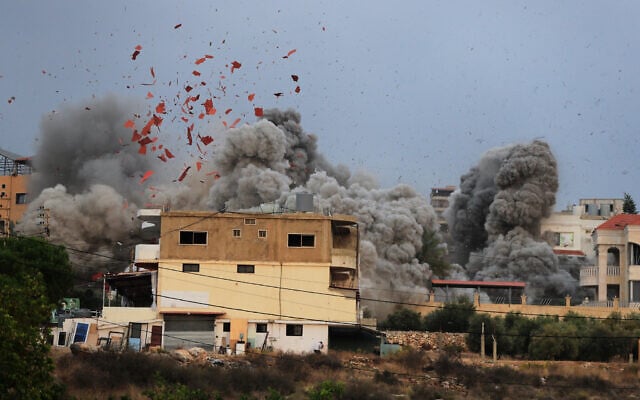
Smoke rises following an Israeli airstrike in the village of Tayr Debba, southern Lebanon, November 6, 2025. (AP Photo/Mohammad Zaatari)
The warnings have not come only from Jerusalem. US Ambassador Tom Barrack wrote on X that if Lebanon’s Western-backed government fails to disarm Hezbollah, the Shiite terror group “will inevitably face major confrontation with Israel at a moment of Israel’s strength and Iran-backed Hizballah’s weakest point.”
Last week, he warned publicly that Lebanon is unlikely to meet its obligations in disarming Hezbollah.
The timing of the exhortations is not coincidental. Both Israel and the US recognize that the deterrent effects of Hezbollah’s military defeat last year are starting to wear off, and that Lebanon’s government and the terror group need to take the possibility of a significant Israeli military operation seriously if another war is to be avoided.
Revolving armory
Israel has been striking Hezbollah targets since the November 2024 ceasefire in an attempt to stop imminent threats and to further degrade the group’s weapons stocks.
But Israeli officials say the current escalation stems from frustration over the pace of the Lebanese Armed Forces’ campaign to disarm Hezbollah.
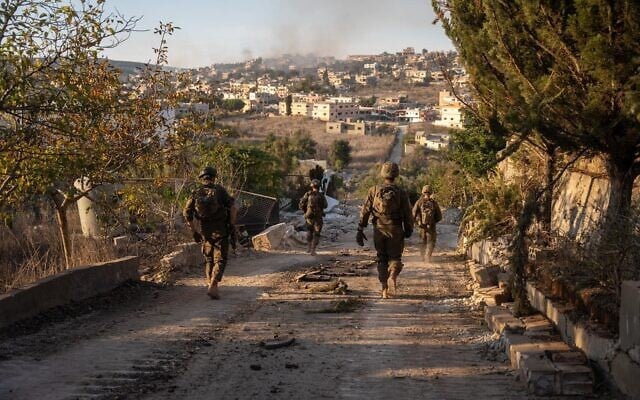
IDF troops operate in southern Lebanon between September and November 2024, in an image released by the IDF on September 21, 2025. (Israel Defense Forces)
Under the terms of the 2024 ceasefire deal, which followed fighting that broke out on October 8, 2023, and escalated into all-out war a year later, Hezbollah was required to vacate southern Lebanon and be replaced by the Lebanese military. Israel was also required to withdraw, but reserved the right to respond to threats and has declined to vacate troops from five strategic locations inside of Lebanon.
Lebanon’s president, Joseph Aoun, has made it clear that he wants to see Hezbollah disarmed — using the euphemism “a state monopoly on weapons” — but is also determined to avoid pushing Hezbollah too hard and sparking a civil war. In August, his government instructed the army to come up with a plan to ensure the state had that monopoly by the year’s end.
In September, LAF Commander Rodolphe Haykal presented a five-stage plan to disarm Hezbollah, starting with a three-month effort south of the Litani River, the part of the country along the Israeli frontier.
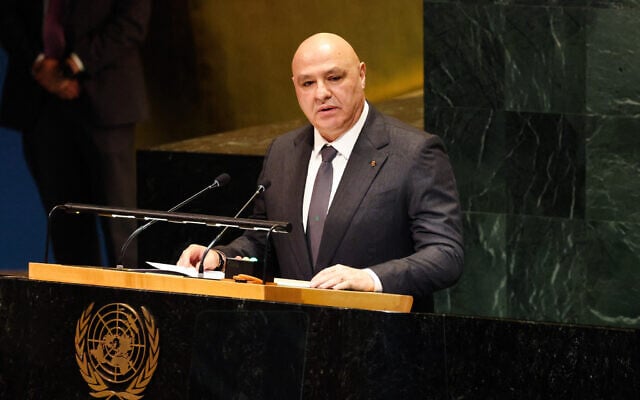
Lebanese President Joseph Aoun addresses the United Nations General Assembly at UN headquarters, in New York City, on September 23, 2025. (Ludovic MARIN / AFP)
And the army has indeed been working on that mission. According to the US Central Command, the LAF has successfully removed nearly 10,000 rockets, almost 400 missiles, and over 205,000 unexploded ordnance fragments during the past year. Lebanon’s army has blown up so many Hezbollah arms caches that it has run out of explosives, sources told Reuters.
Despite the ostensibly encouraging statistics, there is ample reason for Israeli concern.
First of all, the LAF does not appear to be pursuing its disarmament mission with any particular zeal.
“The fact that the Lebanese Army is deployed doesn’t mean that the Lebanese Army is neutralizing Hezbollah’s rehabilitation,” said Sarit Zehavi, CEO of Alma, a think tank that focuses on security challenges on Israel’s northern border.
For more on this topic, listen to this Friday Focus podcast:
So far, the focus has been entirely on the first stage, south of the Litani, and is unlikely to get to the subsequent stages.
“Hezbollah prioritizes north of the Litani, and is deploying there,” said Zehavi.
Even south of the river, the LAF is tiptoeing around Hezbollah, Zehavi contends.
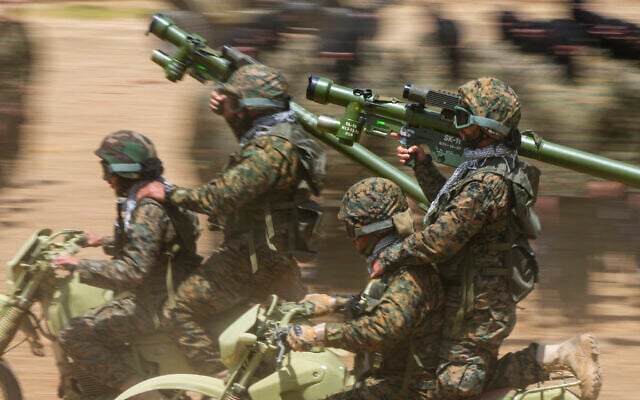
Illustrative: Fighters from the Iran-backed Lebanese terrorist group Hezbollah train in southern Lebanon, May 21, 2023. (AP Photo/Hassan Ammar, File)
“We understand it’s not going into villages,” she explained. “It’s not going into homes. It’s not going into private areas. And Hezbollah hides its weapons in those areas.”
While the LAF is eagerly publishing photographs of weapons it has confiscated in raids against drug dealers and Palestinian refugee camps, it has not released images of its operations against Hezbollah. The type and quality of weapons the Lebanese army is destroying are not at all clear.
“There are more photos from the Syrian government about what they’ve caught than photos from the Lebanese army,” Zehavi charged.
Amid a languid LAF campaign, Hezbollah itself says it will not disarm. Secretary-General Naim Qassem accused the Aoun government of “serving the Israeli project” and issued not especially subtle threats about a civil war, a potent threat for a country still recovering from its last internecine conflict.
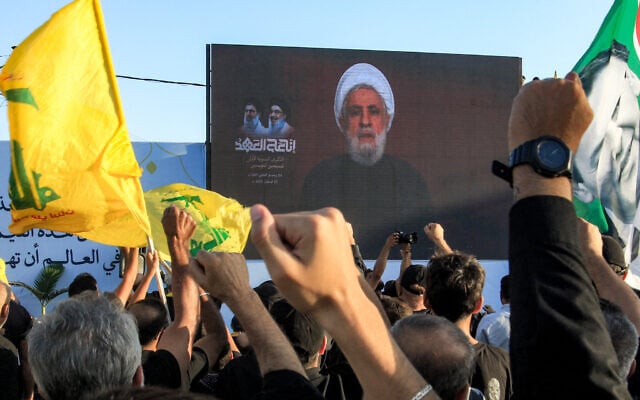
Hezbollah chief Naim Qassem addresses supporters through a screen in a televised address during a ceremony marking the first anniversary of Israel’s assassination of the group’s longtime leader Hassan Nasrallah in southern Lebanon on September 27, 2025. (Mahmoud Zayyat/AFP)
On Thursday, Hezbollah sent a letter to Aoun, Prime Minister Nawaf Salaf, and Speaker of the Parliament Nabih Berri decrying potential negotiations with Israel and arguing that disarmament north of the Litani “was neither stipulated in the ceasefire declaration, nor can ever be accepted or imposed.”
But it is not only a question of refusing to give up the weapons Hezbollah already possesses. After suffering serious losses to its once-vaunted arsenal during Israel’s military campaign last year, the group seems to be actively restocking its supplies.
Hezbollah is “rebuilding its armaments and battered ranks,” including replenishing its rocket, antitank missile, and artillery supply, The Wall Street Journal reported recently.
“Israel sees that Hezbollah is doing exactly what it tried to do in 2006,” said Orna Mizrahi, senior researcher at the Institute for National Security Studies, referring to the group’s massive rebuilding project following the previous war with Israel. “From day one, to return and start to operate beneath the surface, to start to build a physical presence and to preserve and build military capabilities, to continue smuggling.”
“When you look at it over the past year, you see a difference compared to the weak and confused organization in November 2024,” she said.
Hezbollah’s determination to disarm stands in stark contrast to its passive response to a year of Israeli strikes. The organization has not retaliated, saying instead it is the Lebanese state’s responsibility to counter Israeli operations.
Nor did Hezbollah respond to Israel’s devastating strikes on Iran’s nuclear and missile programs in June.
“Hezbollah appears to be guided by a long-term strategic calculus—waiting for conditions to improve before considering a more active role,” according to Reichman University’s International Institute for Counter-Terrorism. “For now, survival is Hezbollah’s top priority.”
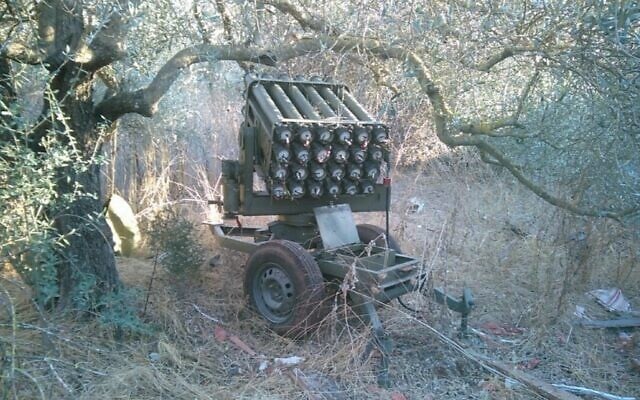
A loaded Hezbollah multiple rocket launcher found by troops of the 769th Brigade in southern Lebanon, in a handout photo issued on November 9, 2024. (Israel Defense Forces)
It may also be playing for time, with a critical election approaching that could help ease pressure from Beirut for it to disarm.
A Lebanese official who is close to Hezbollah and two security sources told Reuters that the Lebanese army wants to give the country’s political leaders time to reach a consensus about Hezbollah weapons north of the Litani before operating there.
A parliamentary election is scheduled for May 2026. If Hezbollah can hold on to its weapons until then, it can both bully its way to success at the ballot box and have a better shot at ensuring the government abandon its campaign to take away its weapons going forward.
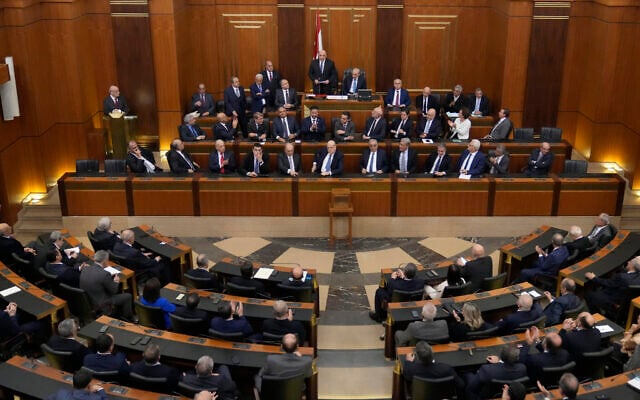
Newly elected Lebanese President Joseph Aoun, standing at background center, delivers his first speech at the Lebanese Parliament, after being sworn in as a new president, in Beirut, Lebanon, January 9, 2025. (AP Photo/ Hussein Malla)
“Their goal today is now to keep their arms until the elections,” said Hanin Ghaddar, senior fellow at the Washington Institute for Near East Policy.
The group is determined to ensure that the 27 seats set aside for Shiites remain in its hands and those of its ally Amal.
The next speaker, who by convention is always a Shiite, has to come from one of those 27 seats. If Hezbollah and its allies lose control of the Shiite seats, the anti-Hezbollah bloc can vote in a speaker hostile to the movement, and the next government could be packed with ministers eager to break Hezbollah’s hold on the country.
“They need their arms in order to intimidate everybody because the candidates (who) are running against them are plenty,” Ghaddar said. “So they need their arms to intimidate everybody into voting for them. And once they win the 27 seats, then they can dictate the next speaker of the House.”
Pressure cooking
With Israel stepping up airstrikes and issuing bellicose threats, the question has now become whether it will embark on another widescale military campaign, including a ground invasion.
Thus far, it seems to be hoping that the mere threat of such action will be enough to make Lebanon’s government understand that they need to step up their disarmament campaign.
“What we’re seeing is a pressure campaign,” argued Will Todman, senior fellow in the Middle East Program at the Center for Strategic and International Studies.

Tom Barrack, US ambassador to Turkey and special envoy to Syria, speaks at a conference in Bahrain on November 1, 2025. (Screenshot from YouTube)
The Trump administration seems to be helping put the squeeze on Beirut as well.
“Clearly, the US is increasing pressure as well on Lebanon to speed up the disarmament, to take it more seriously, to try to prompt action,” Todman continued.
It is not only on disarming Hezbollah where Washington is pressing Beirut. It also wants to see direct talks between the sides on establishing an agreed-upon land border.
Barrack reportedly warned Lebanese officials it was their “last chance” to reach an agreement with Israel: “Either they learn the lesson and decide to enter into direct negotiations with Israel under the auspices of the United States, to set a timetable and mechanism for disarming Hezbollah, or Lebanon will be left to its fate.”
Speaking in Bahrain last week, Barrack publicly called for Lebanese leaders to negotiate with Israel.
“You have Israel, who is sitting ready to make border and boundary agreements with all its neighbors, and it owes America a favor,” he said. “You can’t say the word ‘Israel’ in Lebanon… It’s illegal to have a conversation with Israel. What era are we living in?”
At the same event, Barrack also supported Israel’s right to carry out strikes, saying that the US would support its ally “if Israel becomes more aggressive toward Lebanon.”
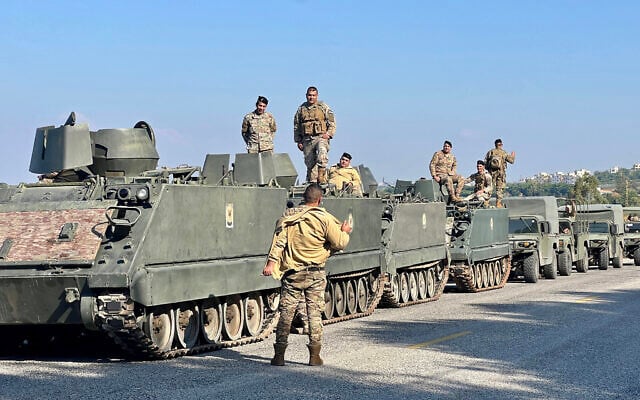
Lebanese army soldiers sit on their parked tanks along a road in the southern Lebanese coastal town of Naqoura, on the border with Israel on January 7, 2025, after Israel’s withdrawal from the area as part of the ceasefire agreement between the two countries. (AFP)
Aoun actually wants to talk to Israel, seeing negotiations as a pathway toward ending the strikes.
“Lebanon has no choice but negotiation, for in politics there are three tools for action: diplomacy, economics, and military,” his office wrote last week. “So when war does not lead us to any result, what is to be done? For the end of every war in various countries of the world has been negotiation, and negotiation is not with a friend or ally, but with an enemy.”
Lebanese officials have proposed adding civilian “technical experts” to the preexisting five-way ceasefire monitoring mechanism, instead of arranging a meeting between Israeli and Lebanese diplomats, in order to minimize the domestic backlash. Once the sides are talking, they can quietly expand the representation.
Hezbollah could well back such talks as a ploy to relieve US and Israeli pressure, while ensuring they drag on and don’t actually lead to it giving up weapons, according to Hussain Abdul-Hussain from the Foundation for the Defense of Democracies.
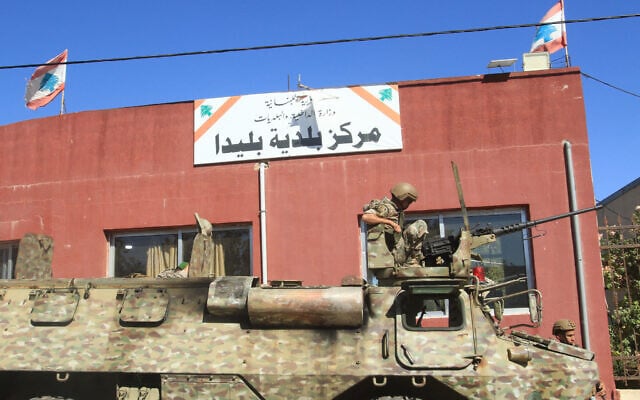
A Lebanese soldier sits on top of a military vehicle outside the municipality building of the southern Lebanese border village of Blida in the aftermath of an Israeli army raid on the village, on October 30, 2025. (Mahmoud ZAYYAT / AFP)
It is unlikely that Israel would go to war in Lebanon while talks are ongoing, especially if they are being sponsored by the US.
Eventually, though, Israel may determine that even with all the pressure, the LAF either cannot or will not disarm Hezbollah, which will not simply fold.
At that point, Israel will see few options other than a military operation.
The pope factor
The coming war will not necessarily involve sending ground troops back into Lebanon. Rather, it will more likely come in the form of several days of bombing, taking out high-value targets that Israel’s intelligence has been tracking.
Ensuring that Trump is on board with such an operation well ahead of time will be a priority for Israel, meaning Netanyahu will likely need to limit the campaign for the famously war-averse president.
“If the Israeli leaders can articulate to the Americans — we have specific aims, this is a time-bound operation, this is what we want to achieve, and then we will return to the ceasefire or the status quo ante,” said Todman, “then maybe they get Trump’s buy-in for that if he thinks that this can sufficiently raise pressure on Hezbollah even more. But I really don’t think that Trump wants a more open-ended conflict in Lebanon again.”
Even if the US is unable to keep Israel from embarking on an expanded operation against Hezbollah, an unlikely world leader will inadvertently keep it from happening for at least a few weeks.

Pope Leo XIV delivers his blessing, next to Cardinal Mario Grech (L) and Bishop Luis Marin de San Martin (R) after participating in the Synod Teams and Participatory Bodies in Paul VI Hall at the Vatican on October 24, 2025. (Filippo MONTEFORTE / AFP)
Pope Leo XIV is planning on visiting Lebanon from November 30 – December 2, in his first trip abroad as pontiff.
It would be utter folly for Israel to bomb Hezbollah sites across Lebanon, which inevitably will cause destruction in the populated areas in which the terror group embeds, just before the pope’s visit.
Such a campaign would shift the focus of his visit from Hezbollah and Iran holding Beirut hostage — harming the interests of Lebanon’s Christians — to the damage caused by Israel’s military machine.
It would be utter folly for Israel to bomb Hezbollah sites across Lebanon just before the pope’s visit.
Pope Leo would be pressed by his hosts to visit burnt-out homes, especially if any Christian sites are damaged, provided a backdrop for global media to energize criticism of Israel and its military operations.
But once the pontiff is back in Rome, all bets are off.
Officially, Beirut’s deadline for clearing southern Lebanon of Hezbollah weapons is the end of the year, though there is no saying if Israel would wait that long.
If the LAF fails to complete its task, or makes it clear that it is not about to get to work on Hezbollah’s arms caches elsewhere in the country, Israel will likely find a short, intense air operation against the terror group irresistibly attractive and utterly necessary.