
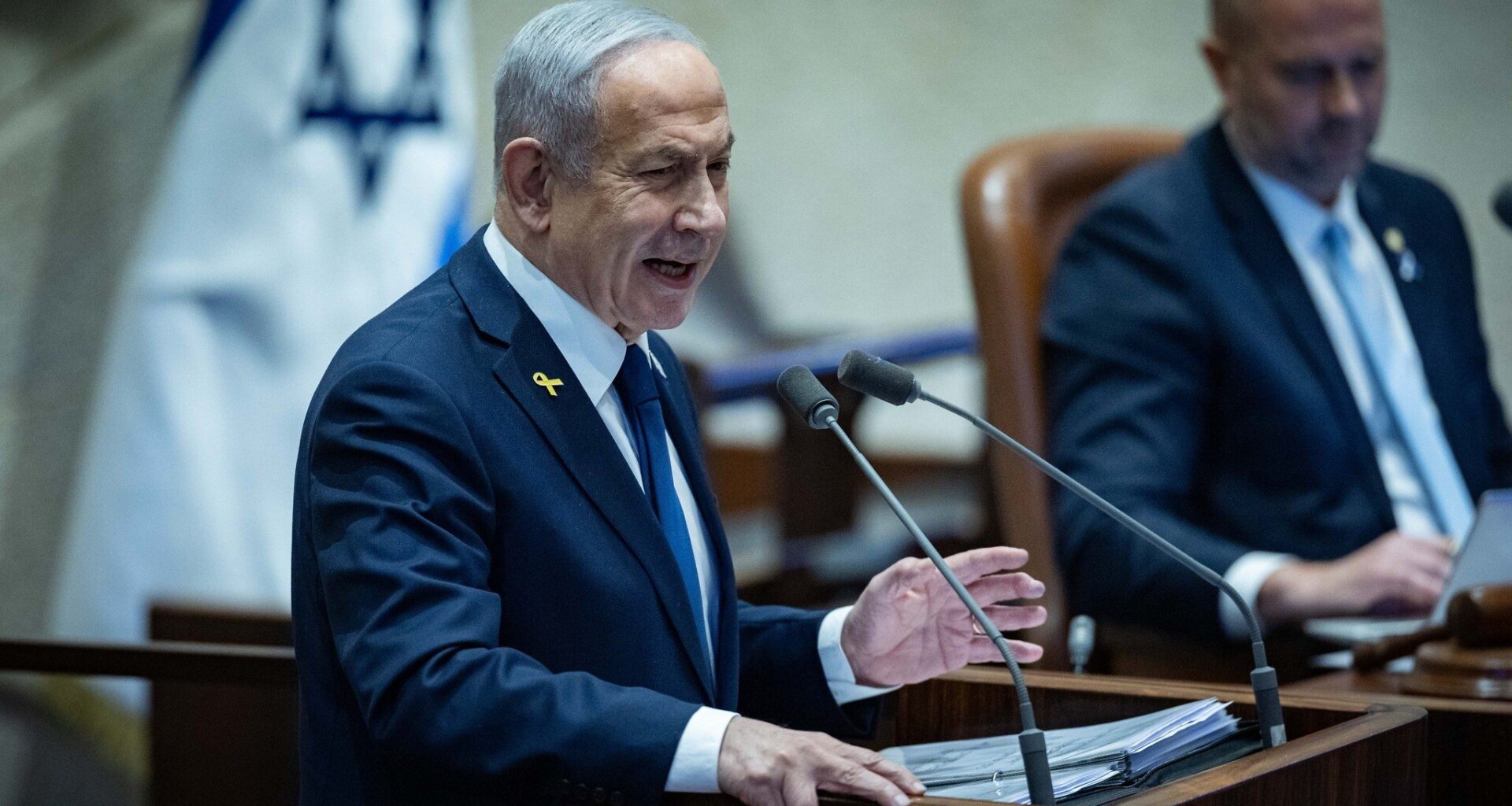
Netanyahu on Monday rejected opposition calls to establish a state commission of inquiry into the failures surrounding Hamas’s onslaught of October 7, 2023, once again claiming that many in the Israeli public would not accept it, while opposition figures accused him of trying to escape accountability.
The comments came during a so-called 40-signature debate in the Knesset to discuss the issue, which the prime minister is legally obliged to attend. The opposition can call for such discussions once a month, usually to discuss criticism of the government, its policies, and its legislative agenda.
Instead of a state commission, Netanyahu said his government “wants to establish a commission of inquiry with as broad public support as possible,” and not one rejected by what he claimed is “at least half the country.”
In fact, polls have consistently indicated a clear majority of Israelis support a state commission, and Netanyahu himself backed such an inquiry into the conduct of the previous government in 2022.
“It has to be a balanced commission that will hear everyone, will investigate everyone, and that will earn the greatest possible public trust,” he said, repeating his argument that a state inquiry would be rejected by many on the right since it would be appointed by the Supreme Court president.
Get The Times of Israel’s Daily Edition
by email and never miss our top stories
By signing up, you agree to the terms
“The only way to ensure public trust in the commission’s work is through broad agreement on its composition,” he said. “The commission of inquiry we establish must be based on representation of all parts of the nation, not only a part of it, or, at least, the great majority of it.”
Prime Minister Benjamin Netanyahu speaks during a ’40-signature’ debate at the Knesset in Jerusalem, on November 10, 2025. (Yonatan Sindel/Flash90)
He said the critical question is whether it is possible to create a commission based on a broad national consensus, pointing to the commission created to investigate the September 11 attacks in the United States as a model. “The American people wanted to understand how such an event occurred,” he said. “Under whom did the event occur? Who has responsibility for the event?”
“They did something different,” he said. “They established a bipartisan commission. A national investigation commission shared equally by Republicans and Democrats. Both sides of the political divide cooperated fully to learn lessons for the good of the country. No one tried to use the commission as a political tool.”
Israel “must establish a commission of inquiry based on broad agreement,” he said, adding: “I will be the first to stand before it and answer every question.”
“But I will not be the only one who answers the questions,” he continued. “Everyone will be asked, and everyone will have to respond.”
“Let’s investigate what happened,” he said. “Let’s investigate who did what — in the diplomatic realm, in the security realm, in the early-warning realm. All of these things must be investigated, but they must be investigated not by a panel that more than half of the public believes has pre-written conclusions.”
Critics claim Netanyahu — who, unlike other senior officials, has not publicly taken responsibility for the failures surrounding October 7 — wishes to establish a governmental committee over whose makeup he will have greater control, and with lesser powers than a state commission, which they argue would hinder its ability to reach the truth and enforce accountability.
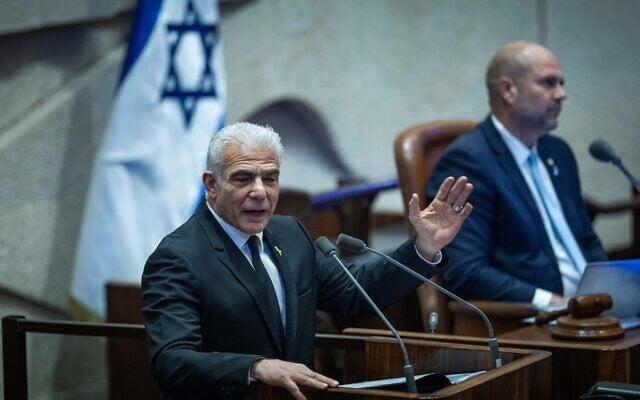
Opposition Leader speaks during a ’40-signature’ debate at the Knesset in Jerusalem, on November 10, 2025. (Yonatan Sindel/Flash90)
Lapid to PM: ‘You are responsible’ for October 7
Speaking before Netanyahu, Opposition Leader Yair Lapid slammed the premier for refusing to establish a state commission of inquiry, painting him as a leader who avoids responsibility and clings to power.
“On your watch, no one takes responsibility; no one says, ‘I apologize,’ ‘I’m ashamed,’ ‘It’s terrible. I know that if I’m at the head of the system, the responsibility is mine,’” Lapid said, addressing Netanyahu.
“It doesn’t occur to you. Someone who didn’t take responsibility for October 7, for the greatest disaster in our history, a disaster that happened on his watch, why would he take responsibility for something else?” Lapid asked, pledging that “we will never forget.”
“Anyone who was in a leadership position on October 7, 2023, cannot and will never be able to remove responsibility and blame from themselves. They need to go,” the Yesh Atid party leader said.
The then-heads of the IDF, Shin Bet, and Defense Ministry have all gone, leaving only Netanyahu, “the one who really headed the system on October 7 and ignored all the warnings,” he added, referring to the resignations of the top officials of nearly all security bodies in the wake of the 2023 attacks.
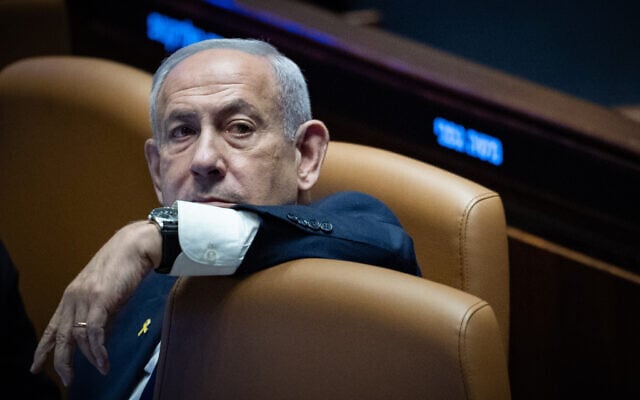
Prime Minister Benjamin Netanyahu at the plenum hall of the Knesset in Jerusalem, on November 10, 2025 (Yonatan Sindel/Flash90)
Lapid asserted that this is why Netanyahu is doing everything he can to prevent the establishment of a powerful inquiry committee, because “there will be no escaping the truth. And the truth is that you are responsible and you are guilty and you need to go.”
“I know what you’re thinking — you think the public no longer cares. You don’t understand that it’s the opposite. The reason no one is shocked by anything anymore is that everyone knows what you are. Everyone understands — even your supporters — that this government is corrupt and rotten to the core,” he said.
“That’s what will bring you down: the public’s realization that everything is rotten. Nothing works, except your corruption operations. This is not a government for the good of the country — it’s a group of people who know the end is near, so each one is rushing to grab as much as he can before leaving the stage,” the opposition leader concluded.
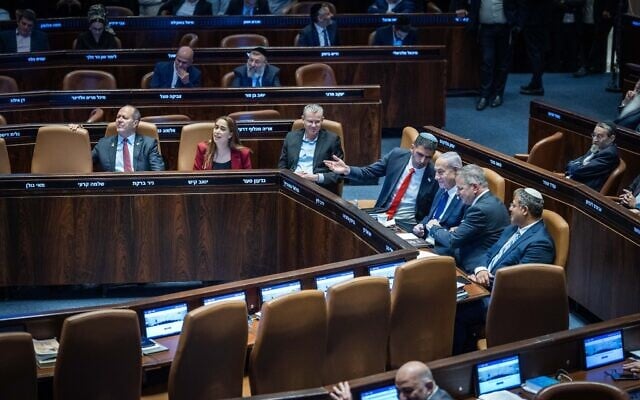
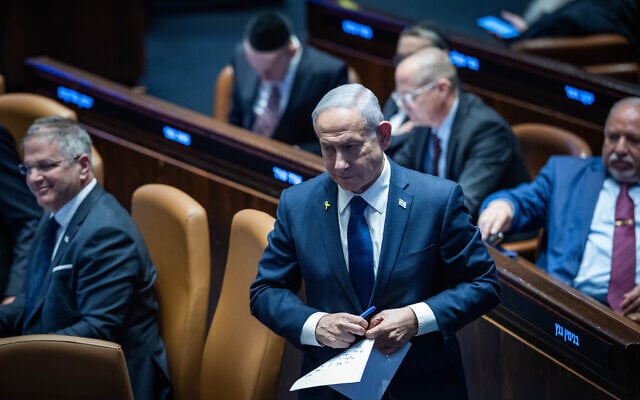
Prime Minister Benjamin Netanyahu sits alongside several ministers and MKs during a ’40-signature’ debate at the Knesset in Jerusalem, on November 10, 2025. (Yonatan Sindel/Flash90)
Also speaking at the debate, Yisrael Beytenu party chairman Avigdor Liberman accused the premier of abandoning his leadership responsibilities while blaming others for his failings.
“Mr. Prime Minister, I hear a lot from those around you about the deep state. Is it the deep state or deep fake?” asked Liberman.
“You are responsible for sabotaging the [Haredi] conscription law, and you are the main person responsible for the October 7 massacre. You corresponded with the arch-murderer Yahya Sinwar… [and] transferred the Qatari money,” he declared.
“The state investigation committee on the Meron disaster determined that you are personally responsible, but did not draw any operative conclusions. I promise you — we will establish a state investigation committee that will really interrogate everyone. We will force it to draw personal conclusions. Nothing will help you — this time you will not be able to escape,” he added.
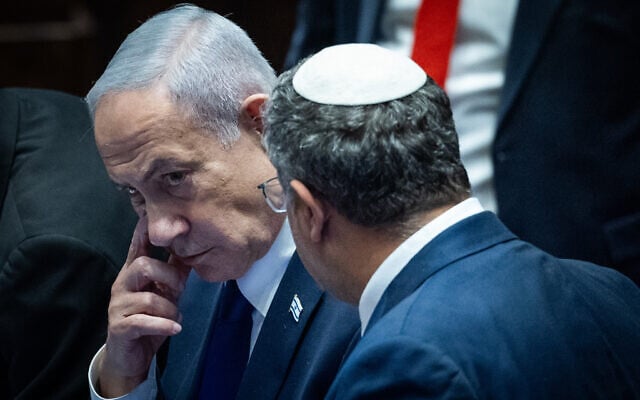
Prime Minister Benjamin Netanyahu speaks with National Security Minister Itamar Ben Gvir during a ’40-signature’ debate at the Knesset in Jerusalem, on November 10, 2025. (Yonatan Sindel/Flash90)
Bennett vows to shut down ‘fake commission’
Also commenting on Monday’s debate was former prime minister Naftali Bennett, who was not present, as he is not currently a member of Knesset. In a statement, Bennett slammed Netanyahu for seeking to establish a “fake commission.”
The families of the fallen “deserve answers about this enormous failure,” he declared. “I now hear that the government wants to establish a kind of fake commission whose members it appoints — even though this same government bears immense responsibility for this disaster.”
“Therefore, I say here as clearly as possible: On the first day of the government that we will form, we will cancel any circus committee that is established, and we will create a state commission of inquiry to investigate the failure of the October 7 massacre,” Bennett added.
The government has long opposed the establishment of a state commission of inquiry into the October 7 catastrophe, originally on the grounds that such an inquiry could not be conducted while Israel was at war, but later due to accusations by several cabinet ministers that Supreme Court President Isaac Amit could not be trusted to appoint a fair-minded judge or retired judge to head the panel.
The High Court of Justice told the government on October 15 that there is “no real argument” against the need to establish a state commission of inquiry in its decision over petitions demanding the establishment of such an inquiry. It gave the government 30 days to submit a new update about “the fate” of such a commission.
Netanyahu has repeatedly asserted that it is the security establishment — not political leaders — that failed to prevent the deadliest attack in Israel’s history.