
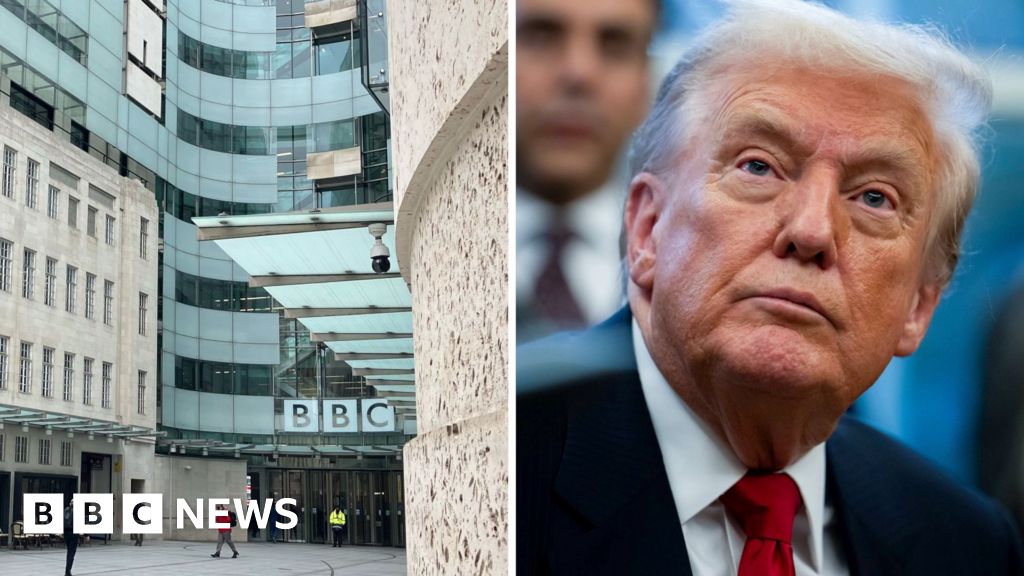
Davie arrived at London Broadcasting House on Tuesday morning ahead of his call with staff
BBC director general Tim Davie has told staff that “we’ve got to fight for our journalism” after Donald Trump threatened to sue the corporation for $1bn (£760m) over a Panorama programme.
It comes after a leaked internal BBC memo, published by the Telegraph last Monday, said the film had misled viewers by splicing together parts of the US president’s speech on 6 January 2021 and made it appear as if he had explicitly encouraged the Capitol Hill riot.
“We have made some mistakes that have cost us, but we need to fight,” Davie, who resigned on Sunday alongside BBC News CEO Deborah Turness after mounting pressure over the memo, said on Tuesday.
“This narrative will not just be given by our enemies, it’s our narrative,” he added.
He said the BBC went through “difficult times… but it just does good work, and that speaks louder than any newspaper, any weaponisation”.
Trump threatened to take legal action if the BBC did not make a “full and fair retraction” of the programme by Friday. The corporation has said it will reply in due course.
BBC chair Samir Shah said in a letter to the Culture, Media and Sport Committee (CMS) on Monday that the corporation would like to apologise for the edit, which he called an “error of judgement” which gave the impression of a “direct call for violent action”.
During Tuesday’s staff call, where Shah also spoke, neither Davie nor the BBC chair mentioned Trump’s legal threat.
Davie said the fact that “there was an editorial breach, and I think some responsibility had to be taken” was one of the reasons he was quitting.
He also cited the upcoming charter renewal – saying he wanted to give his successor a “runway into that” – and the personal pressures of the “relentless” role.
Shah also defended the fact that the corporation did not respond to memo’s publication for seven days.
“We had a deadline, that was Monday… and we met that,” he said, referring to the deadline given by the CMS, and stressed that he “needed to be careful and get it right”.
No timeline was given for selecting Davie’s replacement, but the chair said the corporation was in “succession mode”.
The BBC’s culture editor Katie Razzall said there was “some disquiet” from BBC staff over the Q&A session, which was moderated by a member of the BBC’s communications team, not by a journalist.
Downing Street has refused to comment on Trump’s legal threat, explaining that this was a “matter for the BBC”.
“It is clearly not for the government to comment on any ongoing legal matters,” the prime minister’s official spokesperson said.
“Our position is clear, the BBC is independent and it’s for the cooperation to respond to questions about their editorial decisions.”
Asked whether there were concerns the issue would impact Keir Starmer’s relationship with Trump, the spokesperson said the two had a “very strong” relationship.
The spokesperson would not be drawn on whether the BBC should apologise directly to the president.
Trump’s legal team wrote to the BBC on Sunday threatening to take action over the “false, defamatory, disparaging, misleading, and inflammatory statements” in the Panorama programme.
The BBC said the programme, which was first broadcast on 24 October 2024, was not available to watch on iPlayer because it was “over a year old”.
‘BBC is not institutionally biased’, says Deborah Turness morning after announcing resignation
In his speech on 6 January 2021, Trump said: “We’re going to walk down to the Capitol, and we’re going to cheer on our brave senators and congressmen and women.”
In the Panorama programme, he was shown saying: “We’re going to walk down to the Capitol… and I’ll be there with you. And we fight. We fight like hell.”
The “fight like hell” comment was taken from a different part of the speech where Trump discussed how “corrupt” US elections were.
Sections of the speech that were stitched together were originally more than 50 minutes apart.
Media lawyer Mark Stephens said it would be difficult for Trump to bring the case in the US, since his team would need to prove the programme had been shown there.
“Panorama wasn’t broadcast in the USA, and BBC iPlayer isn’t available… so it’s not clear that any US court would have jurisdiction to hear the claim,” he told BBC Breakfast.
George Freeman, a former assistant general counsel for The New York Times, described numbers cited in legal complaints in the US – such as the $1bn in Trump’s – as “totally meaningless” and “empty”.
“It’s so meaningless that when I was at the New York Times, we had a policy that the paper wouldn’t print the amount sued for,” he told the BBC’s World Tonight programme.
He explained that in the US, Trump’s team would need to prove a “gross distortion” of his meaning, that the edit harmed his reputation, and that it “was done intentionally to create a different meaning”.
Ros Atkins on…the BBC resignations
The resignations at the BBC followed mounting pressure over the leaked memo, written by a former independent external adviser to the broadcaster’s editorial standards committee, Michael Prescott.
Beyond Panorama, the memo also raised concerns about issues including reporting by BBC Arabic on the Israel-Gaza war and coverage of trans issues. Shah said on Monday it was “simply not true” that the BBC had buried them or failed to act.
A spokesman for Sir Keir Starmer said on Monday the prime minister did not believe the BBC was “institutionally biased” and denied the BBC was “corrupt” – a word Trump used to describe some of its journalists.
Meanwhile, Sir Robbie Gibb, a former senior editor at the BBC who was director of communications for Theresa May, has faced calls to be removed from the BBC board.
Liberal Democrat leader Sir Ed Davey wrote in the Guardian that he should be removed immediately and have no role in appointing Tim Davie’s replacement.
“Right wing populists have been attacking the BBC for years,” he wrote, calling for an end to the “practice of political appointments, which so badly undermines the BBC”.
Sir Robbie has not responded.
Conservative leader Kemi Badenoch said there had been “serious questions to answer for a long time” within the BBC, and that the documentary incident had been a “real problem”.
Reform UK leader Nigel Farage claimed the BBC “has been institutionally biased for decades”. He said Trump had told him on Friday: “‘Is this how you treat your best ally?'”