
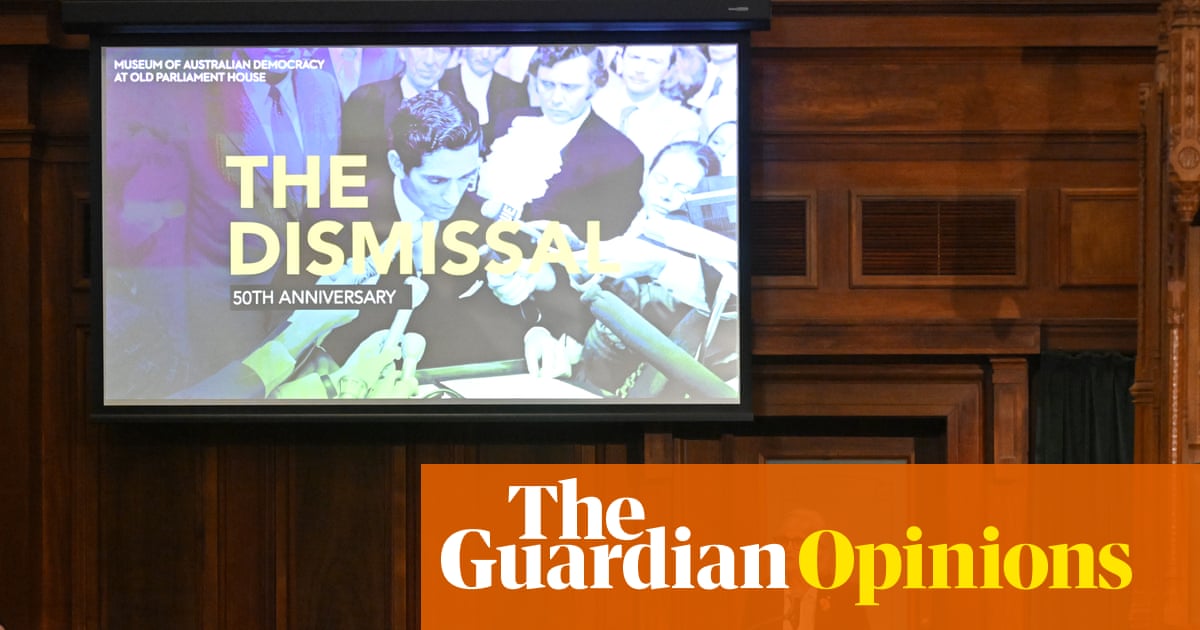
Half a century on from Gough Whitlam’s historic dismissal, the rage and rancour remains.
Paul Keating said he would have arrested governor general Sir John Kerr over what he called a “coup”, while John Howard said the Senate deadlock needed to be broken.
The prime minister, Anthony Albanese, called Kerr’s dismissal “a calculated plot” and partisan ambush.
But among the fizzing division still lingering to this day, one bright spark of common ground: Howard backed Albanese’s long-held push for a move to four-year terms of government.
Sign up: AU Breaking News email
The Liberal titan urged current Liberal leader, Sussan Ley, to “get together” with the prime minister to give more stability and structure to Australia’s electoral system.
In conversation with broadcaster Barrie Cassidy, Howard implored Ley to back the extension of federal parliamentary terms from three to four years, saying it was “crazy” the commonwealth government had shorter terms than state counterparts.
Howard, PM from 1996 to 2007, said he’d discussed the idea twice during his time leading the Liberals – once with Bob Hawke, another with Mark Latham in later years – but no agreement was reached.
“I would say to Sussan Ley, to the prime minister, get together on it now. Don’t attach conditions. It’s ludicrous you’ve got four-year terms in all the states but the national parliament doesn’t. It’s just crazy,” Howard said.
Albanese, earlier on Tuesday, told ABC radio that he wanted the “common sense” change, but that “the problem has been unless there’s bipartisan support for referendums – there have only been eight [that] have been carried of almost 50 that have been put”.
Half a century to the day since Whitlam’s dismissal, commemorations and historical analysis at old Parliament House (now the Museum of Australian Democracy) provided a chance to reflect on this inflection point in federal politics – to debate the decision, rake over Whitlam and Malcolm Fraser’s responses, to pore over the records and reflect on what’s changed since.
Sessions throughout the day were filled with politicians and lawyers, historians and family, scholars and staffers, as political tragics packed into the old House of Representatives chamber or watched on video screens in the main lobby.
The odd bright orange t-shirt blazoned with “It’s time”, the Labor party’s 1972 election jingle, punctuated an otherwise largely grey crowd, packed in among the warm brown wood and deep green leather of the House chamber.
The audience largely seemed on Whitlam’s side, cheering when one panel member said Kerr had acted with “profound dishonesty”.
The current governor general, Sam Mostyn, raised alarm about the potential “fragility” of Australia’s democracy, saying she wouldn’t judge her predecessor but that she couldn’t imagine blind-siding a prime minister in the way Whitlam was.
But Mostyn said the current crop of politicians, and Australians more broadly, should take the momentous dismissal anniversary as an opportunity to reflect on the “collision of apathy and disinformation” troubling democratic and civil institutions.
“I hope young Australians across the country feel the same curiosity about our system … but as you all know, I hold that hope against a tide of mounting evidence, now 50 years on from those events, Australians’ general interest in and understanding of our democratic institutions is much weaker than we need it to be.”