
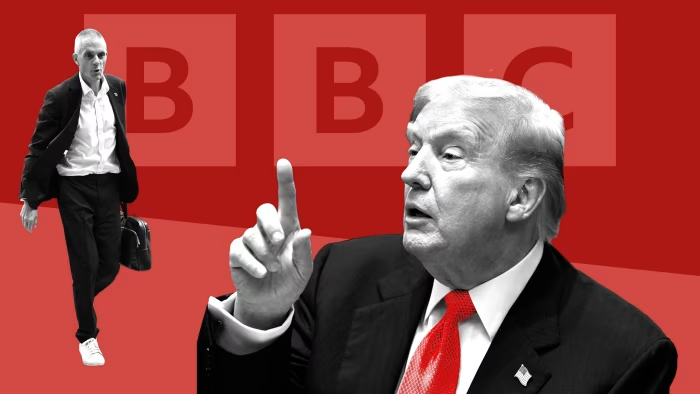
Outgoing BBC director-general Tim Davie has told staff that Britain’s national broadcaster must “fight” for its journalism as its board weighs up demands for compensation in the threatened $1bn lawsuit by Donald Trump.
Lawyers for the US president said he would sue and seek $1bn in damages in a Florida court if he did not receive a full retraction, apology and appropriate compensation by Friday over a misleading edit of a speech he gave on January 6, 2021, the day his supporters stormed the Capitol.
In a speech to staff on Tuesday, two days after his shock resignation, Davie admitted the BBC had made “some mistakes that have cost us”, including the editing in the Panorama documentary that carried footage of Trump’s speech.
But Davie, who quit alongside BBC News head Deborah Turness after the leak of a board memo by former adviser Michael Prescott listing editorial failures, added: “I see the free press under pressure. I see the weaponisation. I think we have to fight for our journalism.”
The BBC board, led by chair Samir Shah, is still considering its response to Trump’s threat, which was sparked by a leaked internal memo that accused the publicly funded corporation of a series of failures in its coverage.
Figures at the broadcaster said an important factor in a decision to contest claims for compensation would be whether the Panorama programme, which aired in October 2024, was shown in the US — where there is no access to iPlayer, the BBC’s streaming service.
Shah, who has said the BBC made an “error of judgment” in the way it edited footage of Trump’s speech, was considering whether he should offer a full apology to the US president, one of the people said.
BBC bosses are taking legal advice before responding ahead of the Friday deadline.
The role of board member Robbie Gibb came under fresh scrutiny on Tuesday, with Labour, Liberal Democrat, Green and Scottish National party MPs calling for the former Conservative press secretary to be sacked from his BBC role.
Pointing to the principle of keeping the broadcaster free from political interference, Labour MP Sarah Owen asked culture secretary Lisa Nandy if it was “time to review the influence of former Conservative spin-doctor Robbie Gibb on the BBC’s board?”
Nandy told the House of Commons that the BBC charter, which sets out its governance and funding arrangements, set a “strict legal threshold that must be met before dismissal of a board member”, leaving her “unable to pursue the course of action”.
The process to review the charter, which is up for renewal in 2027, would begin “imminently” and ensure the broadcaster remained “fiercely independent” and “genuinely accountable”, she added.
One ally of Gibb said this week he had consistently supported Davie and had wanted him to stay in post, adding: “The allegation that there is a conspiracy is absolute nonsense.”
Because the Panorama programme was shown in October 2024, Trump is unable to pursue legal action in the UK, where cases must be brought within 12 months of an alleged libel. By contrast, in the state of Florida, where Trump filed his threat to sue, the time limit is two years.
Legal experts said the case was far from clear-cut for Trump since the iPlayer service is not available in the US.
Prateek Swaika, partner at US law firm Boies Schiller Flexner, said “the jurisdictional hurdle of proving Florida viewership of a UK broadcast may not be straightforward”.
Trump’s lawyers told the BBC in a letter that the “fabricated statements . . . have been widely disseminated throughout various digital mediums, which have reached tens of millions of people worldwide”. The president had suffered “overwhelming financial and reputational harm” as a result, they added.
Chris Ruddy, head of conservative US media organisation Newsmax, told BBC Radio 4’s Today programme that the BBC would probably win if it opted to fight the case because the state of Florida had strong libel laws “that defend media companies and free speech”.
At the same time, juries in Florida, a state Trump has won every time he has run for president, have in past high-profile media cases been “quite sympathetic to libel plaintiffs”, said Jane Kirtley, professor of media ethics and law at the University of Minnesota.
Recommended

Asked by GB News on Tuesday how the BBC should respond to Trump’s legal threat, Conservative shadow culture secretary Nigel Huddleston said the corporation should “grovel . . . because they were wrong”.
The US president has scored a number of notable victories over media groups in the US in recent months, with Paramount agreeing in July to pay $16mn to settle a dispute over an interview broadcast on CBS.
The US network’s willingness to settle the suit sparked concern among free-speech advocates. But media analysts see it as an attempt in part to stay on side with Trump given Paramount’s desire to get his support for its takeover by Skydance, which was finalised in August.
Trump lost a 2023 defamation lawsuit against CNN, in which he alleged the network had likened him to Adolf Hitler, as well as lawsuits against the New York Times and the Washington Post.
Libel lawyer Iain Wilson said, that under US law, it was necessary for a public figure to establish “actual malice”, for example where footage had been “deliberately edited to present a particular narrative with a reckless disregard to accuracy”.
He added: “The BBC could still seek to defend the claim by arguing that the gist of the imputation viewers drew from the broadcast was substantially true. The BBC could also seek to defend the claim on the basis that the Floridian court should not be exercising jurisdiction over it, particularly in relation to a broadcast that was not targeted at US viewers.”
Sinead O’Callaghan, managing partner at law firm Cooke, Young and Keidan, said: “Ultimately, the threat of a billion-dollar claim is as much a tactic to exert pressure on the BBC as it is a statement of legal intent.”
Additional reporting by Alistair Gray