

Ontario, and Canada as a whole, could be in for a “very tough” flu season this year, according to health experts.
Public Health Ontario’s (PHO) data reveals a 1.8 per cent rise in influenza cases in the province within the last week of October, the most recent surveillance week.
Broken down, PHO says three outbreaks, 14 hospitalizations, and 129 cases were reported during that period.
In a statement, PHO says the percent positivity for influenza A cases is currently highest among children aged 5 to 11 at 7.8 per cent, followed by 12- to 19-year-olds at 4.2 per cent.
Between Nov. 2 and 15, the provincial health agency predicts flu activity to rise during that period, with pediatric cases likely to see the highest number of cases.
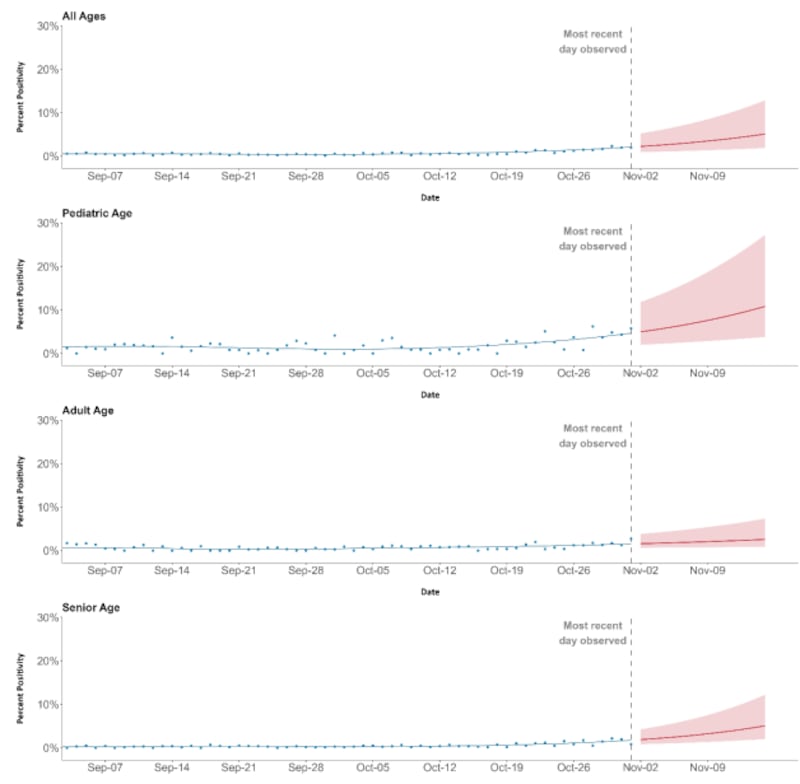 PHO influenza activity Public Health Ontario’s predictions of recent and projected influenza activity among Ontarians. The red line indicates the estimated viral activity with the shaded area representing the 95 per cent prediction interval. (Public Health Ontario)
The most recent federal data reveals similar influenza trends across Canada, revealing roughly two per cent of country-wide tests were positive in the last week. While it’s below the five per cent threshold to declare a seasonal flu epidemic, it still reflects a rise from previous weeks.
Dr. Fahad Razak, an internal medicine specialist at St. Michael’s Hospital, pointed to what is currently being seen in the southern hemisphere, particularly in Australia, as a potential indicator for what is expected to come to Canada this flu season.
“What we’re seeing in the southern hemisphere, so places like Australia, which will lead ahead of us in the flu season because their winters are our summer, they had a very, very bad year, one of the worst years on record,” Razak told CP24’s Arda Zakarian in an interview.
The Royal Australian College of General Practitioners (RACGP) said they saw “startling” flu cases this October, where cases reached an all-time high with around 1.5 per cent of Australians contracted a “notifiable flu infection”— a nearly 11 per cent rise from what the country saw in 2024.
As cases skyrocketed, vaccination rates plateaued, RACGP noted, with roughly a quarter of children between the ages of six months to five years old getting their vaccines this year. The medical association noted this is the lowest vaccine rate seen since 2021.
Though the Public Health Agency of Canada (PHAC) monitors what happens in the southern hemisphere to determine what is in store for Canada this flu season, it says it is not a direct indicator of what will be seen across the country because of various seasonal dynamics, like the dominating circulating type and subtype.
One strain that has been on the rise this year is H3N2, which is a subtype of influenza A. Infants, the elderly, and those who are immunocompromised are hit hardest if they contract this virus, but it can still infect everyone.
For the last 15 years, Dr. Alon Vaisman says H1N1 has been the dominant influenza strain, and it is currently the most common subtype detected across Canada.
“Every once in a while, you see this shift and drift within the flu where you see these strains that people—the human body—has not seen in a while or the vaccines haven’t covered it,” the infectious disease and infection control physician told CTV News Toronto. “H3N2 has that capacity.”
Infectious disease specialist Dr. Isaac Bogoch tells CTV News Toronto that H3N2 tends to bring on a more severe flu season.
“What’s a little bit concerning is that if you look at the current H3N2 that we have in Canada, some of it shows, for lack of a better word, a little bit of resistance to the current vaccine,” he said.
“It doesn’t mean the vaccine won’t work, but it means perhaps it might—keyword might—not be as effective for the H3N2 strain of influenza that’s circulating in the country.”
And that’s mainly because of how this virus mutates. This year’s flu vaccine targets two influenza A strains—subtypes of H1N1 and H3N2 as well as an influenza B strain.
“It is still a very good idea to go out and get the flu shot better than not getting it at all,” Bogoch said.
“Because it’s still, while not perfect, still very, very good in reducing the risk of influenza and complications of influenza.”
PHAC says it is still too soon to predict what sort of flu season Canada will have this year.
“(T)hat will depend on such things as dominant influenza subtype, co-circulation of other respiratory virus, vaccine effectiveness, and vaccine coverage,” the federal health agency said in an emailed statement.
The current federal figures reveal a 50/50 split between cases of H1N1 and H3N2. PHO says that in Ontario, about 55 per cent of influenza A cases seen so far this year have been H1N1.
That said, flu season has already kicked off in other countries across the northern hemisphere.
England, for example, is reporting an “unusually early” start, with the number of influenza cases rising, though still not being widely circulated. Ireland is in a similar boat, though seeing a 37 per cent increase in flu cases over the last week with hospitalizations rising by 141 per cent.
How virulent this year’s flu season will become more apparent in the thick of winter, Vaisman says, likely by the end of December or early January.
“Regardless of what strains arise, the public messaging is the same, the way we prevent flu transmission is identical—it doesn’t matter what strain it is,” he said.
“Don’t go to work sick, don’t go to school sick, wash your hands, influenza vaccination is absolutely critical… thing change, certainly from year-to-year, but the core message of prevention is the same.”