

A former policeman who set himself on fire outside the home of a senior official in the Defense Ministry’s rehabilitation department nearly two weeks ago has died of his injuries, Hebrew outlets reported on Wednesday.
Vital Mishayev, a 46-year-old divorcee and father of three, was diagnosed with post-traumatic stress disorder and a physical disability after a mentally unstable man hit him with a rock while on patrol in 2013.
He was recognized as disabled by the Defense Ministry’s rehabilitation department due to mild-to-moderate PTSD alongside a physical disability, according to Army Radio.
But he had reportedly demanded over the past two years that the department recognize him as fully disabled, which would entitle him to housing. The Ynet news site reported that he had been homeless and sleeping outside the defense official’s home for several months. Efforts to find him assistance and housing had failed.
His case was the latest to draw attention to the plight of soldiers and police who have been mentally and physically scarred by their service.
Get The Times of Israel’s Daily Edition
by email and never miss our top stories
By signing up, you agree to the terms
“Another comrade has found himself facing a system that does not respond and is broken,” the War Wounded Forum, representing soldiers suffering physically and mentally from combat, said in a statement after Mishayev’s act. “This event is a sharp wake-up call for all of us: the war may have ended on the battlefield, but for many of our male and female fighters, it has not ended within their souls.”
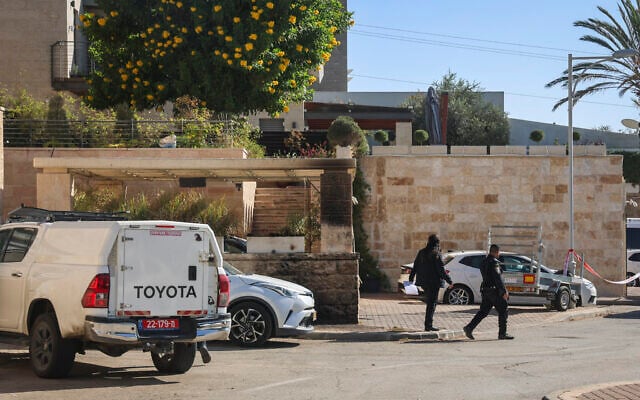
The scene where a former police officer suffering from PTSD set himself on fire outside the home of a senior official from the Ministry of Defense’s Rehabilitation Department, in the community of Neve Ilan, October 31, 2025. (Oren Ben Hakoon/Flash90)
The forum called on the government to take “full responsibility, through its actions, not bureaucracy.”
The issue has taken on increased urgency in the wake of the Gaza war, with tens of thousands of soldiers having seen prolonged combat. An army report from July 2025 noted 9,000 requests for recognition of “psychological suffering” submitted to military health services since the war began.
Days before Mishayev’s self-immolation, a Knesset report found that between January 2024 and July 2025, 279 Israel Defense Forces soldiers attempted to take their own lives. More than three-quarters of suicides in Israel last year were combat soldiers, a sharp rise from previous years.
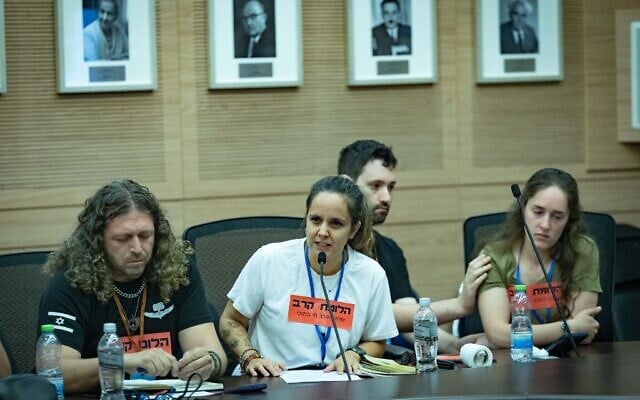
Female combat soldiers speak about PTSD during a Foreign Affairs and Defense Committee meeting at the Knesset in Jerusalem, November 10, 2025 (Yonatan Sindel/Flash90)
Mishayev’s was also one of several self-immolation attempts in protest of the Defense Ministry’s rehabilitation department, which veterans and their advocates claim is neglectful and exceedingly difficult to navigate.
The issue attracted national attention in April 2021, when IDF veteran Itzik Saidyan set himself on fire outside a rehabilitation center in Petah Tikvah. After recovering from the severe burns, he said that he self-immolated to protest alleged neglect by authorities, after struggling for years to receive proper care for PTSD.
ויטל מישייב נפטר מפצעיו. את התמונה הזאת הוא העלה במרץ 2021 https://t.co/gpIThUhntK pic.twitter.com/la4ZQ2OZCC
— גלעד כהן | Gilad Cohen (@GiladCohenJR) November 12, 2025
According to Ynet, in 2021 Mishayev uploaded a photo to social media of himself sitting astride a motorcycle with the caption “I too am Itzik Saidyan.”
In 2023, an IDF veteran attempted to set fire to the department’s offices in Tiberias by pouring flammable liquid near the entrance, after his application to be recognized as a wounded veteran was rejected.
Later that year, 33-year-old Bar Kalaf, another veteran, set himself on fire at his home in Netanya after his application to be recognized as suffering from PTSD was denied by the department.
And in 2012, Moshe Silman, a homeless man, died after setting himself on fire at a rally marking the first anniversary of the 2011 social justice protests. At the time, he attracted comparisons to Mohamed Bouazizi, the Tunisian merchant whose self-immolation ignited the Arab Spring.
Stav Levaton contributed to this report.
Watch DocuNation Season 3: The Heart of Israel
when you join the ToI Community
Support The Times of Israel’s independent journalism and receive access to our documentary series, DocuNation: The Heart of Israel.

In this season of DocuNation, you can stream seven outstanding Israeli documentaries with English subtitles and then join a live online discussion with the filmmakers. The selected films show Israel beyond the conflict: a place of storytellers and musicians, of dreamers, makers, and communities rooted in meaning and trust.
When you watch DocuNation, you’re also supporting Israeli creators at a time when it’s increasingly difficult for them to share their work globally.
To learn more about DocuNation: The Heart of Israel, click here.
Support ToI and get DocuNation
Support ToI and get DocuNation
Already a member? Sign in to stop seeing this
You appreciate our journalism

You clearly find our careful reporting valuable, in a time when facts are often distorted and news coverage often lacks context.
Your support is essential to continue our work. We want to continue delivering the professional journalism you value, even as the demands on our newsroom have grown dramatically since October 7.
So today, please consider joining our reader support group, The Times of Israel Community. For as little as $6 a month you’ll become our partners while enjoying The Times of Israel AD-FREE, as well as accessing exclusive content available only to Times of Israel Community members.
Thank you,
David Horovitz, Founding Editor of The Times of Israel