
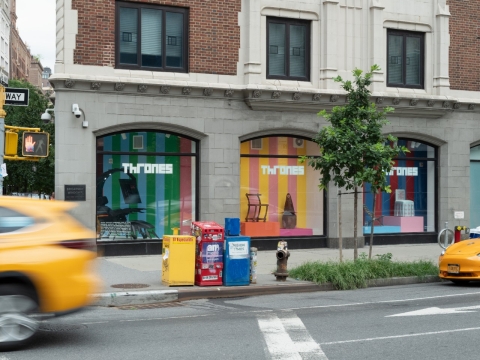
The exhibition includes a specially designed Kohler smart toilet, a virtual chair from Tom Hancocks, and SCORPION, a gaming chair from Cluvens.
“Chairs neatly straddle both function and aesthetics. Their relatively simple form makes them accessible to most makers, allowing for a wide range of interpretations. They’re also substantial enough in size to make a statement within any environment,” Redman says. “The ‘Thrones’ theme provides a framework not only for the design of the chairs but also for viewers to project their own perspectives, shaped by their lived experiences.”
Craig Redman is an Australian-born artist and designer known for his bold, vibrant, and conceptually playful work. A founder of the influential design collective Rinzen, he later co-founded the creative agency Craig & Karl with longtime collaborator Karl Maier. Working across design and art, through Craig & Karl, he continues to push the boundaries of visual storytelling, creating dynamic projects that range from large-scale public installations to fashion and editorial collaborations. Exhibitions and projects include Beijing Times Art Museum (Beijing), Colette (Paris), Liu Haisu Art Museum (Shanghai), Onassis Cultural Centre (Athens) and Musée de la Publicité (Paris).
Cometabolism Studio is a Shanghai-based practice founded in 2020 by Zhang Ning and Yang Yafei. Their work uses mass-produced industrial components, reconfiguring everyday objects to explore their functionality and their role in transforming the built environment. Have a Seat – Square Stool is part of their series reimagining urban infrastructure such as bollards and barriers as furniture.
Founded in 2014, CLUVENS is a Zhejiang, China-based furniture manufacturer focused on ergonomic design for digital and gaming workstations. Incorporating zero-gravity research into their designs, CLUVENS reimagines traditional office furniture by integrating advanced technologies into new speculative and narrative forms. The SK Scorpion King, designed by company founder Jianze Zhou, is inspired by the anatomy of a scorpion and dramatizes the relationship between the human body and machine.
Duyi Han is a Shanghai-based artist working across sculpture and furniture design. Trained as an architect, Han frames his work as a form of “neuroaesthetic prescription,” blending visual experimentation with conceptual inquiry into human emotion, memory, and societal norms. His Vitamin B12 Omega 3 Chair translates contemporary health discourse into a sculptural language, producing a seating object that functions as metaphor and material form.
New York-based artist Jesse Grooms works with found and industrial materials to create assemblages infused with emotional and physical tension and with references to the body, architecture, and ritual. His contribution is from his Cicatrix series, which includes chairs, lamps, and furniture constructed by covering aluminum frames with countless filler rods.
José León Cerrillo is a multidisciplinary artist who works across media—print, sculpture, installation, and performance—to interrogate the politics and contradictions of abstraction. Male Fantasies is a galvanized steel chair constructed from welded strands of linked chain, forming the iconic shape of a butaque, a low, wide-seated lounge chair that originated in colonial Mexico and merges Spanish, Indigenous, and African design traditions.
Serban Ionescu is a Romanian-born, New York-based artist whose work fuses sculpture, architecture, and furniture into animated improvisational forms. Like many of his pieces, Lappis suggests a dreamlike reimagining of the built environment, where chairs and architectural motifs are stretched, exaggerated, and rearranged into whimsical configurations.
Soft Baroque is a London collective founded by Nicholas Gardner and Saša Štucin. Their work exists at the intersection of craft and digital aesthetics, producing works that are surreal and uncanningly expressive. Dancing Chair combines digital illusion with physical function to create a distorted form that interrogates the visual codes of furniture in the post-internet era. Crafted in walnut wood, the chair is engineered to wobble or “dance” on its axis when occupied,
British designer Samuel Ross and his studio SR_A collaborated with Kohler to create Formation 02, a sculptural smart toilet that debuted at Milan Design Week 2024. Built on Kohler’s smart toilet platform, Ross’s design blends brutalist lines with cutting edge technology to reflect his vision of “social architecture for the body.”
Based in New York, Tom Hancocks uses CGI and new technologies to explore the boundary between physical and digital objects. His fantastical digital furniture, featuring exaggerated sculptural forms, circulate on social media and other digital platforms and challenge conventional notions of materiality and function. His HD digital video, Flux, is included in the exhibition.
Kristen Wentrcek and Andrew Zebulon have collaborated for over a decade as Wentrcek Zebulon. Based in New York City, the duo creates a wide range of works, from functional furniture to sculptural artifacts, embracing an aesthetic that is simultaneously tactile and analytical. The Club Chair is part of a furniture series made from hand-carved industrial-grade foam, coated in thick layers of pigmented rubber.
The five windows on a busy corner in Greenwich Village have been designed to frame the objects, setting the stage for a unique visual experience that changes as the day becomes night. The public art gallery is free and accessible 24/7 daily.
ABOUT 80WSE
Founded in 1974, 80 Washington Square East (80WSE), NYU is a not-for-profit gallery presenting contemporary and historical exhibitions. The gallery exhibits in two further locations, at Broadway Windows at Broadway and East 10th Street, and Washington Square Windows. Howie Chen is curator and director; Jon Huron is Gallery Manager. 80WSE.org