

Earlier this year, All Blacks head coach Scott Robertson said that he felt Damian McKenzie was one of the best impact players in world rugby.
It felt a slightly grandiose claim. The theory of it stacked up as McKenzie, with his searing acceleration, ability to scoot east to west to evade defenders, and his comfort with operating at first receiver and in the back-field, has the skill-set to be devastating off the bench.
But the reality has never quite matched the theory and in the nine years since McKenzie made his debut for the All Blacks, there has never been a consistent period in which his impact has been undeniable.
Part of the problem is that there has never been a consensus among his various coaches about how best to use him. He’s been shifted around – at both the Chiefs and All Blacks – from full-back to fly-half to the bench and round it has gone.
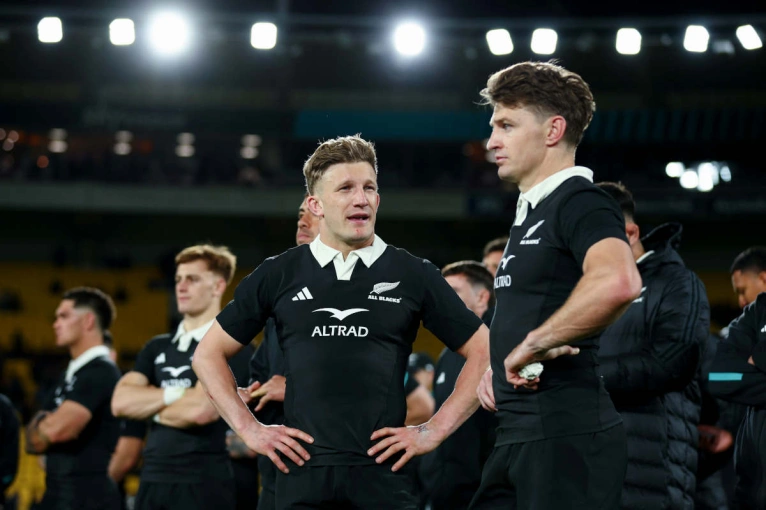 Since Beauden Barrett was restored at No.10, McKenzie has tended to be used as a second play-maker, mostly from full-back (Photo Hagen Hopkins/Getty Images)
He’s lacked the game management to establish himself as a strategic general at No 10, and there has, in his time, always been a better option – Jordie Barrett, Beauden Barrett and Will Jordan – to start at full-back.
When Robertson took over as All Blacks coach last year, he had a clear plan to establish McKenzie as his starting No 10. He gave McKenzie eight consecutive starts at fly-half, but his form was patchy and he was dropped for Beauden Barrett.
Whether Robertson was of the view that McKenzie was going to be his guy through to the 2027 World Cup is hard to know, as the All Blacks coach spent a lot of last year trying to persuade Richie Mo’unga to cut short his contract with Toshiba Brave Lupus in Japan and return to New Zealand.
McKenzie is not an international No 10: he can get by there if the All Blacks have injuries, but he’s not the play-making fulcrum around whom Robertson is going to build the attack.
There seemed to be a correlation between Robertson’s desire to bring Mo’unga home and McKenzie’s form – which was maybe not surprising.
After eight Tests it was apparent that wearing No 10 for the All Blacks was not McKenzie’s natural home.
That demand to be tactically disciplined, to manage the game-plan and kick strategically, has proven to be too much for him.
McKenzie is not an international No 10: he can get by there if the All Blacks have injuries, but he’s not the play-making fulcrum around whom Robertson is going to build the attack.
But whatever the head coach’s original plan was, it has been changed now as the evidence has finally stacked up to conclude that the best way to use McKenzie is off the bench.
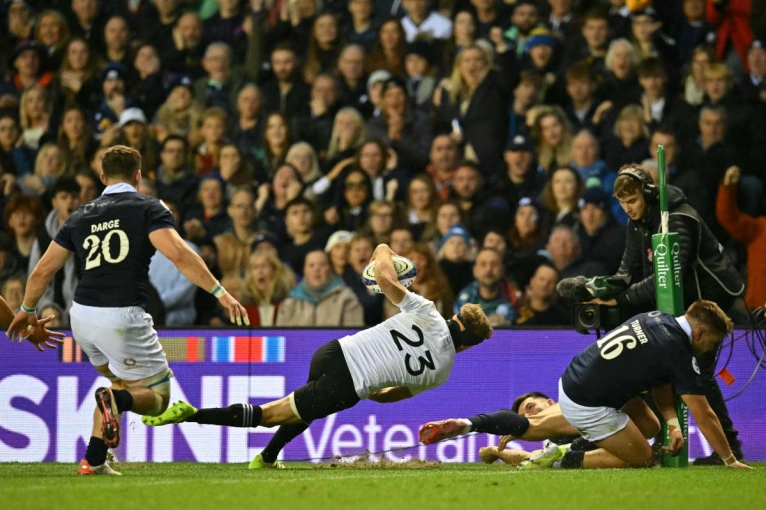 McKenzie’s incredible finish, avoiding two covering tacklers before contorting his body to touch down, was the decisive act at Murrayfield (Photo Andy Buchanan/AFP via Getty Images)
Robertson’s earlier claim about McKenzie now looks spot on and he is almost certainly going to be the All Blacks’ wildcard to bring off the bench with a licence to play almost wherever and however he wants.
Basically, putting him on the park sometime in the second half, with a brief to get his hands on the ball and make something happen, is the best way to use McKenzie.
He proved that beyond any doubt in Edinburgh where he was named man-of-the-match after delivering an extraordinary 35 minutes at Murrayfield in which he almost single-handedly dug the All Blacks out of the hole they were in.
McKenzie made critical tackles, covered the back-field supremely well, but he also contributed a game-changing 50-22, a miracle try, and a long-range penalty.
“D-Mac was pretty handy wasn’t he? Player of the day in 20-odd minutes,” Robertson said. “You need someone who is clutch and he’s pretty mercurial. He can kick a 50-22, score a try and kick that penalty. You know he’s going to inject something and he did… his timing, his skill-set. He’s not big but he’s tough.”
There has been a bigger factor at play within the All Blacks – which has been their attempts to reposition the way the bench is perceived by the players.
McKenzie’s game-winning performance against Scotland followed what was a high-impact cameo the week before in Chicago, and what has been a much better contribution from him all season.
He’s had two starts at No 10 and one at full-back, but the bulk of his selections have been on the bench and the consistency of being used mostly in one role has undoubtedly helped him build his form and confidence.
But there has been a bigger factor at play within the All Blacks – which has been their attempts to reposition the way the bench is perceived by the players.
New Zealand’s professional teams tend to still see being picked to start as more prestigious than being picked on the bench. There remains this idea that there should be promotion and relegation between the bench and the starting team and that a performance such as the one that McKenzie delivered at Murrayfield should be rewarded with a starting spot the following week.
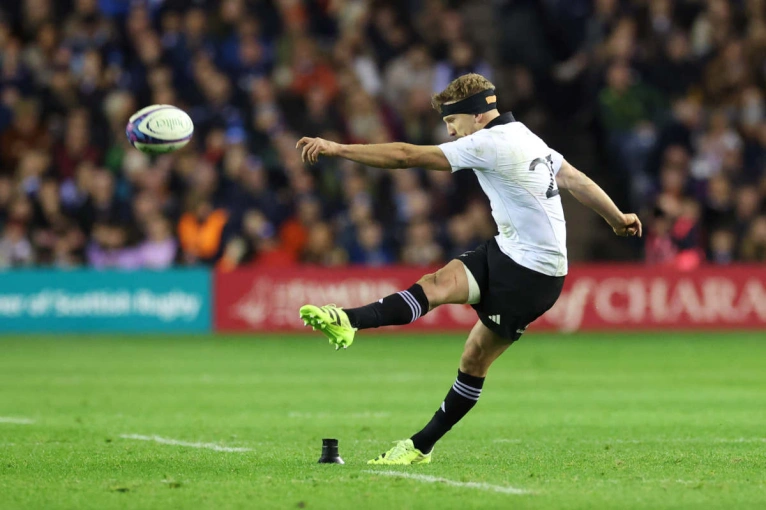 McKenzie’s goalkicking – he landed a 45m penalty to clinch victory over Scotland – is another boon for New Zealand (Photo Ian MacNicol/Getty Images)
But this is where McKenzie has been let down a little in the past. He’s been in and out of the starting team since making his debut in 2016, never quite able to deliver the same impact when he starts as he does when he’s used off the bench.
To some extent a narrative has built that he has constantly under delivered because he can’t hold a starting spot, and that’s because there has been a reluctance to accept that being an impact player is a high value proposition of itself and not a failing.
McKenzie is someone most comfortable playing off instinct. He’s quick, agile, innovative in his skill-set and a player who prefers to live in the moment rather than deliver to a prescribed plan.
He has the respective skills required of a 10, but perhaps one without the patience and mental discipline to deliver the full extent of the game-plan.
The failure to get much, if any, lift in the final quarter of Tests last year was a constant lament for Robertson, which is why this year, there has been greater emphasis on trying to lose any sense of division between bench and starters.
When he’s started at full-back, his influence has tended to be curbed by the natural rhythm of most Tests where there is significantly more kicking in the first 60 minutes and less opportunity to counter-attack.
But stick him into a game when there may be some fatigue building, more opportunity to run at broken defences, less structure and less kicking, and he can be deadly.
“As an impact player it’s about reading the game, coming on and injecting energy where you can,” he said after the 25-17 win against Scotland. “The first half of that 20 minutes we were on defence most of the time. I’m pleased with how we were able to withstand that and turn it around to play some attacking rugby.”
And it’s not just McKenzie learning the art of making an impact. Robertson and his coaching team are improving their ability to select, motivate and utilise their bench.
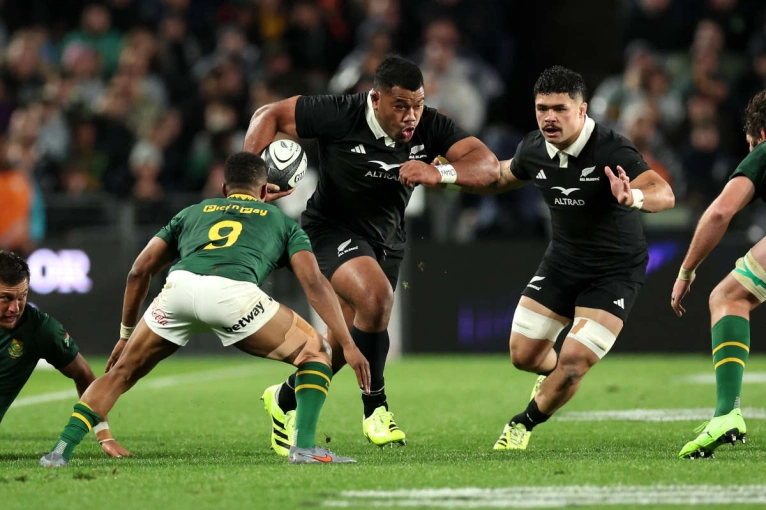 Hooker Samisoni Taukei’aho is another player who has brought great impact off the bench (Photo Fiona Goodall/Getty Images)
The failure to get much, if any, lift in the final quarter of Tests last year was a constant lament for Robertson, which is why this year, there has been greater emphasis on trying to lose any sense of division between bench and starting players.
The All Blacks have borrowed a little from the Springboks, who have arguably been the first team to truly embrace the idea that rugby is a genuine 23-man operation and that time on the field, and the time within the game that a player enters the field, is not the right way to measure importance and influence.
They have the famed Bomb Squad – a clever rebrand to up the public and media focus on the importance and influence of the bench – and the All Blacks are trying to build something similar.
The All Blacks really just need to settle on a loose forward and outside back and they will have quite the bomb squad of their own.
“It’s all 36 [players] that get you ready and then a 23 on game day,” says Robertson. “Who is starting and who is finishing is just as important and [we ask when picking the bench] who has done that previously? [made an impact as a replacement].
“Look at Keven Mealamu who is a prime example. A humble hero. Tough, whatever is best for the team [is our philosophy].”
Upselling the importance of the bench has been one step in the right direction, as has the selection plan which has seen McKenzie, Samisoni Taukei’aho, Tamaiti Williams and Pasilio Tosi set up as regulars and making high-impact contributions.
Patrick Tuipulotu was another bench regular who was having an outstanding year until injury ruled him out of the Grand Slam tour. The All Blacks really just need to settle on a loose forward and outside back and they will have quite the bomb squad of their own.