
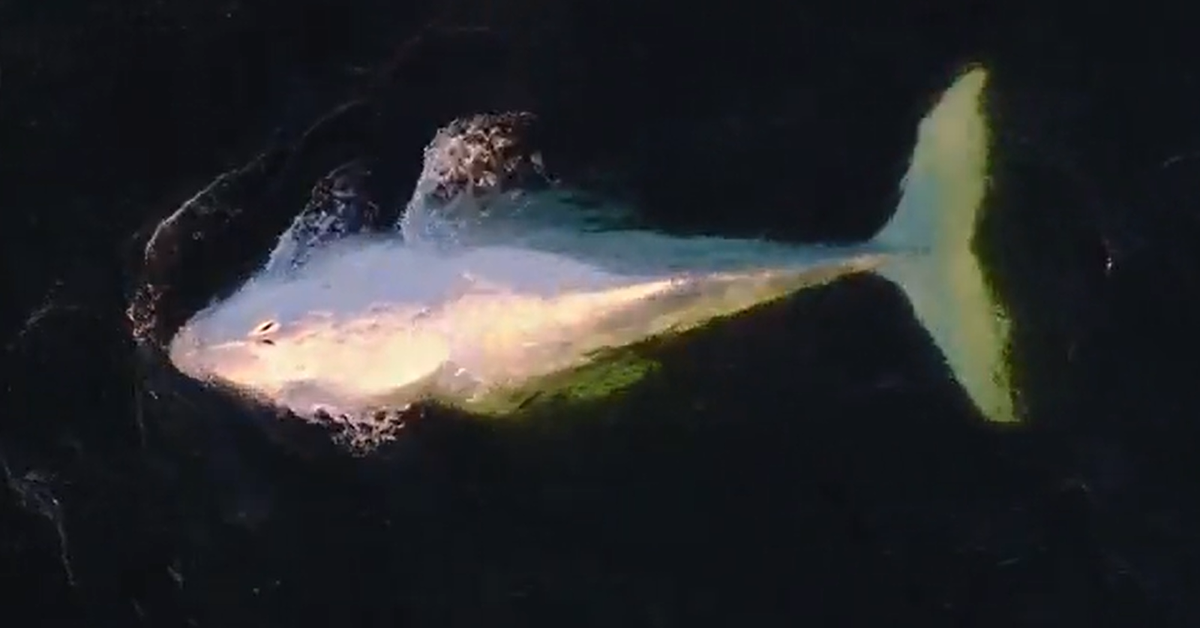
A white humpback that created a buzz as Australia’s second albino whale now has some concerned over its health and unusual migration pattern.
But while humpback whales migrate thousands of kilometres south to Antarctica to feed, the albino, fondly named “Siale”, is travelling north.
 A white juvenile spotted off the NSW South Coast last week was confirmed to be albino. (Khynan Gardner/ORRCA)
Her 10-metre-long body also appears thin.
Organisation for the Rescue and Research of Cetaceans (ORRCA) spokesperson Pip Jacobs confirmed Siale had lost body condition.
“Based on the current information and footage we have of Siale, we can’t draw any conclusions about her health,” she said.
“It’s unusual to see a humpback whale travelling north at this time of year.
“We’re hopeful Siale will soon turn south as well, where she can feed and rebuild her strength and condition ahead of next year’s migration.”
Jacobs urged anyone who spots her to share footage, which can help experts get a better understanding of her health and movements.
Humpback whales will return to warmer waters on the East Coast between April to November.
ORRCA was able to confirm Siale’s albinism late last week due to her red eyes and total lack of pigmentation.
 Migaloo was first spotted in 1991 as it passed through Byron Bay. (AAP)
“True albinism in humpback whales is extraordinarily rare, occurring in only about one in 40,000 births,” the organisation said.
“The only other confirmed albino humpback on the Australian east coast is Migaloo, making this identification a truly historic moment.”
Migaloo, an albino adult male first spotted in Byron Bay in 1991, has not been seen since the last sighting off Port Macquarie in June 2020.
ORRCA, with the help of Whale Discoveries, was able to identify Siale as a female calf first documented in Tonga.
Experts used previous and current footage to analyse her tail, which is unique to each whale, similar to a human fingerprint.
Due to special legislation, white whales have an exclusion zone of at least 500m for swimmers, surfers and vessels and 100m for drones.