
“We need another option – a simple test that could help GPs determine who’s safe and who needs further investigation.”
Why breath?
Hanna wanted a test that would be easy for doctors and comfortable for patients.
“For a new test to be acceptable to patients and GPs, it must be simple, non-invasive and cheap,” he explains.
That’s when Hanna turned to breath.
“We know that the breath contains molecules that could indicate disease or other condition, like the breath analyser for alcohol, or breath tests for stomach infection,” he says.
These tests pick up gases on the breath that are produced in a relatively high volume. For cancer, it’s not as simple.
Scientists have long suspected that cancer-related gases could be found in the breath, but they’re released in much smaller amounts – and until recently, the technology and biological understanding just weren’t advanced enough to spot them.
A unique signature
Hanna and his team believed that cancer would leave a distinct mixture of gases in the breath. So, they set out to determine the biological processes in cancer that would produce gases and what the mixture looked like.
They focused on three sources: gases from the tumour itself, from the body’s immune response, and from the microbiome – the community of bacteria in our gut and other organs.
To study this, Hanna’s team grew stomach cancer organoids – ‘mini-tumours’ derived from patients’ cells – along with immune cells and a mini microbiome.
They then analysed the gases each one produced, both separately and together.
The result was a unique “breath signature” for stomach cancer.
Developing the test
Once they knew what to look for in the breath, the next step was designing a way to capture and analyse it.
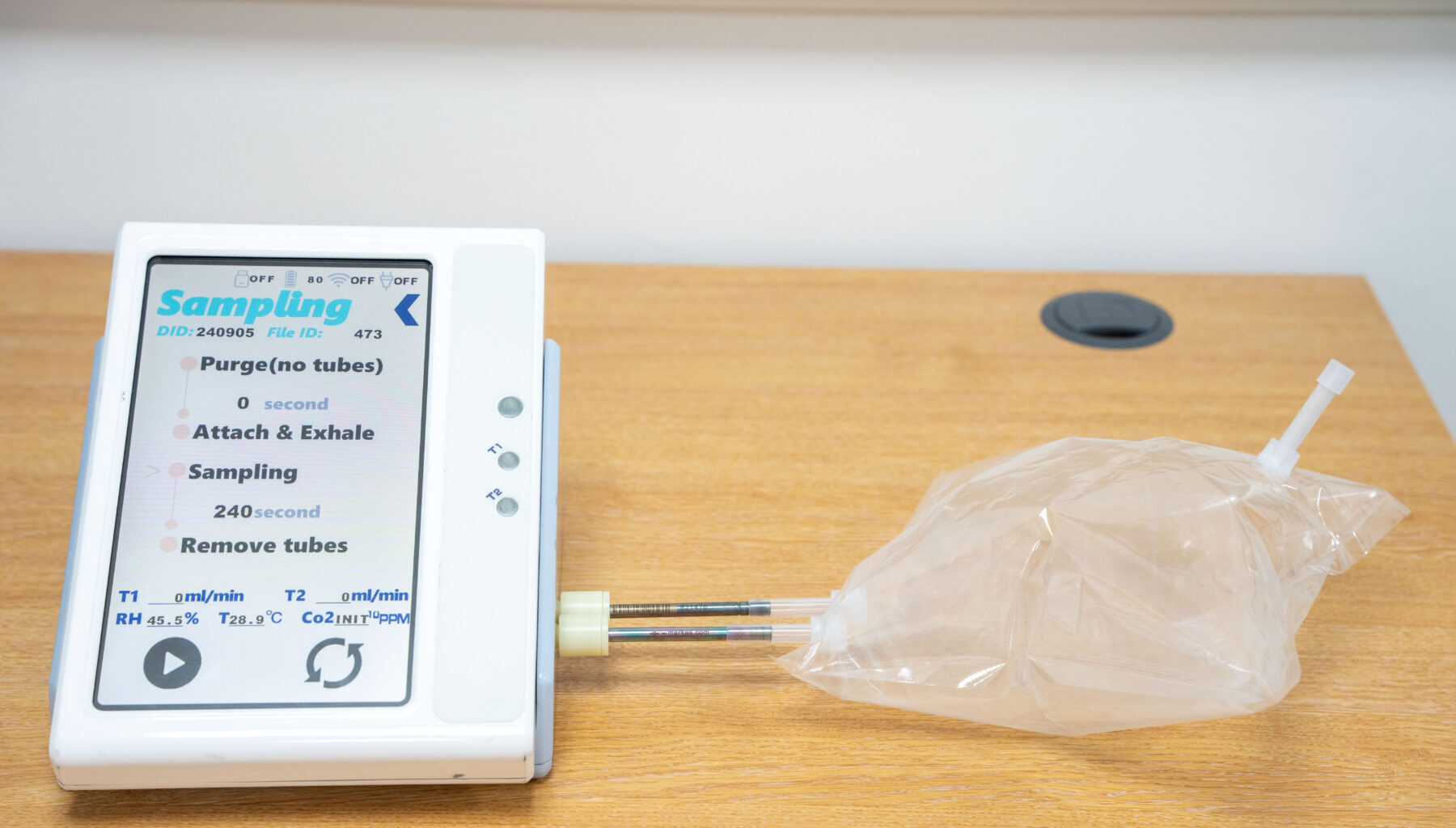
Their design was simple: a plastic bag to blow into, connected to a tube that took the gas into a machine for analysis.
“It’s like taking a blood sample and sending it for analysis in the lab,” Hanna says, “except instead the patient breathes into a bag and the tube sends it for analysis straight away.”
The technique used to analyse the breath is called gas chromatography. It’s an analytic technique used by chemists that separates different gas molecules based on their size and shape, and it’s incredibly sensitive.
“We can pick up even the tiniest amounts of the gases. And then a special algorithm tells us whether there’s cancer or not.”
Hanna and the team have trialled their test on people with stomach cancer, to see if it could pick up the molecular signatures they were expecting.
And it did.