
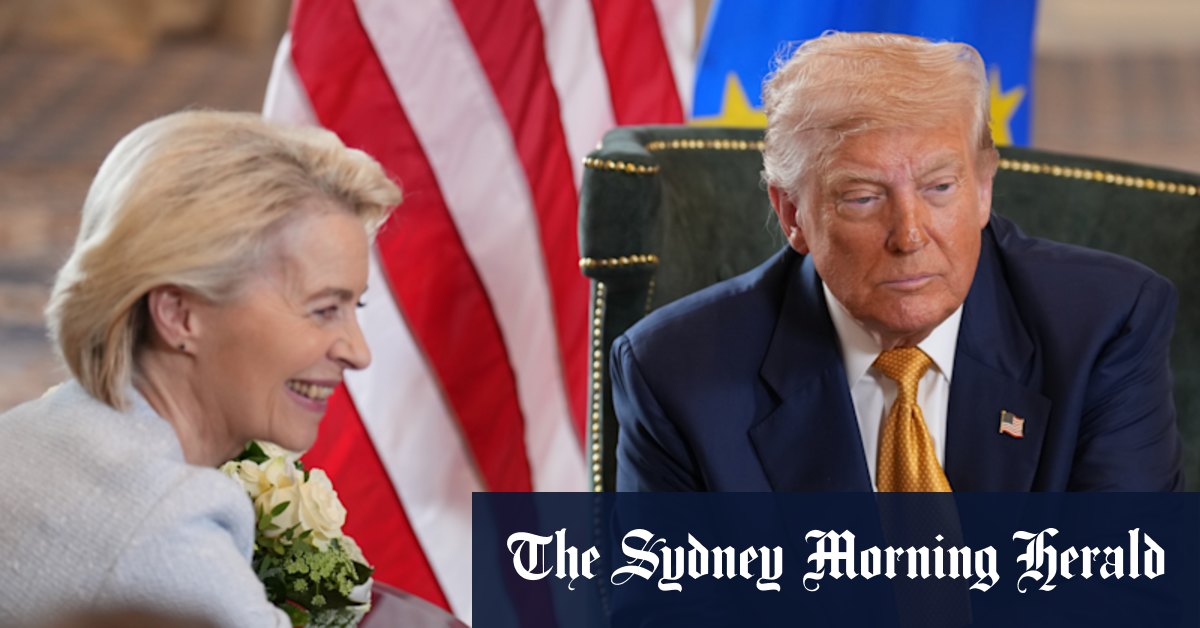
“We have a trade deal between the two largest economies in the world, and it’s a big deal,” she said.
“It’s a huge deal. It will bring stability. It will bring predictability.”
Trump was threatening to impose a 30 per cent tariff unless the EU agreed to a deal before this Friday, prompting European leaders to prepare to retaliate with their own trade barriers on US products. That option was dropped, however, in the decision to accept the deal on Sunday.
While the 15 per cent tariff rate is better than Trump’s stated threat, it is a big increase from the average tariff rate of 4.5 per cent applied on EU products before Trump’s return as president in January. This leaves von der Leyen exposed to criticism that she has caved in to Trump.
In a sign of the pressure on European industry, Volkswagen revealed on Friday that US tariffs had cost the company €1.3 billion ($2.3 billion) in the first six months of the year. The company reported a 29 per cent fall in operating profit, missing analyst forecasts.
Europe also risks an economic hit from Trump’s pressure on US industry giants to invest more at home. Tech giant Intel has scrapped plans to build new silicon chip manufacturing plants in Poland and Germany.
American consumers will incur the tariffs by paying higher prices for European cars, wine, cheese, other farm products and manufactured goods, but Trump’s top advisers are counting on the policy to increase government revenue.
Loading
US Commerce Secretary Howard Lutnick told Fox News on Sunday in the US that the revenue could be worth $US1 trillion over a decade.
“What’s going to happen is very few products are actually going to move in price,” he said.
Economists have warned, however, that tariffs push up prices for customers because the impost is applied by governments on the products, leaving producers with few ways to cover the added cost.
The trade outcome has far-reaching implications for both economies when the goods trade between them was worth $US976 billion last year alone, according to data from the US Trade Representative.
A key feature of the trade relationship, and a source of aggravation for Trump, is that Europe sells more to the US than it buys. The US goods trade deficit with the EU was $US235.6 billion last year, up 12.9 per cent over the year.
The 15 per cent rate does not apply to steel and aluminium, which incur a 50 per tariff.
EU member states agreed last Thursday to hit back at the US if it went ahead with 30 per cent tariffs, setting up a spiralling trade war that would have hurt economies on both sides.
The retaliatory tariffs on US exports would have covered annual exports worth €93 billion and would have started from August 7 if Trump had proceeded with his threat. The outcome on Sunday averts that danger, even though the 15 per cent tariff is far above what many European leaders would otherwise accept.
Get a note directly from our foreign correspondents on what’s making headlines around the world. Sign up for our weekly What in the World newsletter.