
Going into the season, one of the biggest stories for the Vancouver Canucks revolved around the health of goaltender Thatcher Demko. He missed a large chunk of the 2024-25 season and looked to be ready to go in 2025-26, but after missing games over the weekend, and leaving Tuesday night’s game after the first period, he is back on the injured list, according to Frank Seravalli. He is going to miss at least a couple of weeks and while the team is saying it’s not related to any prior injury, they have been very secretive about Demko’s health status this season in general, so take everything they say with a Hope Diamond-sized grain of salt.
While Kevin Lankinen is the obvious choice if he’s on waiver wires, Vancouver has just six games in the next two weeks, two of those games are a back-to-back against Florida and Tampa Bay, and three of the other games are in Carolina, at home to Dallas, and in Anaheim. That is a brutal schedule, so buyer beware.
*
With Victor Hedman, Anthony Cirelli, and Ryan McDonagh all missing from the lineup, the New York Rangers were able to take care of a short-handed Tampa Bay Lightning squad and thrash them by a 7-3 margin. Vincent Trocheck had a pair of goals, a block, and three hits, Will Cuylle had a pair of goals (one PP), a block, and four hits, and Artemi Panarin had four assists (one PP) and a shot.
Alexis Lafreniere, J.T. Miller, and Will Borgen had the other tallies. Adam Fox registered a pair of helpers with three blocks and two PIMs in the win.
Igor Shesterkin stopped 33 of 36 shots for his sixth win of the season as his save percentage has crept over. 910.
Zemgus Girgensons, Scott Sabourin, and Jake Guentzel scored the goals for Tampa Bay. Goaltender Andrei Vasilevskiy was pulled after the second period after giving up five goals on 13 shots. He did not have his best game on this night.
Brandon Hagel took a hard hit in the first period, left the game, and did not return.
*
It looked as if Travis Konecny scored with under 25 seconds left in Philadelphia’s home game against Edmonton on Wednesday night, and that goal would have given the Flyers a 2-1 lead late in the game. The goal was called back on an offsides, though, and it was the break the Oilers needed as Jack Roslovic scored the overtime winner to give Edmonton the win and the two points.
Evan Bouchard had the other Oilers tally while Matvei Michkov scored the lone Flyers goal on a second-period power play. Bouchard finished the game with four shots and a block.
Roslovic now has five goals and 11 points in 16 games since joining the Oilers.
Stuart Skinner stopped 20 of 21 shots for the win while Dan Vladar took the hard-luck loss by allowing two goals on 32 shots.
*
After falling behind 2-0 to Buffalo, the Utah Mammoth peeled off five straight goals, including four in the third period, to manage a 5-2 win. Nick Schmaltz, JJ Peterka, and Clayton Keller each had a goal and an assist while Lawson Crouse and Nick DeSimone each scored. Peterka and Schmaltz remain tied for the team lead in points at 5-on-5 with 12 apiece, and Schmaltz is 1 of 10 players across the league with at least 10 goals and 10 assists.
Mikhail Sergachev posted an assist, five shots, and a pair of blocks in the win while goalie Karel Vejmelka held the Sabres to just two goals on 19 shots. Among the 25 goalies with at least 10 starts this season, Vejmelka has the third-worst save percentage at .882, but he’s also tied for second in the league with eight wins.
Isak Rosen picked up a pair of goals for the Sabres and now has three goals in five games since being called up.
Colten Ellis took the loss by allowing four goals on 36 shots.
*
In one of the more unlikely fantasy performances we’ll see this season, Simon Nemec recorded a hat trick (!), including the overtime winner, to lift the New Jersey Devils to a 4-3 win over the Chicago Blackhawks. Nemec finished the game with five shots in 26:27 of ice time, trailing only Luke Hughes‘ 26:48. Nemec now has 12 even-strength points on the season, tying him for third in the NHL among blue liners. Overall, he has 12 points in 17 games with 27 blocks.
Dawson Mercer tallied the other Devils goal, posting five shots and a block. He has 16 points (four of them on the power play), 33 shots, 18 blocks, and 12 hits in 17 games. A very solid multi-cat season thus far.
Luke Hughes managed an assist, seven shots, a block, and two PIMs in a good multi-cat night. Goalie Jacob Markstrom earned the win by keeping the Blackhawks to three goals on 20 shots.
Sam Lafferty, Landon Slaggert, and Connor Bedard all scored for Chicago. The Lafferty goal was a sick little dance move:
https://players.brightcove.net/6415718365001/EXtG1xJ7H_default/index.html?videoId=6385037061112
Bedard’s goal brings him back into a tie for second in points this season with 26 as he, Leo Carlsson, and Macklin Celebrini trail Nathan MacKinnon‘s 32 points.
Louis Crevier managed two assists, a shot, and a pair of hits in the loss as goalie Spencer Knight allowed four goals on 37 shots.
Both Cody Glass and Zack MacEwen were injured in the game for New Jersey and did not return.
*
“Goaltending is voodoo”. It is one of the most famous phrases to come out of the online hockey analyst community in the near-15 years that I’ve been doing this, and it’s hard to disagree. Very few goalies are great year after year, sometimes goalies we thought weren’t very good have a tremendous season (Darcy Kuemper in 2024-25 comes to mind), and it can be very frustrating for fantasy managers.
Often, the best we can do in the preseason is target goalies on good teams, or goalies on improving teams, and hope they’re 2024-25 Sergei Bobrovsky and not 2024-25 Stuart Skinner. After that, it’s in the hands of the hockey gods.
One thing worth looking at is shot distance faced. That can be found both in our Frozen Tools as well as Natural Stat Trick. There is a caveat here: shot distance appears to have one specific use-case and that’s looking for goalies with the longest average shot distance. The reason for that is that when looking at goalies from 2021-2025 that had at least 2000 minutes played in a season – it generally gives us 30-35 goalies a year – the correlation between shot distance and save percentage is very low (yellow box) but the p-value (light-blue box) is also very low:
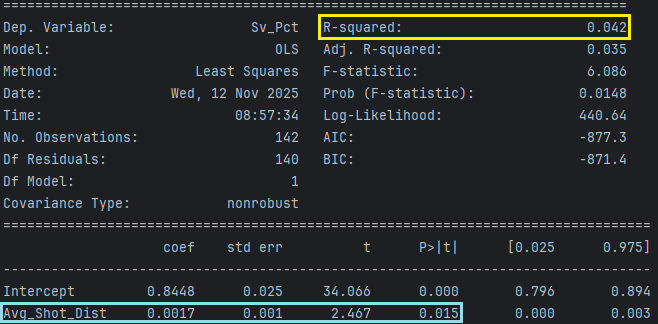
In short, this tells us that while the single-season correlation between shot distance and save percentage is minimal, it is very unlikely that the save percentages results from the shot distance are random chance. There is something here.
To visualize what the low correlation looks like, here are 142 goalie seasons in the 2021-2025 sample:
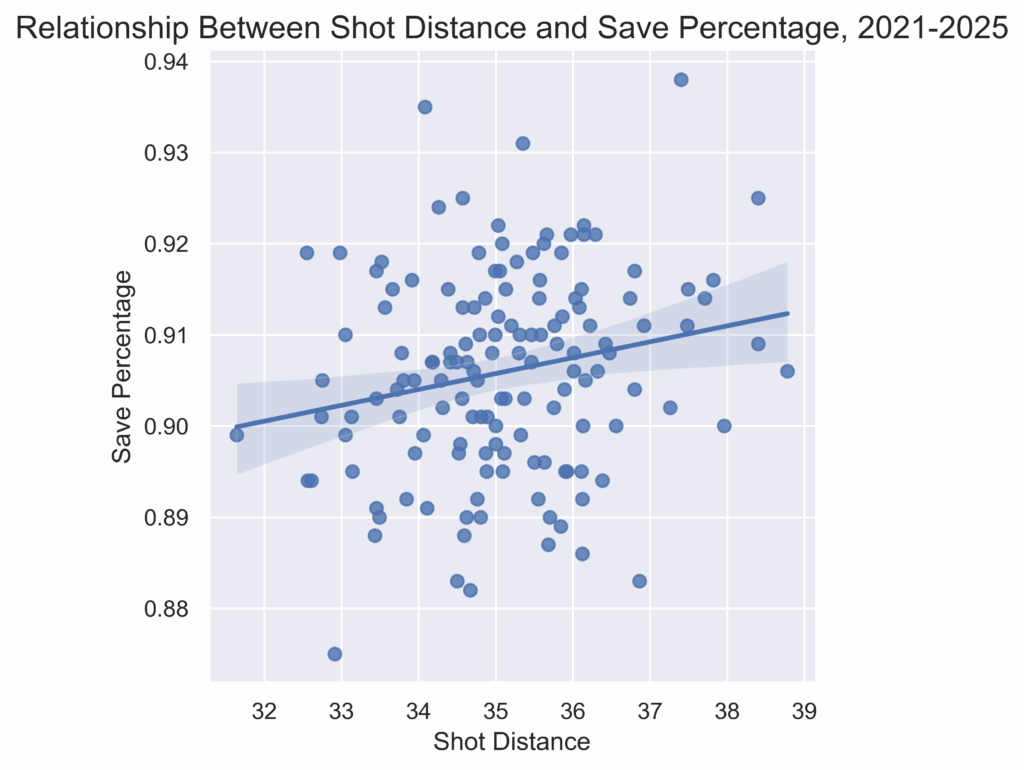
We can see that there is an upward slope, which means that, in general, a further shot distance gives us higher save percentages, but there is variance when looking at individual goalie seasons.
But this is where I think it can be valuable: the goalies facing extremely far shot distances. If we look at just the goalies with an average shot distance one standard deviation above average, we have the goalie seasons with the 23 furthest shot distances. This is the same plot with those 23 goalies and their save percentages:
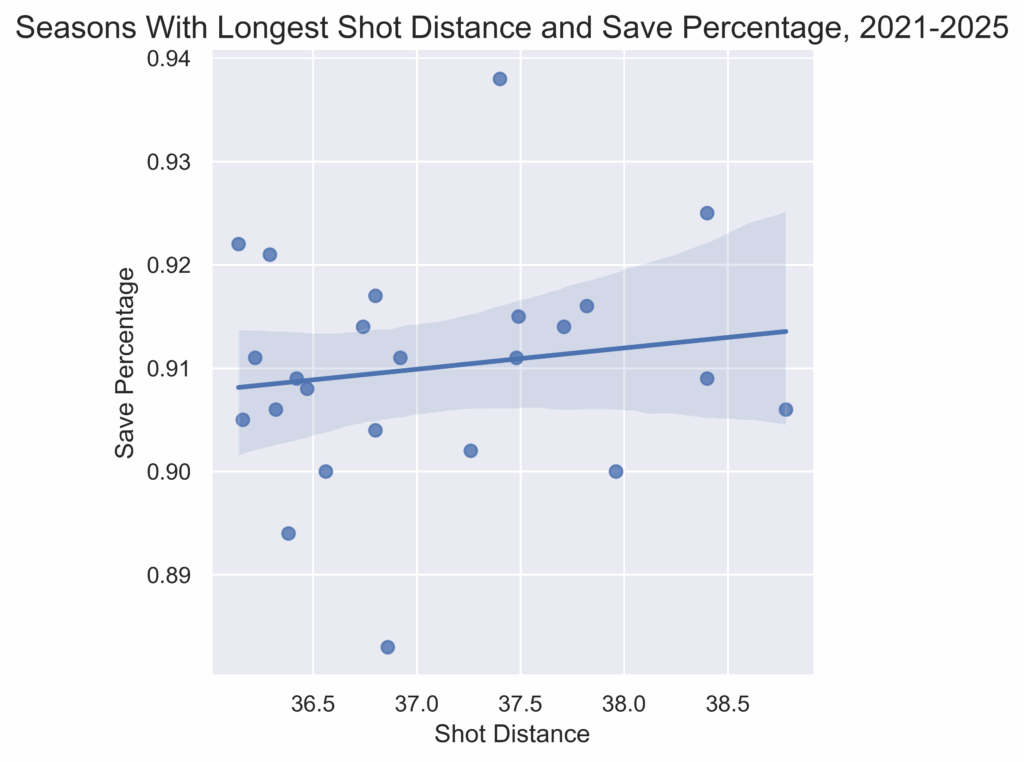
Out of those 23 goalie seasons with at least 2000 minutes and average shot distance faced of 36.15 feet or longer, just two of them (Samuel Ersson and Alex Nedeljkovic in 2024-25) finished their campaign with a save percentage under .900. The other 21 goalies finished the year with a save percentage of .900 or better, and they averaged .912.
This is one of those things that makes intuitive sense. The further the shot, the more time the goalie has to react to the shot, and the more likely they will be to make the save. Once we get down from the extreme long distances there is a lot of randomness and team effects that come into play, but it does seem as if the goalies with the long shot distances generally stand a very good chance of having a solid-to-great performance.
That brings us to the 2025-26 season. We are still early-ish, but 20% of the season is behind us. At some point, we have to stop saying “it’s still early” and make some decisions. I am going to use a low ice-time cutoff of 250 minutes to try and get in some goalies who may be heading for positive regression, but here are a few goalies with long shot distances we need to (re)consider.
Jordan Binnington (St. Louis Blues)
The goalie with the longest average shot distance in the NHL is Jake Oettinger in Dallas. The goalie with the second-longest average shot distance in the NHL is Binnington:

Binnington has been one of the worst goalies in the league to start this year with an .872 save percentage in 12 games but recently had a great outing at home to the Calgary Flames with 38 saves on 40 shots. It is also worth pointing out that in his first 11 games last year, Binnington had an .886 save percentage and then from Game 12 onward he posted a .904 save percentage. Not elite, but above average, and serviceable for fantasy. It may be hard to trust him right now, but if the Blues can keep up this kind of defensive performance in front of him, his numbers are only going to get better.
Alex Lyon (Buffalo Sabres)
A big problem for Lyon right now is the Sabres have three goalies on the roster and potentially being part of a three-goalie rotation on a non-playoff team is just about the definition of a fantasy headache. All the same, he is 1 of 4 goalies with an average shot distance faced of at least 37 feet:
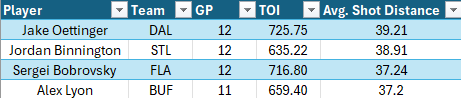
The key here is that in Ukko-Pekka Luukkonen‘s three games, UPL has an average shot distance faced of 39.6 feet, so it does seem as if the Buffalo defence has improved compared to last year. It seems unlikely that the Sabres run a three-goalie rotation all year, so whether Colten Ellis gets demoted or one of UPL/Lyon gets traded, whomever is left over may have some solid fantasy value over the next 60-some games. Or they should, if the Sabres can ever get-and-stay healthy.
Dustin Wolf (Calgary Flames)
There is a double-edged sword with Wolf this season. The good news is that he’s facing the sixth-furthest average shot distance of any goalie in our sample at 36.7 feet:
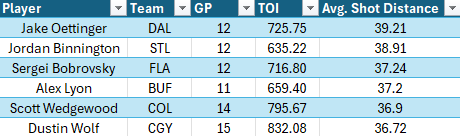
After a very tough start, Wolf has a .912 save percentage with a 2.71 goals against average in his last 10 starts. Those are very good ratios and are more like what we expected from him when doing our season-long drafts.
The bad news is that Calgary can’t score. Despite a .912 save percentage and a 2.71 GAA in those 10 starts – both better than league average, the former by a lot – he has just three wins in those 10 starts, Calgary has scored 24 goals, and are a distant last in goals scored per 60 minutes this season. Wolf could perform as a top-10 goalie and lose over half his starts because his team can’t score. A long shot distance faced is nice, and the ratios should stabilize with that kind of performance, but if the team can’t score, he won’t rack up wins.